
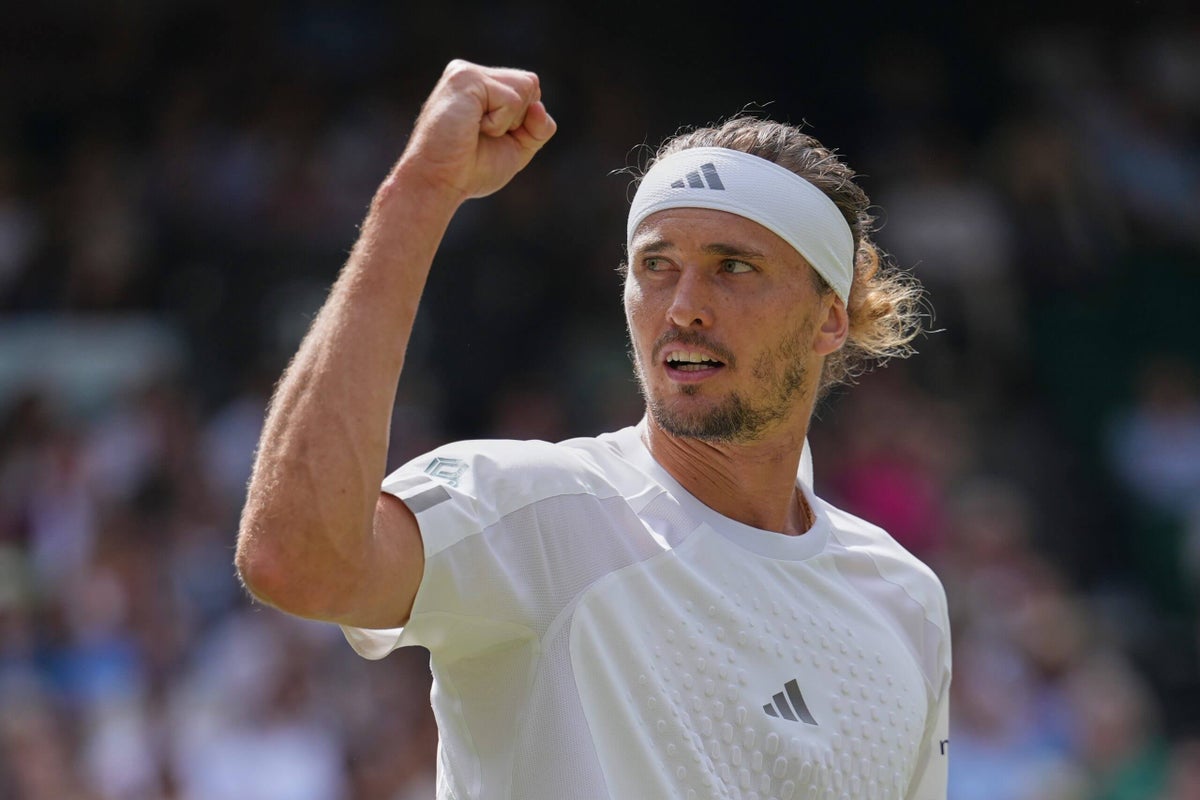
THE ALL ENGLAND CLUB, London — Arthur Féry’s barely believable Wimbledon run ended at the semifinal stage with defeat to world No. 2 Alexander Zverev Friday on Centre Court.
Féry, the British wild card ranked No. 114, had been defying gravity all fortnight, but ultimately found Zverev, the French Open champion, too big a step up in quality throughout a 7-6(0), 6-2, 6-4 defeat.
Germany’s Zverev, 29, has seemingly been liberated by finally becoming a Grand Slam winner at Roland Garros last month. He played Féry with authority and confidence, and the kind of aggressiveness on the forehand side he has often pledged to show, but has rarely been able to in practice. Twenty-two winners on that wing underlined how much Zverev was feeling the shot, especially against an opponent who has shown himself extremely difficult to hit through.
In the final, Zverev will be an underdog against defending champion Jannik Sinner, who defeated seven-time Wimbledon winner Novak Djokovic in the other semifinal, but after that breakthrough in Paris last month, he’ll surely be able to play with far less pressure than in his previous four Grand Slam finals.
Why do players wear white at Wimbledon?
Ava Wallace and Madison Eades
Féry’s remarkable run may be over, but his tournament has exceeded all expectations, perhaps other than his own, given how remarkably unflustered he has been over these two weeks.
Wimbledon 2026 has transformed his career, propelling him to world No. 36, and having never previously made the main draw of a Grand Slam by ranking, he is suddenly on the verge of being seeded at the biggest events.
Féry turns 24 Sunday, but he is a rookie in professional terms, having spent three years at Stanford University in California between 2020 and 2023 before largely managing injuries more than playing tennis. He has played as many matches in this event as he had previously at Grand Slam level in his career.
Where he goes from here is uncertain. For every player who kicks on after this kind of breakout run, there’s one who fairly swiftly retreats to the margins.
Féry said in a news conference after the match that he would try and learn from players who have had a similarly transformative tournament. Compatriot Emma Raducanu, who won the U.S. Open in 2021 as a qualifier, is an obvious reference point. Féry also cited Valentin Vacherot, the Monégasque player who won the Shanghai Masters last year while ranked outside the top 200, and has built on it in 2026, climbing as high as No. 16 a couple of months ago.
“He’s done an incredible job. He went from 200 to winning a Masters. Suddenly it almost seemed like his base level switched overnight,” Féry said.
“Now, yeah, that seems like his everyday level. Guys like that, try and take from what they’ve done and do the same.
“It’s going to change things, for sure. I’m going to be able to play tour events at least for a full year, hopefully for more. It’s going to be interesting to see how I deal with that change and everything that that brings in terms of expectations from myself, from the public, from everyone.
“Already looking forward to that. It’s going to be a challenge to deal with all of that, but I’m conscious of it already and that’s the first step.”
Féry’s already made changes to his schedule, having had to cancel a holiday to Greece with friends because of his run to the second week of Wimbledon. He will now give himself a good break after an exhausting grass-court season that also included a quarterfinal run at Queen’s, the prestigious Wimbledon warm-up event.
“I think his game is very, very good,” Zverev said in a news conference.
“I think he has a lot of things in his game that he can still improve, which is a positive thing, because he just made semifinals of Wimbledon for the first time. He probably still feels the same way: He has a lot of things that he can still do a bit better.
“That’s a massive compliment, I feel like, because if you’re complete and that’s your ceiling, then you know that’s your ceiling. If you know that you’re just starting and you’re making semifinals of Slams, that’s positive.”
The main obstacle for Féry maintaining this kind of level would appear to be the suitability of his game for hard and clay courts, which make up the bulk of the tennis calendar. His fluid service motion makes up for his diminutive — for a top male tennis player — 5ft 9in (175cm) height, and his skidding backhand slice has been devastating on grass, but it remains to be seen how it will transfer to those other surfaces.
He has plenty of time to try to develop his game in this regard, given that he has so few ranking points to defend in the rest of the year. A few wins at ATP Tour level could hoist him up to being seeded at the majors and in ATP Masters 1000 events, let alone being an automatic entry for them.
Part of that process will involve trying to learn from the lesson he was given by one of the best players in the world on Centre Court today.
Féry looked typically unflappable in the opening exchanges. He forced Zverev to deuce on the German’s first service game and then held to love himself. And even when his opponent grabbed an early break, he didn’t roll over against a player who had only been broken four times all tournament coming into this match.
Féry broke straight back for 3-2, including a point that electrified Centre Court as he chased down a drop shot and outmaneuvered Zverev with an angled backhand flick.
Zverev was getting around 75 percent of his first serves in, which usually spells game over for his opponent. But Féry was getting a read on it, returning one hit at 137mph and winning the point with Zverev serving at 3-3. And despite the chasm in experience, it was Zverev who looked the edgier of the two players — just as Flavio Cobolli had done in his quarterfinal against Féry.
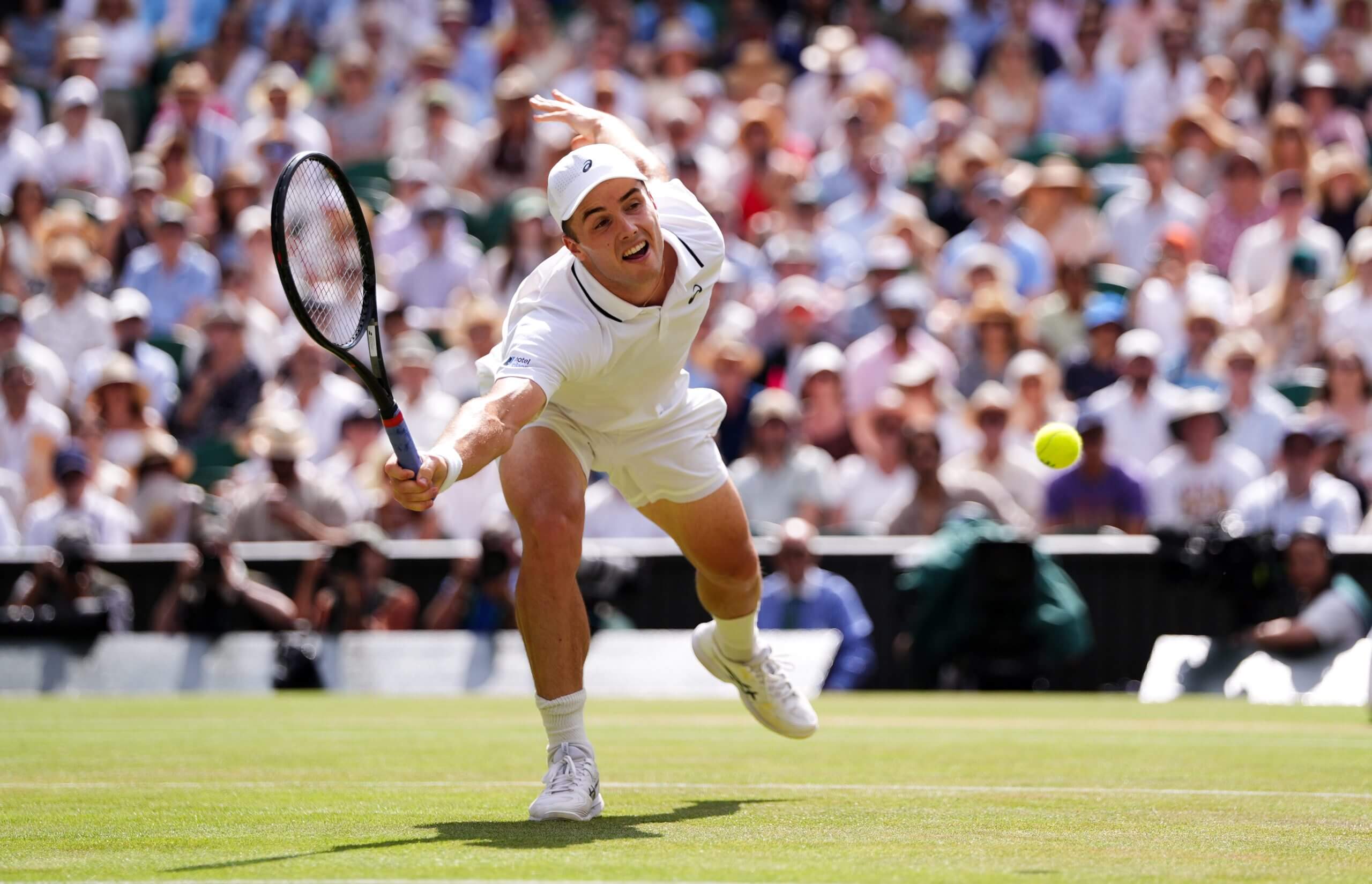
Arthur Féry’s dream run ended on Centre Court as the gulf in class between him and Alexander Zverev proved too much. (Adam Davy / PA Images via Getty Images)
Unlike the Italian No. 9 seed though, Zverev started to loosen up and feel the ball, particularly on his much-improved forehand side.
Previously the weaker and far more conservative wing for Zverev, he’s made a concerted effort to hit the shot more aggressively — and has rarely done so with more authority than towards the end of the first set and in the second Friday. He finished the opener with six forehand winners, then hit another nine in the second.
“I’ve been trying to play a more aggressive game style,” Zverev said in his news conference.
“I’ve been trying to take on the game a bit more. For sure my forehand is a big part of it. When I hit that shot well, I feel like I’m playing well. When I don’t hit that shot well, that’s where I’m more beatable.”
Despite Zverev lacing those winners, Féry did enough to force a first-set tiebreak. But at that point, Zverev did what a Grand Slam champion is supposed to do and raised his level. He made all three of his first serves, and hit a couple more bruising forehands on his way to winning it 7-0.
“It was definitely a step up today,” Féry said of his opponent. “We know how well he can play. He was hitting his forehand really well, I thought. Really going big.”
Féry’s remarkable ability to recover from losing positions this fortnight had the vast majority of the Centre Court crowd holding out hope for another famous comeback, but Zverev is a master of managing opponents ranked lower than him.
The game he played to break to love for 2-1 in the second set was described by John McEnroe in commentary for the BBC as “one of the best I’ve ever seen from him”. A bullet forehand return winner for 0-40 was the highlight, and all of a sudden, this semifinal looked like the tennis version of a boxing match between fighters from different weight classes.
When Zverev broke again for 4-1, helped by a sensational flicked forehand pass off a drop volley, he sucked any of the remaining crowd-energy out of Centre Court. The expectation had been that this was going to be a tricky atmosphere for him to deal with, but he’d pretty much taken the fans out of the equation by dominating to the extent he was. A lob at the start of the next game almost felt cruel.
Féry took a lengthy break at the end of the second set, but Zverev carried on from where he left off when they resumed. He broke for 3-2 with an inside-out forehand hit with such ferocity that visions of what he might have achieved in his career if he’d always played this way rose from the grass.
It looked to be all over when Zverev had three break points for 5-2, but Féry gave the crowd something to cheer about at last.
He saved them all, the last with a sublime half-volley passing shot that earned him applause even from Zverev. Féry then banged down a couple of aces for the hold. Centre Court was as loud as it had been all afternoon, willing Féry to pull off another miraculous comeback, like the ones to beat Zizou Bergs and Grigor Dimitrov over five sets in the third and fourth rounds.
Zverev slammed the door shut one last time though, holding serve a couple more times to reach his first Wimbledon final, meaning he’s now made the final of all four majors.
“You can talk about mental stuff, you can talk about, I don’t know, certain situations, coaching changes, whatever,” he said. “But if you improve as a player and you make the decision as a player to improve, you’re going to do better in tournaments.”
Féry left the court to a standing ovation, surely believing that this was no aberration and will be the start of something big for him. And with Jack Draper and Emma Raducanu managing injuries, British tennis may have found itself a very unlikely hero.
The start of his possible ascent is well timed, given how poor a tournament this was for home players. Fifteen of 19 Brits went out in the first round, with Féry the only one to go beyond the second round. Generally what federations want is depth, but when the rankings update on Monday, Britain’s Lawn Tennis Association (LTA) will have just three players in the ATP top 100 and two on the WTA side.
Two of the men in that category, Féry and Cameron Norrie, went to American universities, and that will remain a big part of the LTA strategy for developing players. Many of its top doubles players also went down that route, and Féry is a good example of how much more mature and ready players are for the rigors of tour life in their early 20s rather than as teenagers. Norrie and his fellow Texas Christian University alumnus Jacob Fearnley were the same.
But the lack of depth means Féry will enter the North American hard-court swing as the British No. 1. That might be a burden for some players; for Féry it could be fairly incidental. Like far more experienced players having big leads against him, or playing on Centre Court for the first time.
Unflappable these past two weeks, Féry now has a platform to climb to even greater heights.