
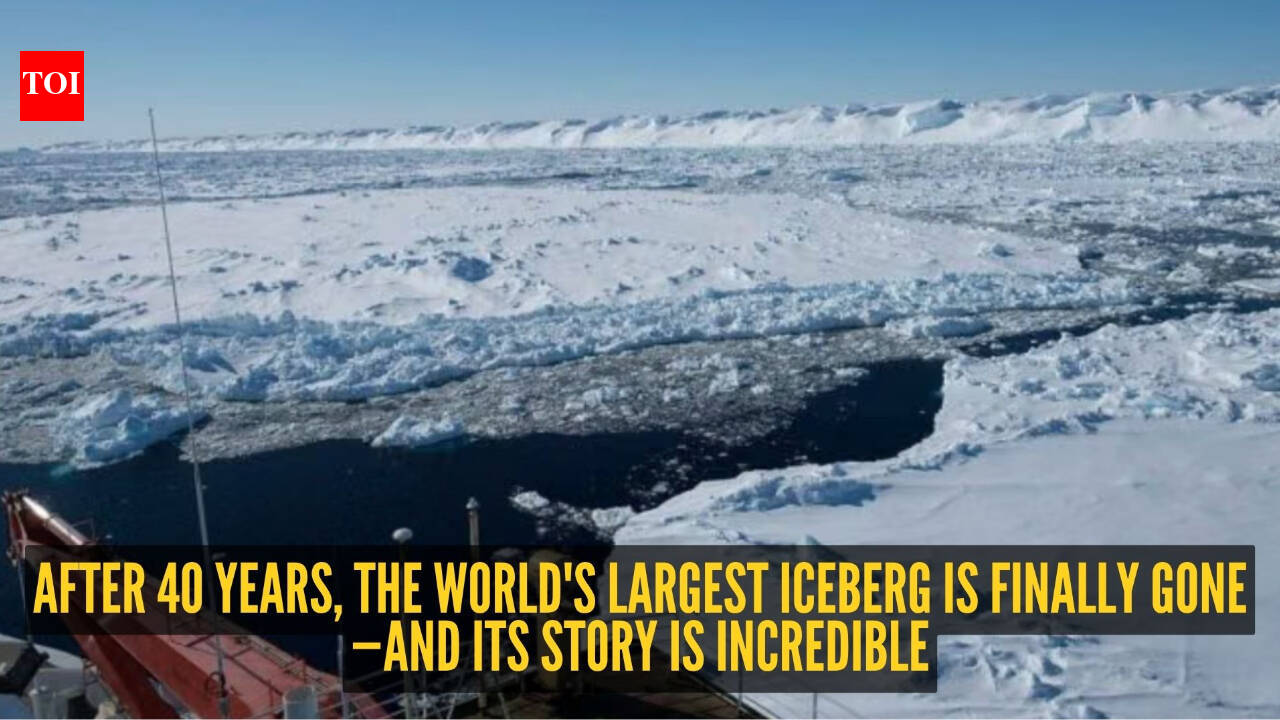
 Some things become so familiar that you almost assume they’ll always be around. For scientists studying Antarctica, iceberg A23a was one of them. It had been floating around for so long that it became part of the landscape. It survived changing weather, shifting oceans and decades of scientific research. But now, after nearly 40 years, its journey has finally come to an end.The world’s largest iceberg has broken into tiny pieces and melted away. The last fragments are no longer visible in satellite images, bringing the story of one of Earth’s most extraordinary ice giants to a quiet close.It wasn’t just big. It was unbelievably huge.Numbers don’t always paint the full picture, but they help.When A23a first broke away from Antarctica’s Filchner Ice Shelf in 1986, it covered around 3,500 square kilometres. That’s bigger than Goa, roughly twice the size of London and nearly three times the size of New York City.Its weight was estimated to be close to one trillion tonnes.It’s the kind of size that’s difficult to imagine until you realise people could have driven across entire cities and still not crossed it.
For almost 30 years, it barely moved
You’d think something this massive would slowly drift across the ocean from the moment it broke off.Instead, it stayed put.Soon after separating from the ice shelf, A23a got stuck on the seabed in the Weddell Sea. It remained there for almost three decades, almost like it had anchored itself to the ocean floor.While the rest of the world moved on, the iceberg hardly did.Then, in 2022, it finally came loose.Scientists who had watched it for years suddenly had something exciting to follow.
Its final journey stretched over 2,300 kilometres
Once it started moving, A23a didn’t stop.The iceberg drifted more than 2,300 kilometres through Antarctic waters and into the South Atlantic. Satellites tracked almost every stage of its journey.There was even a point when experts worried it might crash into South Georgia Island, a place famous for its huge penguin and seal colonies.Thankfully, it changed direction before reaching the island.Even so, everyone knew the ending was getting closer.The farther north it travelled, the warmer the water became. And warmer water slowly eats away at ice.
It slowly faded away
There was no dramatic moment when the iceberg suddenly disappeared.It happened little by little.Large chunks broke away first. Then those pieces cracked again into smaller fragments. Eventually, what was left simply melted into the ocean.By March this year, the iceberg had shrunk to just 170 square kilometres, a tiny fraction of what it once was.In April, satellites captured one of its last images.Soon after, there was nothing left big enough to spot from space.Just like that, a giant that had survived for decades was gone.
Why were scientists so interested in one iceberg?
Because A23a wasn’t just another block of floating ice.It helped researchers understand how Antarctica works.Scientists studied how it moved, why it stayed stuck for so many years and what happened as it slowly broke apart. Every stage offered new clues about ocean currents, rising temperatures and the changing Antarctic environment.Research ships even travelled close to the iceberg to collect water samples around it.The more they studied it, the more questions it raised.
Its melting mattered too
Icebergs like A23a are made of freshwater.As they melt into the salty ocean, they change the surrounding water. That freshwater carries nutrients that feed tiny marine organisms, which eventually support fish, whales, penguins and many other animals.So while the iceberg was disappearing, it was also becoming part of the ocean ecosystem.Its end was also the beginning of something else.
It quietly witnessed four decades of history
Perhaps the most remarkable thing about A23a wasn’t its size.It was how long it survived.It first broke away in 1986.Since then, the world has changed in countless ways. Governments have changed. Technology has transformed everyday life. Entire generations have grown up.Yet the iceberg remained.It quietly floated through all those years without anyone outside the scientific community paying much attention.Only recently did people begin following its story more closely.
The story doesn’t end here
A23a may be gone, but scientists will keep learning from it for years.The satellite images, research data and ocean samples collected throughout its life are expected to improve our understanding of Antarctica and how the polar regions are changing.Meanwhile, another giant iceberg, D15a, has now taken over as the world’s largest.Nature doesn’t leave empty spaces for long.But A23a was different. It wasn’t famous because of a single event. It became unforgettable because it lasted so long.For nearly 40 years, it quietly drifted across one of the harshest places on Earth. And now that it’s finally gone, it leaves behind something bigger than its size – a story that reminds us just how long nature can hold on, and how quietly it can let go.