
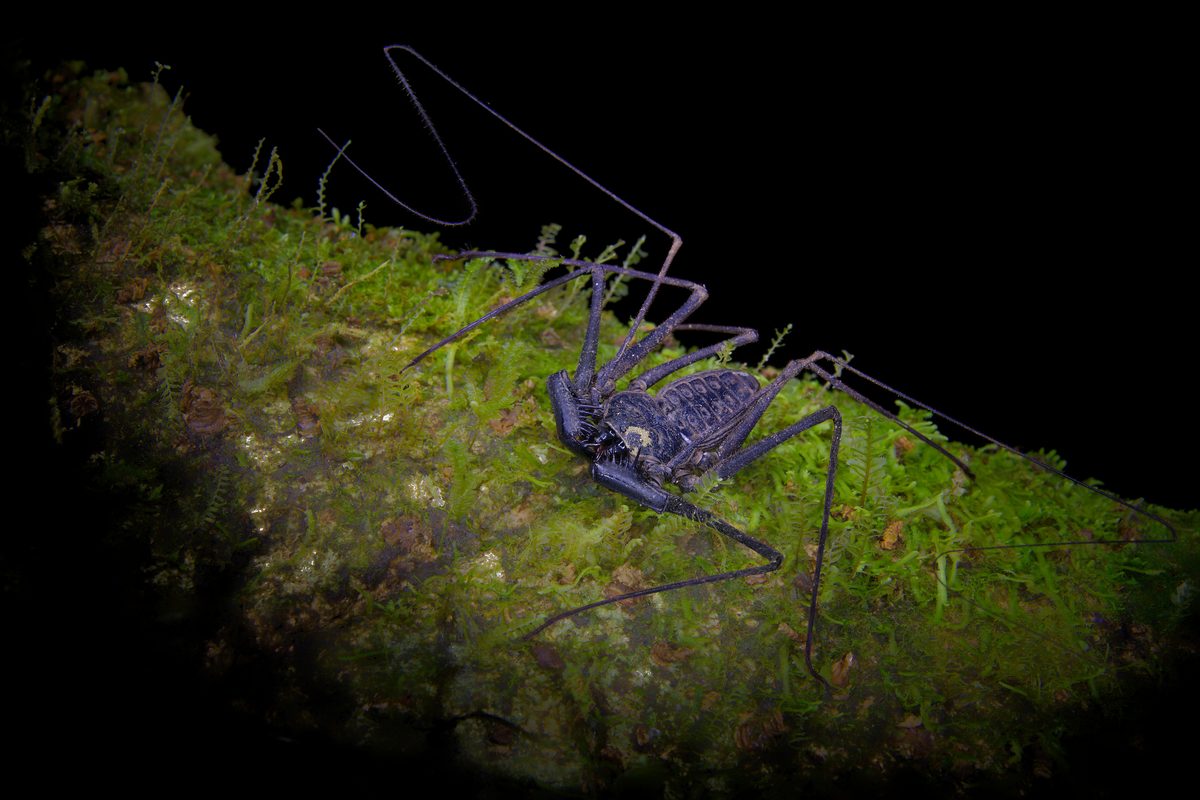
This spider-like creature is not dangerous to humans – at least, if entomologist George McGavin’s efforts to catch one in the darkness is anything to go by. “One’s just crawled across my face,” he declares.
These nocturnal, cave-dwelling animals are commonly known as whip spiders or tailless whip scorpions – but they’re neither spiders nor scorpions.
Even if they look like a spider with their eight spindly legs and a flattened body, they actually belong to the order Amblypygi, which is separate from Araneae.
Whip spiders are found in tropical and subtropical regions worldwide, mainly in warm and humid environments. A few differences set them apart from true spiders – firstly, they have no silk or venom fangs. Another is their large, spiny, raptorial pedipalps which they use to catch and hold prey, similar to how scorpions use their pincers.
And lastly, the hard-to-miss modified front legs – elongated into whip-like sensory structures, which they use to feel around the environment. Their eyesight is relatively poor and they mostly hunt in darkness.
They don’t use these two appendages for walking, so they often move in a crab-like, sideways fashion. When suitable prey is located, the whip spider seizes the victim with large spines on the grasping pedipalps, impaling and immobilising it.
“It uses these very long legs to feel its prey, and its prey are these cave crickets here. Very sneakily, sometimes the whip spiders reach behind the cricket and just go tickle, tickle on the back end, and the cricket jumps forward into the jaws of the whip spider. It’s a really clever trick,” says McGavin.
Top image: phototrip/Getty Images