
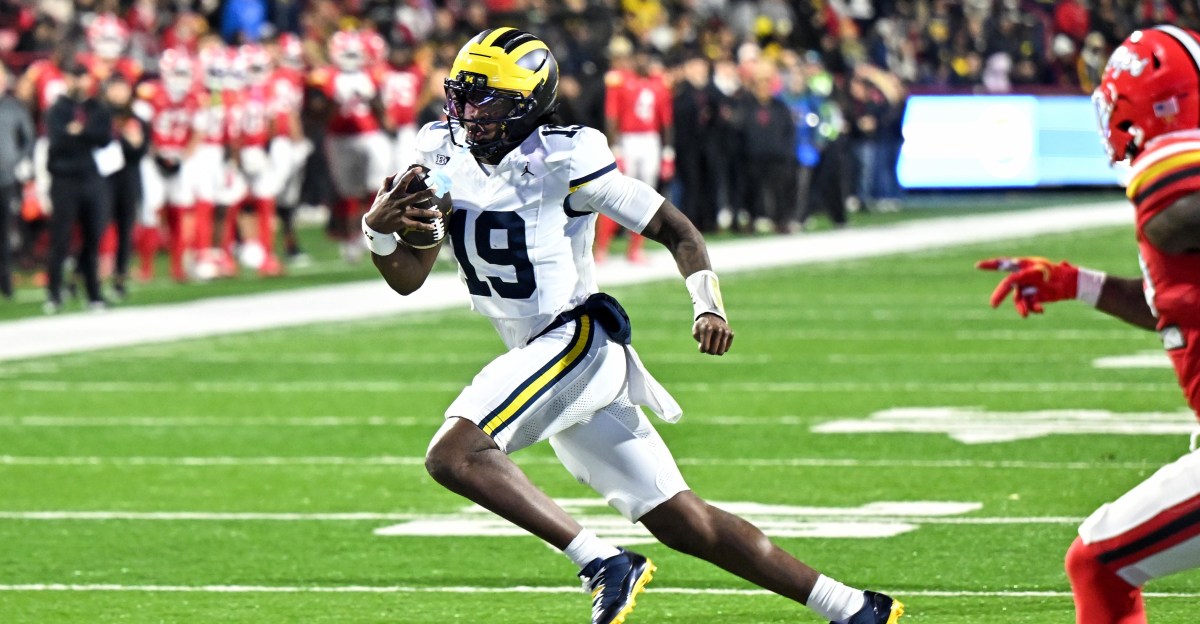
Michigan finished the regular season 9-3 in 2025, but even that was a bit better than what the eye test showed. Ahead of the upcoming season, the Wolverines made sweeping changes to their coaching staff and roster, headlined by the arrival of head coach Kyle Whittingham.
With Whittingham’s arrival, there’s plenty of optimism Michigan can get rolling in the right direction again after two underwhelming seasons. But a tough schedule on deck, getting back to nine wins will be pretty challenging. Improvement isn’t impossible, which is why we are going to take a look at five things that need to happen for Michigan to win more games than it did last season.
Improvement for Bryce Underwood
We’ll get the most obvious thing out of the way first, but if Michigan wants to win 10 or more games this season, it’s going to need its quarterback to play well. Bryce Underwood was hardly the only thing holding Michigan back a year ago, but there were still plenty of freshman mistakes and a lack of precision that left fans wanting more.
Improvement for Underwood should come in the form of better performances and better usage. As we saw last season and in this year’s spring game, his throws, decision-making and footwork can still be pretty erratic at times. Cleaning up these issues will allow him to be more trustworthy as a passer and raise the potential of the offense a great deal. He’ll likely have a better group of pass-catchers this year as well to make things easier.
On the usage front, Michigan also needs to understand what makes Underwood such an interesting player is his dual-threat ability. We saw him run the ball a decent amount last season, but the Wolverines need to be much more intentional about letting him do so in 2026, not only because he’s good at it, but also because it provides another means of exploiting defenses. Thanks to offensive coordinator Jason Beck’s past success with running quarterbacks, it’s a good bet we can see this in 2026.
An offense can only go as far as its line will carry it. Fortunately, Michigan took a step in the right direction there in 2025. The bad news is it was really only in the run game. Going hand-in-hand with improvement for Underwood in 2026, the Wolverines need to get some better results in pass protection.
The Wolverines allowed 21 sacks in 2025 — far from terrible, but well off the standard Michigan’s offensive lines have set in recent years. Furthermore, defenses were continually chasing Underwood around and forcing him into some careless throws. He took plenty of hits as well, something Michigan will look to limit this season.
The good news is Michigan now has Jim Harding on staff. He has been one of the nation’s best offensive line coaches over the last several years at Utah and should offer some new perspectives to a group that returns six players who started games in 2025.
Limiting inconsistency in the secondary
On paper, Michigan’s defense should once again be pretty solid thanks in part to a secondary that returns both starting outside corners in Jyaire Hill and Zeke Berry, while also bringing in Smith Snowden from Utah. Hill and Berry have both improved steadily the last two seasons and have the potential to be a great duo this year, but both have also had spells of poor play and a lack of discipline that opposing offenses have exploited.
The issues have largely been the same with both Hill and Berry — both do a great job locking down receivers in the short and intermediate areas of the field, but they have had a tendency to get beat on deep balls and have also had issues tackling, leading to yards gained after the catch. Hill specifically has also had issues with drops on should-be easy interceptions. If both can make a leap and limit their miscues, it could help Michigan go from being good to great defensively.
When Michigan has had its elite defenses in the past, it’s largely been because of a great pass rush. Last season, the defense only registered 28 sacks, which was ninth in the Big Ten and down from totals of 36 and 40 in 2024 and 2023, respectively. Simply put — not good enough.
Going into this season, Michigan has a pretty different looking group of defensive tackles and edge rushers. On the edge, Michigan has All-American John Henry Daley, but he’s coming off an Achilles injury from last season. Senior Cam Brandt, junior Dominic Nichols, sophomore Nate Marshall and true freshman Carter Meadows are expected to be more involved as well.
At tackle, Michigan will be relying on Enow Etta and Trey Pierce for most of the snaps, but both have been eyed as potential breakout candidates with more chances to get on the field this fall.
Don’t ever let anyone tell you special teams aren’t important.
Last season, Michigan’s special teams unit would do something at least once a week that would make you want to pull your hair out, often costing the team valuable field position or missing out on the chance to score points in key moments. Fumbled kick returns, muffed punts, missed field goals — you name it, they did it.
This season, Michigan has Kerry Coombs on staff leading the special teams units, a polished coach with stops at Ohio State, Cincinnati and in the NFL. Furthermore, Michigan brought in Trey Butkowski as its new kicker and Cam Brown as its new punter, both of whom are only sophomores but were successful as freshmen at Pitt and should help raise the floor of the group by a good margin.
The Wolverines will still need to determine who will be returning kicks and punts this year, though, since it seems pretty inadvisable to use Andrew Marsh regularly in those spots since he’ll be a critical piece of the offense. Perhaps this is where true freshman wide receiver Salesi Moa can shine early in his career and use his speed and athleticism to his advantage in the return game.