
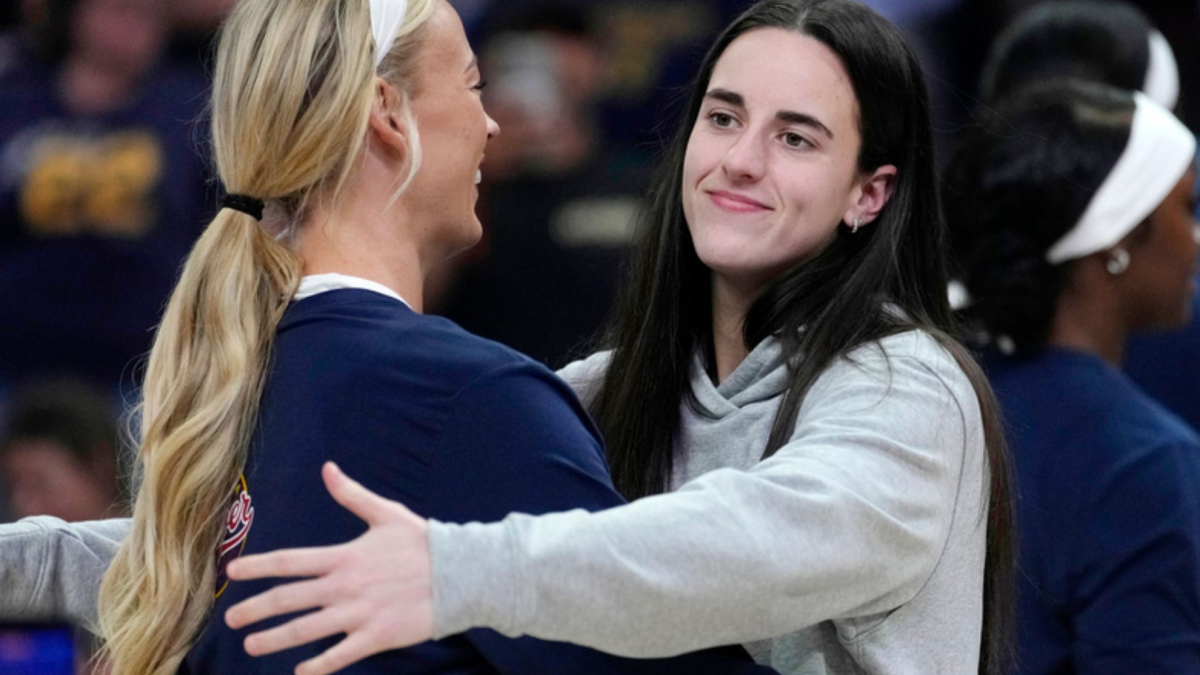
Caitlin Clark’s WNBA career has become one of the most scrutinized storylines in American sport, with every foul, comment, and reaction around the Indiana Fever guard pulled into a much wider debate.
Her popularity has helped bring record attention to the league, but it has also made her a lightning rod in conversations about race, sexuality, media coverage, and what some people expect from the WNBA’s biggest young stars.
Caitlin Clark takes a blow to the throat, and officials don’t call a foul
In an OutKick column, Bobby Burack argued that Clark receives a different level of criticism than Cameron Brink or Paige Bueckers because she refuses to become a culture-war figure.
“The problem, for many around the league, is that Clark refuses to play the role expected of her,” Burack wrote.
“She is a straight White woman who has declined to turn herself into a vehicle for the racial and sexual activism that increasingly defines the league’s public image.”
The debate followed a CNN discussion in which former ESPN host Cari Champion rejected the idea that race explains some of the hostility directed at Clark.
“To suggest that it is intentional or that people are being racist towards her leaves out a long history of women who have supported this league and started this league who were Black,” Champion said, as per OutKick.
“It’s very disrespectful to them.”
Why Brink and Bueckers are treated differently
Burack contrasted Clark with Brink, who has repeatedly spoken about privilege in women’s basketball.
“I could go way deeper into this, but I would just say growing the fan base to support all types of players,” Brink said.
“I will acknowledge there’s a privilege for the younger White players of the league.
“That’s not always true, but there is a privilege that we have inherently, and the privilege of appearing feminine.”
She later made a similar point to Interview magazine.
“I’ve tried to be vocal about this and acknowledge there’s such a privilege, marketing-wise, being White and blonde,” Brink said.
“It does really bother me seeing athletes and players who are consistently putting up crazy stat lines and not being rewarded by brands.”
Bueckers has also spoken publicly about race and opportunity in the WNBA.
“[The WNBA] was built on a lot of Black women,” Bueckers said, via Yahoo Sports. “It’s definitely right for them to get the same equal opportunity as everybody else.”
Clark remains different
Burack argued those comments help explain why Brink and Bueckers are received differently by some critics.
“Viewed through that lens, the acceptance of Brink and Bueckers makes more sense,” he wrote. “Both have repeatedly signaled they are, in fact, anti-racists.”
Clark, by contrast, has mostly kept her public focus on basketball.
“Caitlin Clark has chosen a different path,” Burack wrote. “She’s a basketball player. That’s all she’s ever claimed to be.”
The column also pointed to Jemele Hill’s 2024 comments to the Los Angeles Times as part of the broader conversation around Clark’s popularity.
“We would all be very naive if we didn’t say race and her sexuality played a role in her popularity,” Hill said.