
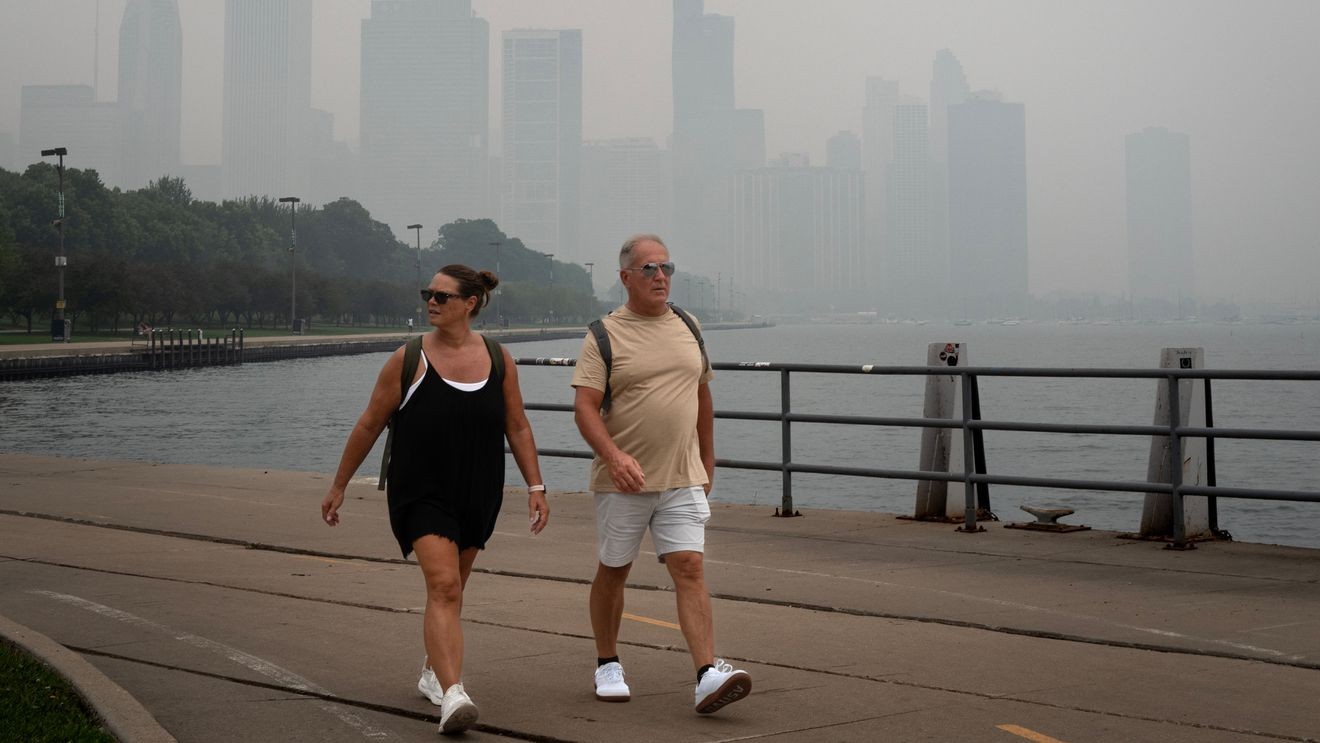
(TNND) — Millions of Americans are breathing unhealthy or even hazardous air as winds push smoke from wildfires raging in Canada across the upper Midwest and Northeast.
Air quality alerts are in place for a large swath of the U.S., with the National Weather Service flagging air quality as a concern through the weekend.
The Canadian government is reporting nearly 900 active fires, with 53 new ones reported Friday.
Dr. Lawrence Shulman, a pulmonologist and the chief medical officer for Optum New York and New Jersey, said you don’t have to smell the smoke or see the haze to be impacted by the poor air quality from wildfires.
You can check the air quality in your city to guard against the hidden health danger.
“When the air quality index starts to get above 50, or even 100, that’s when there are health effects of the particles that are in the air,” Shulman said. “We’ve seen AQIs of well over 200 and in some areas over 500 in the last days due to this current round of Canadian wildfires.”
Dr. Lawrence Shulman, a pulmonologist and the chief medical officer for Optum New York and New Jersey, discusses the health impacts of wildfire smoke. (TNND)
Wildfire smoke can travel hundreds or even thousands of miles, carrying small particles, or aerosols, dangerous to human health.
Luke Montrose, an environmental toxicologist at Colorado State University, wrote in the past that smoke from wildfires contains thousands of individual compounds, including carbon monoxide, volatile organic compounds, carbon dioxide, hydrocarbons and nitrogen oxides.
And a study published earlier this year found that exposure to wildfire smoke was responsible for about 24,000 deaths a year between 2006 and 2020 in the contiguous U.S.
“So, wildfire smoke has multiple different components to it,” Shulman said. “When we talk about particles within any type of air pollution, we really have to talk about the size of those particles. And when the size of the particles is around 2.5 microns, which is really small, or less, they can enter your respiratory tract. So larger particles are normally filtered out by our airways, by saliva, by our nose hairs. But when those particles get to a 2.5-micron size or less, they can be absorbed into the bloodstream. So, you breathe them in, they bypass your body’s natural defenses. And once they hit the end air sacs, the alveoli, they can actually be directly absorbed. So, the smoke has multiple different particles, but the particles that we’re worried about are those smaller size, 2.5-micron or smaller, particles.”
Shulman said even short exposure can set off a chain reaction in your respiratory system, and the most effective protection during high pollution days is to just stay inside if possible.
If you do have to spend time outdoors on bad air days, an N95 mask can help. Specialized masks are made for very young children or for some older people, Shulman said.
If you’re in your car, switch the ventilation system to recirculate the air instead of pulling air in from outside.
Dr. Lawrence Shulman, a pulmonologist and the chief medical officer for Optum New York and New Jersey, discusses the health impacts of wildfire smoke. (TNND)
If you’re at home during dangerously polluted days, use air purifiers or HEPA filters to create a cleaner “safe room.” Close the door to that room, and if smoke conditions are especially severe, place wet towels along the bottom of the door to help keep smoky air from seeping inside.
“You can get symptoms such as watery eyes, coughing, sneezing, but as those particles continue to go down into your lungs, or they set off that cascade, you can get some deeper coughing, you can get heavy mucus production, you can feel short of breath, and it can even set off some of your underlying medical issues,” Shulman said. “So, patients who have asthma or chronic obstructive pulmonary disease, COPD, or emphysema, children, older people, these are the populations that are even more affected by the cascade that is set off by even a small exposure to some of these pollutants.”
If you are outside for a few minutes and cough a few times but recover quickly after going back inside, you don’t need to seek extra attention, Shulman said.
“However, if you have one of those comorbidities — if you have asthma or emphysema, COPD, lung cancer, pulmonary fibrosis — and you are having prolonged symptoms, meaning that they are lasting well more than 30 minutes to an hour after you have removed yourself from exposure, you should definitely seek attention,” he said.