
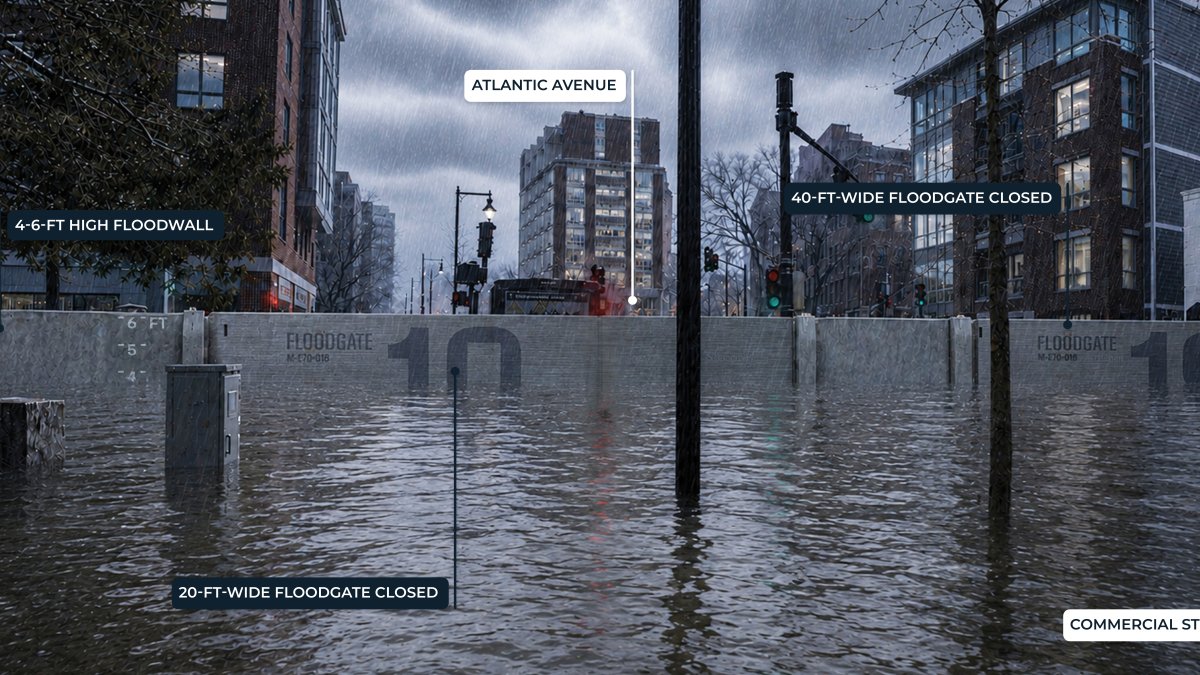
Boston leaders and the U.S. Army Corps of Engineers unveiled a draft $10 billion coastal flood protection plan Thursday, warning that failing to prepare for rising sea levels and stronger storms could leave one-sixth of the city vulnerable to flooding and result in an estimated $54 billion in damages.
The plan calls for constructing about 16 miles of floodwalls, berms, levees and storm surge barriers designed to protect vulnerable neighborhoods.
The proposal is the result of a four-year study examining how to protect Boston from increasingly severe coastal flooding driven by climate change.
Officials said roughly half of the city’s population lives in areas that could be affected.
“Doing nothing is not a viable solution,” Lt. Col. David MacPhail of the U.S. Army Corps of Engineers said.
Boston City Councilor Gabriela Coletta Zapata said some of the city’s most vulnerable neighborhoods face the greatest risks.
“Communities like East Boston, Charlestown, the North End and the downtown waterfront are on the front lines,” she said. “Every resident deserves to know that their home and livelihood are worth protecting.”
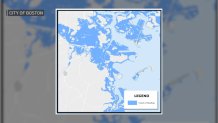
City of BostonCity of Boston
A map showing land Boston leaders say is at risk of being underwater.
“Our study that we partnered with Boston on assessed the people, the ecosystems of the area, the property and the critical infrastructure that Boston has,” MacPhail said.
By working together on the Boston Coastal Storm Risk Management Feasibility Study, currently a draft that’s open to public comment before it’s finalized in 2028, would let the city and other local stakeholders pay just 35% of the projects’ cost, with the federal government picking up the rest of cost of the baseline infrastructure, officials said.
“What this study unlocks is the opportunity to tap into federal funds at a scale that is a game-changer for Boston,” Mayor Michelle Wu said.
North End resident Ryan Leach said he has witnessed the effects of rising sea levels firsthand and supports investing in flood protection before conditions worsen.
“I walk around here all the time,” he said. “I definitely see the changing sea levels.”
Leach said he would rather see officials act now than wait until the problem becomes more severe.
“I definitely would prefer somebody be proactive about it, at least to look into it, rather than just turn a blind eye and say, ‘Hopefully, it gets better,’ because I think it’s going to take some kind of human effort,” he said.
The draft plan will remain open for public comment from Friday through Sept. 18. The Army Corps is expected to finalize the report in 2028 before submitting it to Congress for consideration.
Read the city’s explanation here: