
A NASA spacecraft on its way to study a strange metal asteroid recently took a detour above Mars. And the striking images it captured during the interlude provide a rare and captivating look at Earth’s planetary neighbor.
Most photos of Mars showcase the planet’s iconic red-hued disk and its rust-colored surface.
But in May, the Psyche spacecraft caught an unusual glimpse of Mars while performing a maneuver to harness the planet’s gravity and send it whizzing beyond the planet toward the main asteroid belt. Now, NASA has released some photos the vehicle captured during the rendezvous that show Mars in a new light.
Groundbreaking observatory begins 10-year mission exploring the cosmos
1 of 12
This is a section from a larger image the Vera C. Rubin Observatory captured referred to as the “ocean of stars.” The view shows millions of multi-colored stars against a backdrop of galaxies close to the Milky Way’s plane, the crowded disk of the galaxy.
(NSF–DOE Vera C. Rubin Observatory/NOIRLab/SLAC/AURA)
Here’s a look at what the Psyche spacecraft photographed during its approach toward Mars.
What is NASA’s Psyche mission?
Artist’s concept illustration depicting the spacecraft of NASA’s Psyche mission near the targeted metal asteroid Psyche.
NASA’s Psyche spacecraft is on a mission to a distant metal-rich asteroid of the same name.
Since launching in October 2023, the shuttle has been traveling on a six-year, 2.2 billion-mile journey to the main asteroid belt between Mars and Jupiter. Its final destination is a metallic asteroid of the same name that scientists hope to study in order to glean valuable insights about Earth’s own core.
Psyche captures these stunning images of Mars during May flyby
About two months after Psyche made a close approach of Mars, NASA on July 17 released some images captured during the flyby.
The photos were captured in May as Psyche came no closer than about 2,800 miles from the red planet’s surface. NASA teams then spent weeks downlinking, analyzing and processing the views of the encounter before releasing them to the public.
The results offer “rarely seen views of the red planet,” Jim Bell, the Psyche imager instrument lead at Arizona State University in Tempe, said in a statement.
See these photos from NASA of Psyche’s close approach with Mars
1 of 6
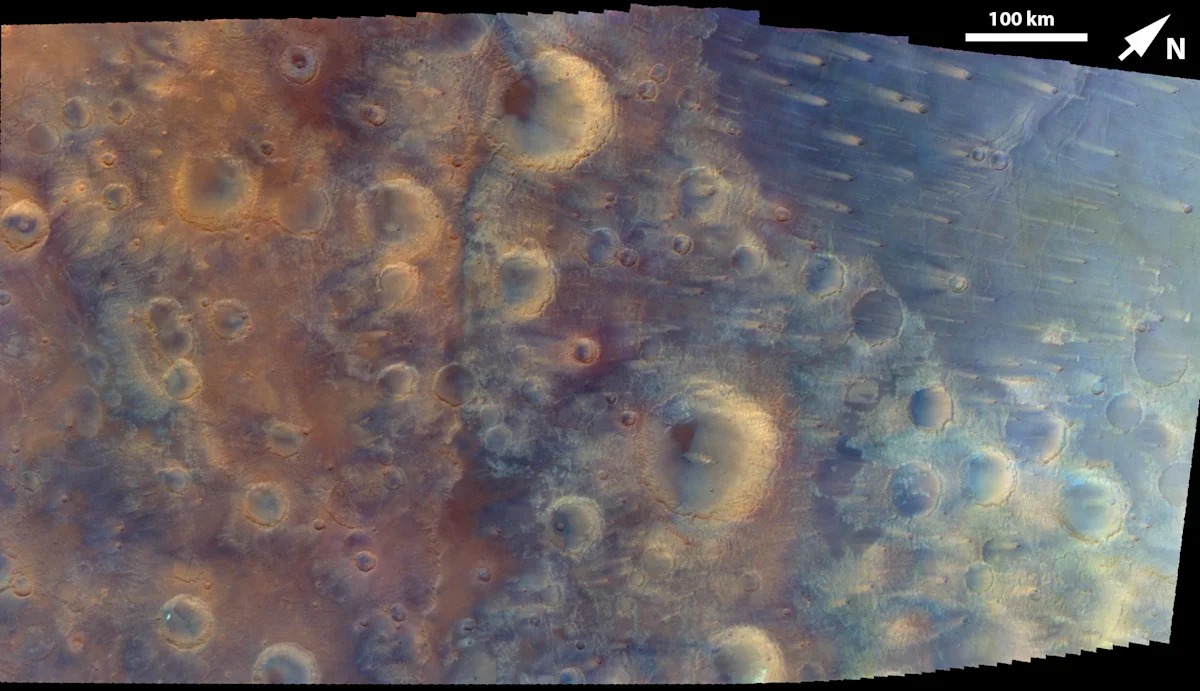
This is an enhanced-color mosaic created from four individual images acquired on May 15, 2026, during Psyche’s flyby of Mars. The spacecraft’s suite of instruments helped reveal craters, ridges, wind streaks and volcanic plains materials over the southern highlands of Mars.
(NASA/JPL-Caltech/ASU)See timelapse video of Mars flyby
NASA also released a timelapse video showing the Psyche spacecraft’s approach to and departure from Mars.
Mars provides gravity boost to asteroid-bound vehicle
The flyby provided not just an opportunity to capture the stunning imagery, but also benefit from a valuable speed boost courtesy of Mars’ gravity.
The gravity assist maneuver wasn’t unlike a slingshot, propelling the Psyche spacecraft on a trajectory to arrive at the metallic main-belt asteroid Psyche by the end of 2029, NASA explained.
The Psyche spacecraft, which was whizzing at approximately 12,333 mph when it reached Mars, had already been gradually gaining speed since its launch.
But the mission team at NASA’s Jet Propulsion Laboratory in Southern California needed to use the Mars flyby to harness some of the planet’s gravitational forces for even more of a boost. The maneuver was also meant to give the vehicle’s propulsion system a bit of a break and even save some propellant while adjusting its trajectory if needed, NASA said.
Eric Lagatta is the Space Connect reporter for the USA TODAY Network. Reach him at elagatta@usatodayco.com
This article originally appeared on USA TODAY: You can see Mars as rarely viewed in new NASA spacecraft photos