
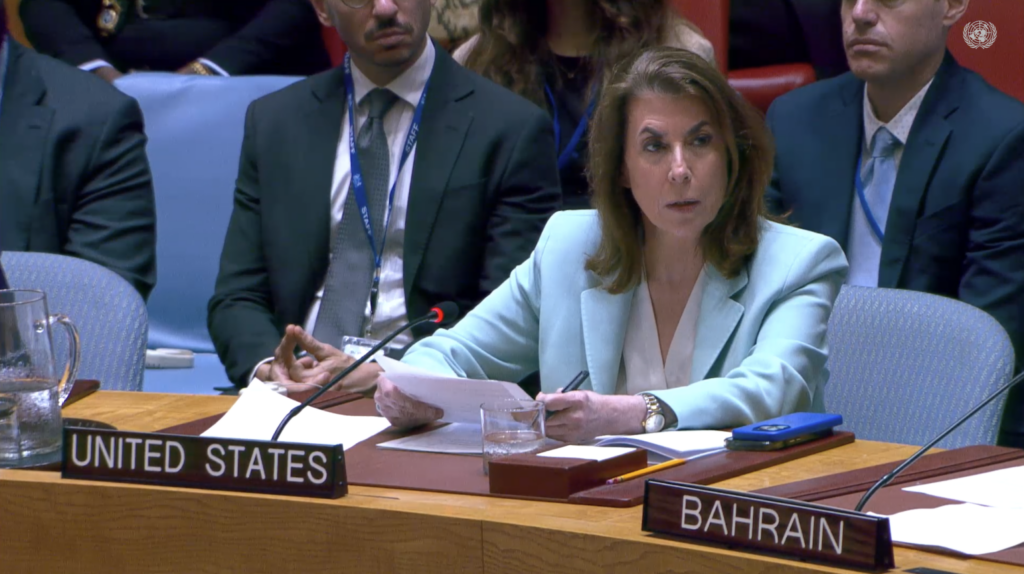
Ambassador Tammy Bruce
Deputy Representative of the United States to the United Nations
New York, New York
AS DELIVERED
Thank you, Madam Foreign Minister, for convening this open debate and for your remarks, and congratulations again on the Democratic Republic of the Congo’s presidency. And thanks to the Secretary-General and to the Director General of the World Trade Organization. Thank you, Madam.
Colleagues, when managed responsibly and strategically, natural resources have the potential to support peace, investment, and shared prosperity. As part of these efforts, stakeholders must take into account the nexus between natural resource governance and conflict prevention.
In December 2025, President Trump took action and brokered the Washington Accords for Peace and Prosperity between the DRC and Rwanda, building on the Washington Peace Agreement signed in June 2025. This landmark achievement represents a historic opportunity to unlock lasting security and prosperity for the people of the Great Lakes region.
To reinforce this progress, the U.S.-DRC Strategic Partnership Agreement harnesses the economic potential of the DRC by creating the conditions for the United States and the U.S.-aligned investment. This includes encouraging and supporting U.S. engagement in Congolese export infrastructure and helping build a skilled workforce with quality job opportunities across the country.
The Strategic Partnership Agreement offers the potential for tangible growth, stability, and prosperity for both the Congolese and American people, and we are already seeing progress.
This is evident in our effort and commitment to the Lobito Corridor, a transformative infrastructure project that will enhance regional connectivity, secure critical mineral supply chains, and drive sustainable economic growth by linking the DRC to the Atlantic Ocean port of Lobito in Angola.
The Lobito Corridor will open new avenues for two-way trade between Central Africa and the United States and Europe.
Just as in the DRC, we believe Sudan’s durable path out of conflict runs through its people’s ability to rebuild safely, with resources that finance recovery rather than fuel further war.
As Senior Advisor Boulos noted last month in this Council, it is time to consider the role gold plays in fueling this conflict. Gold offers a major source of revenue that finances much of the acquisition and flow of drones and other weapons.
Traceability and transparency are not obstacles to investment, but rather the foundation of it. Legitimate companies invest where supply chains are clean and peace is durable.
In that regard, we commend the United Kingdom for sanctioning individuals suspected of participating in the illicit trade of gold and finance networks sustaining the conflict.
The United States has targeted our sanctions on individuals and networks profiting from this war, including those recruiting foreign fighters and supplying the weapons that have prolonged the conflict and enabled atrocities against civilians.
The United States also continues to press the parties for an immediate humanitarian truce without preconditions to allow humanitarian assistance to reach those in need and to open the door to a civilian-led political transition.
These are not separate efforts. Rather; they reflect one conviction: that diplomacy succeeds when it turns resource wealth from a driver of conflict into a foundation for regional integration and shared growth.
The United States remains prepared to use every tool at our disposal to help the DRC, Rwanda, and Sudan deliver the peace and prosperity their people deserve.
From his first day in office, President Trump has made clear that economic security is indeed national security. Together, we can ensure the resource wealth finances peace, and not war.
Thank you.
###