
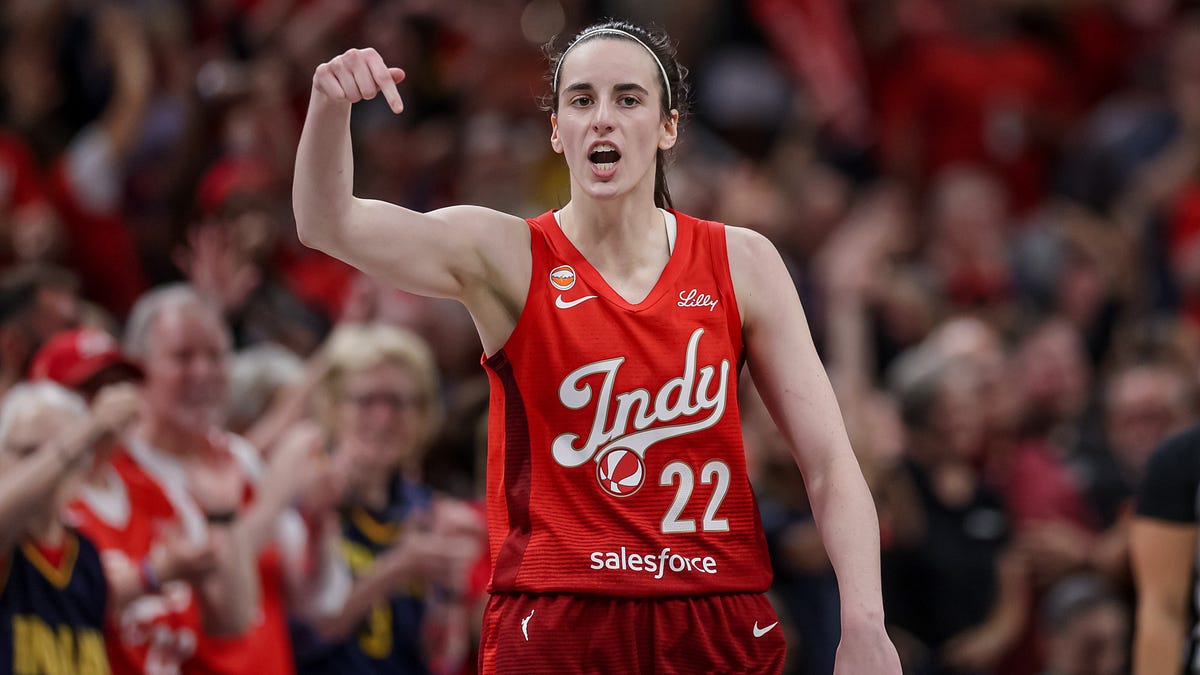
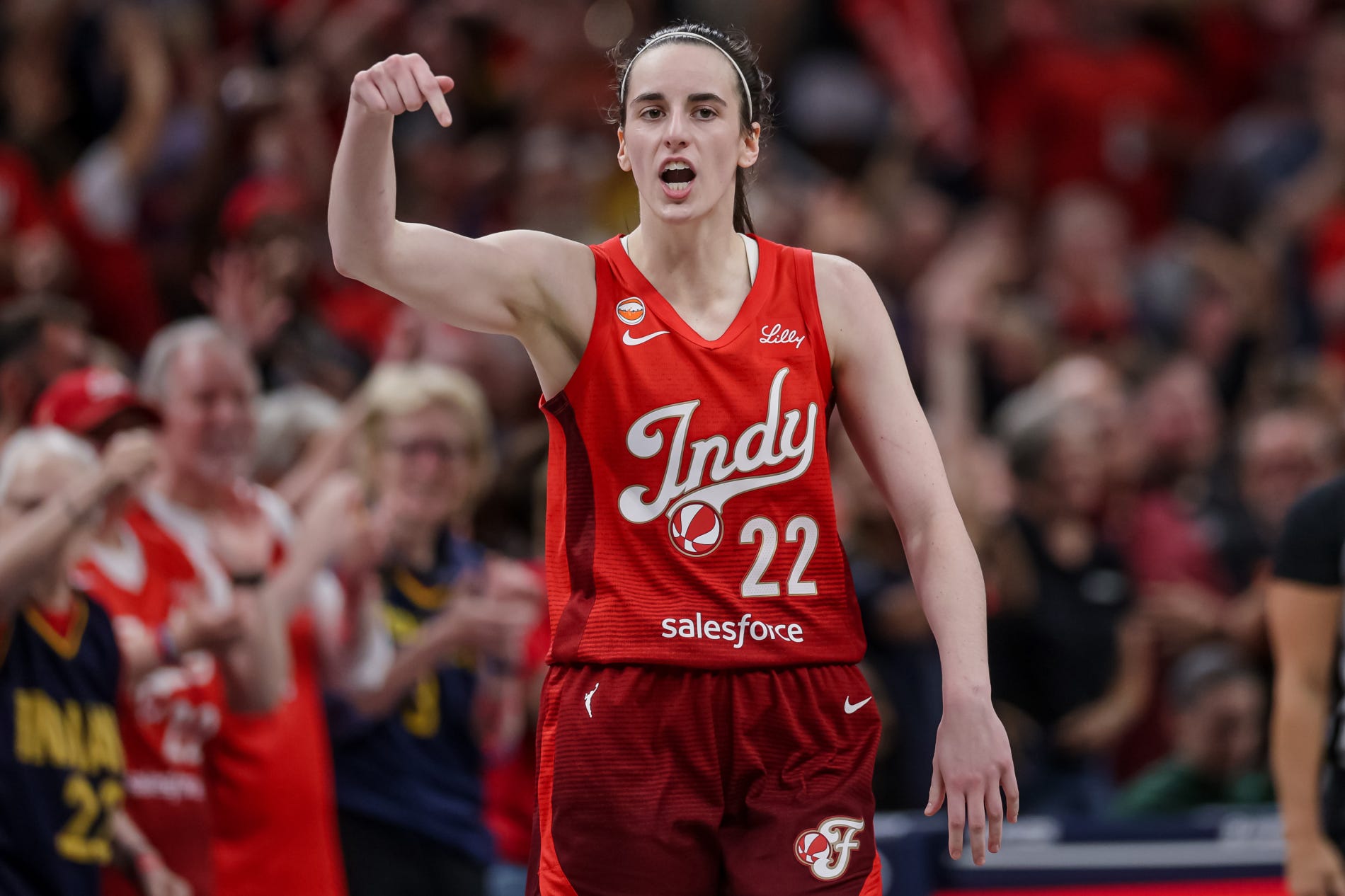
 Caitlin Clark of the Indiana Fever reacts during the game against the Seattle Storm at Gainbridge Fieldhouse on July 17, 2026 in Indianapolis, Indiana. (Michael Hickey/Getty Images)
The WNBA is officially on its All-Star break now, which means a chance for everyone to relax and enjoy some festivities before the stretch-run grind in what’s shaping up to be a really interesting 2026 season.
Oh, who am I kidding? We’re probably going to spend the break stirring up more drama around Caitlin Clark.
Through no fault of her own, the Indiana Fever phenomenon is the favorite totem for approximately 15 different culture wars at once, so it makes sense that a bunch of other people seeking to make money for themselves have decided to mine her polarizing type of celebrity for their own personal content.
(Not me, though — I’m writing about her with pure intentions. Or at least, purely about basketball, which is mostly what I care about anyway.)
And basketball-wise, Clark has been at the center of another long-running argument: How exactly should we value a player whose analytical impact — she only ranks around 30th in my LAKER wins added metric — feels so much smaller than her reputation (or the eye-test) suggests? I already wrote a bit about that here…
 Why Don’t the Advanced Metrics Like Caitlin Clark (Yet)?
…but a recent post by my buddy Ethan Strauss prompted me to think through another round of this Great Caitlin Clark Debate:
The Bill James Theory That Keeps Me Believing in Caitlin Clark
WNBA culture is insane, which inspires many to fight back against its conventional wisdoms. If the crazy people in that league have it out for Caitlin Clark, it’s tempting to then assume that their criticism of Clark is all fake. Of course, it’s not so simple. In 2024, WNBA legend Diana Taurasi made waves by saying …
Read more
4 days ago · 34 likes · 28 comments · Ethan Strauss
While Clark’s current weaknesses (a mixed-bag of electric scoring/shooting/playmaking, but also high turnovers, poor defense, uneven plus/minus impact and surprising injury proneness) make it easy for skeptics to call her overrated, Ethan essentially argues that her peak performances — such as 45 points and 10 assists a week ago, or 27 and 11 on Wednesday night — are proof of her potential for consistent future greatness. As the theory goes, anyone capable of sufficiently historic feats is inherently special.
And I think that’s correct. Clark can become a more dangerous offensive weapon if she gets more efficient within the archetype she’s already established for herself, as a high-volume scorer and playmaker: