
The Detroit Red Wings’ search for a new general manager is underway. And beyond the obvious question of who they will hire is another that will loom over the process: what exactly is the new head of hockey operations walking into?
Detroit is a storied NHL market, an Original Six franchise with a long history of winning and a passionate fan base. It’s also home to the league’s longest active playoff drought, and recently, some internal turmoil — which, added together, proved to be too much to solve for even one of the franchise’s most iconic figures.
That all means the new GM is going to take over the franchise at a critical and fascinating moment.
But even for all the angst and struggles of recent seasons, this does not look like the same level of ground-up rebuild Steve Yzerman inherited back in 2019. There’s more talent in the system this time, and that gives the potential for a quicker timeline back to contention — with potential being the key word.
Is Zach Werenski really committed to the Blue Jackets?
Aaron Portzline and Sean McIndoe
What’s in place
Putting aside, for a second, the Dylan Larkin trade request and whatever comes of it, the Red Wings have an appealing foundation in Moritz Seider.
A top-five finisher for the Norris Trophy last season, Seider is just entering the prime of his career as a do-it-all defenseman — something every team covets. That’s a great place to start, especially when paired with another big, mobile pillar in Simon Edvinsson, who is already logging huge minutes and has even more runway ahead of him at age 23.
Add in another young first-rounder in puck-mover Axel Sandin-Pellikka (21), the steady Albert Johansson and intriguing big right-shot prospect Anton Johansson and the Red Wings’ blue line has a strong young core to build upon.
Up front is a little murkier, owing to both the Larkin uncertainty and the future of Alex DeBrincat, who has one year left on his contract. Last season, DeBrincat was Detroit’s best and most consistent forward, scoring 41 goals and 85 points and playing all 82 games.
At age 28, DeBrincat still has many productive years in front of him, and if the Red Wings can extend him, the combination of him and Raymond gives Detroit a strong duo of wingers atop the lineup. Both were among the top 20 NHL wings in points last season, and Raymond still has a higher gear in him than his 76 points a year ago (down from 80 a year prior). At 24, he is just entering his prime, and there is 90-point upside in his game.
If they can’t extend DeBrincat, it gets much more complicated. Detroit has some notable scoring prospects on the wing — Michael Brandsegg-Nygård, Carter Bear, Max Plante and J.P. Hurlbert — but 40-goal scorers such as DeBrincat are rare and hard to replace. That makes his future a key domino for the Red Wings’ direction.
The biggest questions, though, are still down the middle. If Larkin doesn’t walk back his trade request, Detroit will have a major need there in both the short- and long-term. Certainly the Red Wings would love to get a young top-six center back in a potential Larkin deal. But typically, there’s only one real way to land those players: by drafting them, usually early.
The Red Wings have a pair of young recent top-10 picks down the middle in Marco Kasper and Nate Danielson, plus veterans Andrew Copp and J.T. Compher in the short-term. And Kasper in particular has a lot of winning elements, making him an important piece going forward for Detroit. He’s an up-tempo, hard-edged player who can score at the net and do a lot of dirty work. But the offensive ceiling for both him and Danielson is a question, and likely will prevent either from being a first-line center on a contender.
That reinforces the need to draft a center with major offensive potential in the next year or two. Still, the Red Wings have quite a bit to work with on defense, a couple of stars on the wing (if they can keep DeBrincat) and a deep system of good complementary players. If they can add a top young center (or two), their future outlook could improve in a hurry.
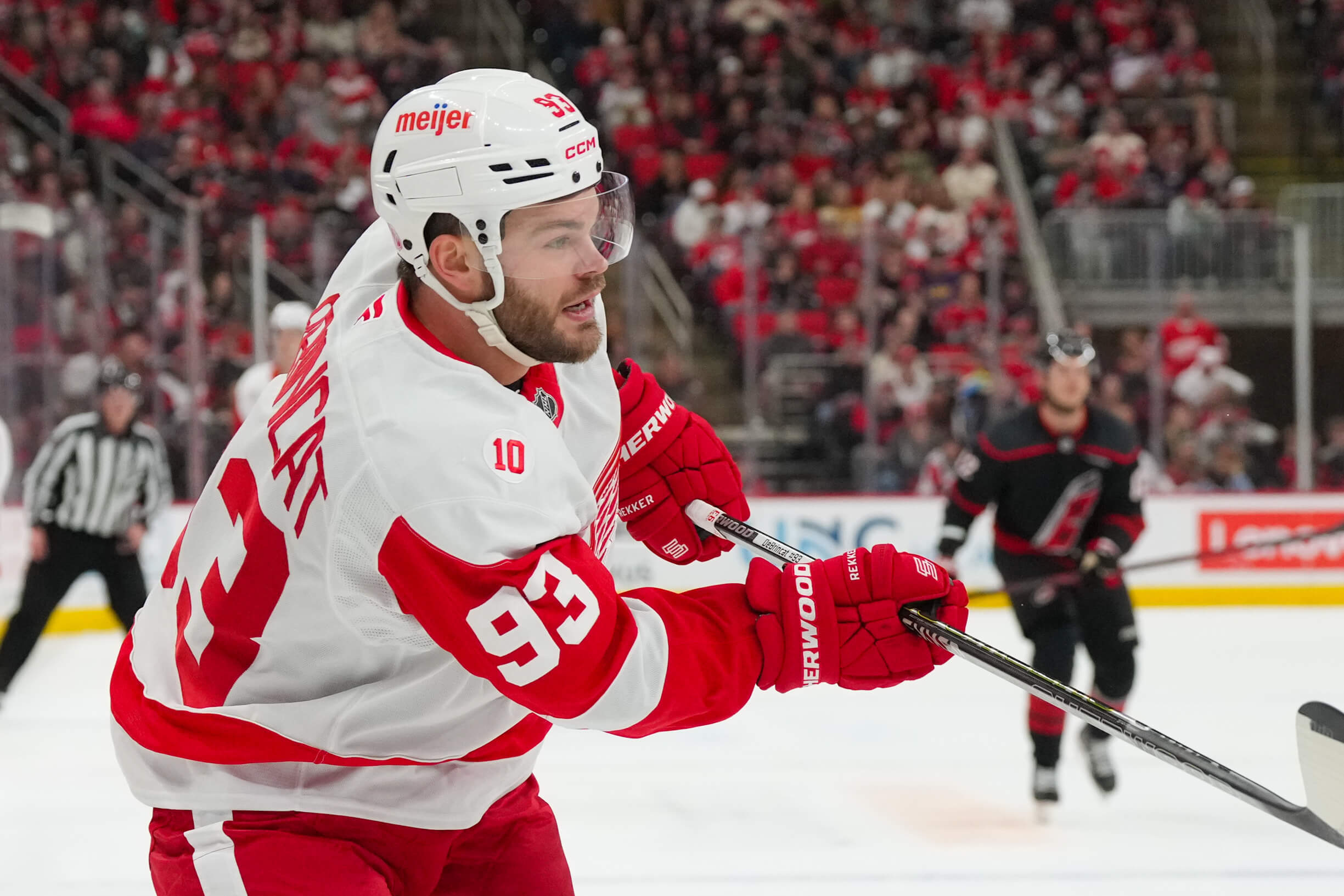
Alex DeBrincat has one year left on his contract. (James Guillory / Imagn Images)
Competitive timeline(s)
Even with a solid foundation of talented players, so much of the Red Wings’ competitive timeline still revolves around the Larkin situation.
If a new GM were to smooth things over with Larkin, it would make this next season a continuation of where this team left off: in the playoff race, with work to do around the fringes to level up in a competitive Atlantic Division.
The problem is, whether due to the Larkin situation, Yzerman’s more patient (or passive) approach, or a combination of the two, Detroit was stuck in limbo during the busiest part of the offseason. So that puts more pressure on the Red Wings to 1) get creative in the later stages of the offseason, and 2) bet on a lot of internal growth.
The latter has obviously been the focus in recent years. Raymond may not be at the level of a franchise forward just yet, but that path is there; comps such as Artemi Panarin and Patrick Kane add more weight to that.
If Edvinsson can take the next step offensively, he could follow in Josh Morrissey’s footsteps; if he doesn’t, he could still become the next Ryan McDonagh or Hampus Lindholm.
Marco Kasper shows signs of William Karlsson in his game, while Emmitt Finnie has some Artturi Lehkonen in him. Pair that with more development from players such as Danielson, Sandin-Pellikka and the Johanssons, and there is the makings of a really solid supporting cast in the near future.
But relying on the best-case scenarios out of everyone is dicey — even more so with this team’s track record and tendency to completely collapse in March.
What if Raymond doesn’t level up, or Finnie doesn’t have that consistency to his game yet? What if John Gibson can’t stay healthy? That’s why the status quo, alone, doesn’t put Detroit on a strong enough path — even if Larkin stays. It puts this team on the fringes of the playoff picture, but may not be enough to actually turn it into the tangible results that have been missing over the last few years.
So, the next GM has to be ready to take a more proactive approach to give this team its best chance of turning midseason momentum into the start of its playoff window. Or, make on-the-fly changes if that momentum never even builds.
And until the Larkin situation has a resolution, the team has to consider its competitive timeline without him. That’s obviously a little tougher to project, because what Detroit adds in return could decide just how much this team has to reset its timeline.
Could the Red Wings make a lateral move with a Larkin return and stay on their current track? Is a quick retool enough to turn this team around? Or will this team have to take a meaningful step back to fully reshape into a contender? The fallout of that decision could influence DeBrincat’s future, and potentially move the goalposts even further back.
A full tear-down rebuild may not be necessary. But maybe the most realistic timeline to becoming a sustainable contender post-Larkin is one that puts the Red Wings on a path similar to the Canadiens, who just exited one of the best quick-turn rebuilds of the salary cap era.
Maybe Detroit’s already ahead of where Montreal was when Jeff Gorton and Kent Hughes took the reins. The Canadiens’ foundation, at the start of the process, already included Nick Suzuki, Cole Caufield, Kaiden Guhle and Jakub Dobeš. Detroit’s combination of young stars, plus up-and-coming talent, can compete with that. Maybe that helps shorten the timeline slightly, or lets the team use that framework as a part of a retool versus a full rebuild.
Figuring out the team’s direction is just one step of the process, though. Committing to it and executing will define this team’s timeline. The plan would have to include bringing back a haul for Larkin (and potentially DeBrincat, depending on how that situation unfolds), aiming for a couple more top-five picks, taking swings at big-name RFAs (such as Montreal did with Noah Dobson), betting on reclamation projects and adapting to an ever-changing NHL landscape.
Tradeable assets
Who falls into this category depends heavily on the vision of the next GM and what direction they want to take.
If the Red Wings were to keep Larkin and stay the course, they would likely need to get aggressive to become a more serious threat in the Atlantic. They have the picks and prospects to make a big trade, but the question would still be how long of a window they really have to work with. That had become an issue by the end of Yzerman’s tenure.
Conversely, if they go forward with trading Larkin, he’s the biggest trade chip. And in a world where the Red Wings aren’t able to sign DeBrincat, he becomes a massive one, too — though with only a year left, the return may not match his real impact, which is yet another reason to keep him if possible.
But even beyond those two, there are multiple veterans who could be very interesting around the trade deadline, starting with Detroit’s own 2026 deadline acquisition, Justin Faulk.
Faulk’s arrival coincided with a rash of injuries down the middle last year, which ultimately blunted any boost he gave the Red Wings. But individually, he was still impactful, with five goals and eight points in 17 games in Detroit — tied for fourth and sixth, respectively, among all Red Wings from March 7 through the end of the year.
That offense, combined with a sturdy frame and generally solid defending, would likewise make him an appealing deadline target for playoff hopefuls in 2027 — though his status as a 20-game rental means Detroit wouldn’t get nearly the same haul it gave up for him in March, with an extra year left.
A similarly valuable player could be Andrew Copp, a pending UFA who will spend most of this season as a top-six (and possibly top-line) center for the Red Wings. It’s not impossible that the local product Copp could want to extend. But if Detroit intends to reset, the veteran center fits the bill of a deadline trade chip.
Copp is smart, kills penalties, and while he’s not a finisher, he has proven he can still be a good set-up man for offensive players. He can also take tough defensive matchups, making him a compelling deadline target and a real asset for an incoming GM.
And then there is goaltender John Gibson. After a rocky start last season, Gibson really found his form in December and was lights-out for three months.
His play dipped late, as was the case for the Red Wings as a whole, but the body of work showed he is still a legit starting goalie. So, do the Red Wings extend him, preserving stability? Or do they look to deal him as a pending UFA?
It’s not one of the first decisions a new GM will have to make, but it will quickly become one of the most interesting.
How desirable is the job, and who’s well suited for it?
An incoming GM in Detroit has the immediate task of resolving a franchise-altering situation with its captain and figuring out this team’s direction. And while there may not be a mandate of when the Red Wings have to return to the playoffs, there is nonetheless pressure to end a 10-year postseason drought. Any steps backward will have to be careful and purposeful, because patience is wearing thin.
That said, any NHL GM position is coveted — after all, there can only be 32 of them — and the allure of joining a historic franchise will always be a part of the equation in Detroit. Working for a team with deep pockets doesn’t hurt, either.
And while the slate may not be clean in Detroit, it’s pretty malleable with picks, prospects and cap space, and craves a fresh perspective.
Of course, there’s a difference between being malleable and not committing to a plan. That’s a key part of what went wrong for Yzerman. As were some of the grinding negotiations.
Pair those shortcomings with some lessons from this year’s top contenders, and it helps identify important qualities for Detroit to focus on, such as blending diverse perspectives.
The Red Wings’ current front office is heavy on former players, and while that’s a valuable perspective to be sure, one key going forward will be having multiple different backgrounds to form a more well-rounded brain trust.
So while current assistant GM Shawn Horcoff (himself a former player) is a good internal candidate, Detroit will also surely look outside for different elements it can add — that’s why Brett Peterson (a former agent an assistant GM in Florida), Sam Ventura (vice president of hockey strategy and research in Buffalo), and Darren Yorke (assosiate GM in Carolina) all come to mind as intriguing candidates.
And whichever direction they go, it’s a massive decision at a pivotal moment for the franchise.