
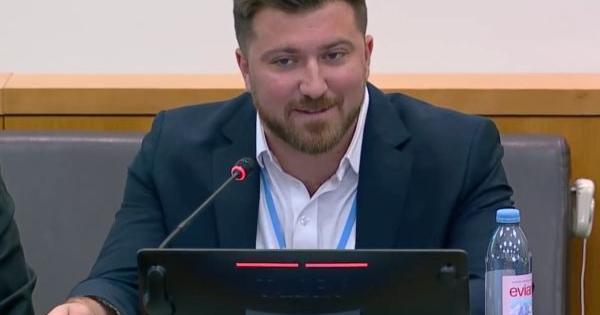

80 Acres Farms Head of Operations Noah Zelkind speaks at United Nations headquarters in New York City on Friday, July 10, 2026. His presentation at a High-Level Political Forum on Sustainable Development side event, “Humanity at the Center,” focused on how vertical farming has moved from concept to large-scale reality. CONTRIBUTED
CONTRIBUTED
Hamilton’s 80 Acres Farms took its vertical farming message to United Nations headquarters this month, presenting how technology can reshape food systems at a global forum on sustainable development.
The company presented at High-Level Political Forum on Sustainable Development side event, “Humanity at the Center,” on July 10 about how vertical farming can advance sustainable food production.
80 Acres Farms Head of Operations Noah Zelkind detailed how vertical farming has moved from concept to large-scale reality, starting out by noting the achievements and shortcomings of modern food systems.
Zelkind said that public health challenges have shifted, with hunger declining but nutrition problems remaining widespread. He said that technology must play a bigger role in driving progress toward healthier outcomes.
To test vertical farming’s potential, 80 Acres Farms planted identical seeds in outdoor farms, greenhouses and vertical farms, Zelkind said. A subsequent nutritional analysis by the University of Auburn showed the vertical farm produce was not only similar, but “actually healthier,” he said.
“There was actually higher nutritional content in the vertical farm produce, and that was when we realized that we didn’t just have an opportunity to do something, but really had a responsibility to try and help create this technology so that it can be delivered all around the world,” Zelkind said.
He said the company began with proof-of-concept trials, scaling rapidly through multiple small farms to refine its systems. After trial and error, it developed efficient, sustainable methods and built in Ohio what Zelkind described as “the world’s first profitable vertical farm at scale.”
From there, the Hamilton-based company expanded nationwide, producing millions of pounds of food annually, he said.
What the company set about to build, Zelkind said, is something it calls “Plantopia”: farms that use 95% less water, no pesticides or GMOs and deliver food three times faster with yields 100 times larger on a smaller footprint.
“We’ve now built the infrastructure that is generating plant data at a quality that has never before existed, and so now we’re able to start to use AI to understand what plants want, so we can continue to grow them more and more efficiently, and the impact is already becoming real,” he said.
He said 80 Acres Farms has saved “literally over 100 million gallons of water” and prevented “hundreds and hundreds and hundreds of thousands of pounds of food waste.”
This month’s trip to the United Nations wasn’t the first time 80 Acres Farms was there. In early February, Zelkind presented at a UN side event in the Economic and Social Council Chamber, “Youth Digital Collaboration for a Sustainable Planet,” sponsored by the Permanent Missions of Korea, Portugal, Senegal and Indonesia, where students shared their own solutions to the UN Sustainable Development Goals.
80 Acres Farms spokesman Jed Portman said the company was there in February to talk about the importance of partnerships between mission-driven organizations, presenting with Hamilton’s JEE Foods, a longtime collaborator.
“Being invited to speak validated that we’ve made a big idea real, and people are paying attention,” Zelkind told Journal-News. “Being invited back told us that we’ve built technology with global impact. That’s always been our goal.”
For now, 80 Acres Farms is “focused on feeding people,” Portman said.
“We’ve scaled up in the past few years, building a network of farms that supplies more than 18,000 retail locations across the U.S,” he said. “It’s all rooted in Hamilton.”