
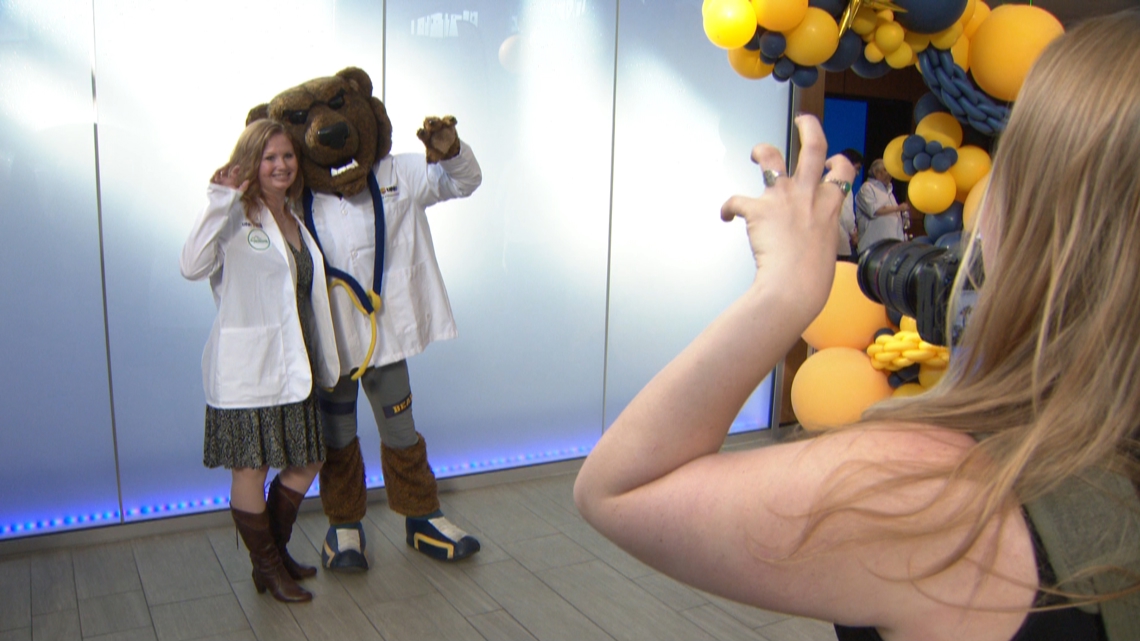
The University of Northern Colorado inaugurated its new College of Osteopathic Medicine with 81 future physicians, aiming to address the state’s physician shortage.
GREELEY, Colo. — Eighty-one aspiring physicians received their white coats on Friday as the University of Northern Colorado (UNC) welcomed the first class of its new College of Osteopathic Medicine, the state’s third medical school, which officials say could help address Colorado’s physician shortage.
Gov. Jared Polis joined UNC President Andy Feinstein, founding Dean Beth Longenecker and community members Friday to celebrate the school’s grand opening.

This story continues below.
Just over half of the incoming students are Colorado residents, according to the governor’s office.
Among the students is Heather Hazen, who said she has wanted to become a doctor since childhood. “I was the one in my family who would take splinters out and do it with surgical precision,” Hazen said.
Hazen said she spent time in and out of foster care as a child and moved to Colorado five years ago from California to be near her brother, of whom she took custody when he was 10. She currently works at Presbyterian/St. Luke’s Medical Center, a hospital in Denver, where she said she regularly treats patients from Greeley.
“Being able to serve a population that has that need and is different than what I have seen in Denver has different needs, I think that’s exciting and what draws me to UNC and what it has to offer me,” Hazen said.
UNC says only 34% of Colorado’s need for physicians is currently being met.
“It just means the sooner I do this, the sooner I’m going to be able to step in and help fill that need,” Hazen said.
The Colorado Department of Public Health and Environment said in a statement that health professional shortages vary by community across the state, with rural, frontier and other underserved areas facing the greatest need.
The department said where medical students train and complete residency strongly influences where they ultimately decide to practice, and that UNC’s new medical school has the potential to help meet the state’s physician workforce needs by recruiting students with ties to Colorado, emphasizing community-based clinical training and partnering with local health care providers.
Hazen said she plans to stay in Colorado after completing her training.
“The kind of physician I want to be, I want to be able to serve my community and be part of the community, and really where I see that happening is here in Colorado,” she said.
The medical school was funded in part through HB24-1231, legislation Polis signed two years ago that invested $247 million across four Colorado higher education institutions, including $128 million specifically for construction of the UNC medical school, according to the governor’s office.
Reflecting on the milestone, Hazen said her younger self would be proud.
“I think I would be in disbelief. I’d be so proud,” she said.