
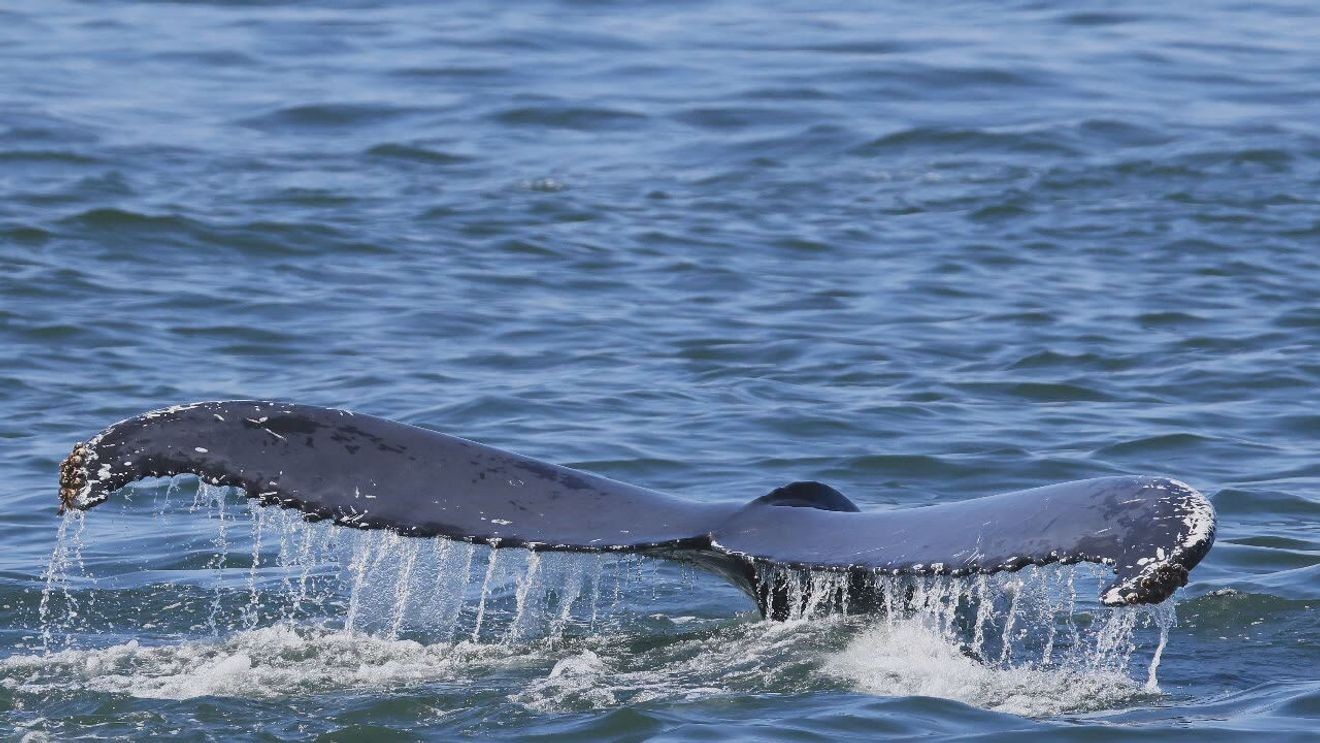
Each year, peak whale watching season around the Puget Sound spans from March to October, but our waters have whales in them 365 days of the year.
How whales are spotted and named
Aboard the Puget Sound Express whale watching tour is a marine biologist, an experienced caption and several other seasoned crew members. That’s why, when you go out on a whale watching tour and actually spot one, part of it is surely luck, but there is also a lot going on behind the scenes.
Captain Brian said when he is cruising, at about 40 miles per hour, he is looking for blows, fins or anything like that to spot a whale from the captain’s cabin. And it happens quickly; one second you might not see a whale, and the next there is a blow. But it is not just scanning with your eyes to find any of the six species the Puget Sound is home to.
On board, the caption has access to an internal logging system. Every time a tour boat, ferry or any of the other Pacific Whale Watch Association (PWWA) members see a whale, they log it. That log includes, where the whale was last seen, what type of whale it is, and the whale’s name or number.
“If we see a ferry coming or a cargo ship, we will call them on the radio and let them know that whales are nearby,” Executive Director of the PWWA, Erin Gless said. “It’s just part of what we do to help keep the whales that we’re watching safe.”
Boats, both members of the PWWA and not, will then put up a special flag, to let others know that there is a whale nearby, as the state has strict distance rules.
“We have some of the most precautionary regulations when it comes to vessels and whales,” Gless said.
But the rules do not stop the ships from knowing exactly which whales they come across each day. On my tour, the first whale we saw was a 7-year-old humpback named Graphite. The tour learned that Graphite goes to Hawaii each winter.
Then, it was a gray whale, unnamed and new to the area, but assigned a number. And finally, Little Patch, another gray whale, number 53, and one of the first to ever be in the Puget Sound. In-fact, we learned that Little Patch has been in our region since 1991. For context, there are about 2,700 gray whales that are assigned a number, but Gless said they believe there are 14,000 to 15,000 out there.
But the tours only look for whales that are not endangered. While we did not see any Orcas (killer whales) that day, there are two types in our waters. The first are Biggs killer whales, and there are about 400 in the region, having had around 150 calves in the last decade. However, southern resident killer whales are endangered.
“There’s only 75, so they are endangered, and our tours do not focus on that type of whale,” Gless said.
Legislative action
So, what can be done to help preserve the whales in our waters, and ensure that the endangered species do not go extinct?
Gless said there are a few things the PWWA keep an eye out for, first it is entanglement response funding, for the teams that respond to whales getting caught in fishing gear, for example. And she said federal grants for those teams has been slashed in recent years.
“They’re basically crowdsourcing the funding to go out and help these whales,” Gless said. “They desperately need funding whether it’s from the federal government, the state government, but they’re really facing a budget crisis.”
The team that is based in our area, Gless said, is responsible for cases in Oregon and California, so when they need to fly out, it leaves no one covering our region for a period of time.
“We really just need more resources up and down the entire coast,” she said. “The whales lives depend on those people.”
In our waters, Gless aid we have more whales than we did a century ago. She credits that largely to the Mammal Protection Act, which went into effect in 1972 to protect marine animals and stop commercial hunting of them. But a new push in congress could undo part of that decades-old law. Here’s why:
Right now, a type of salmon is endangered in our waters, both seals and sea lions eat that type, and southern resident killer whales. The bill in congress aims to restore that fish population by allowing the lethal, controlled killing of pinnipeds. Gless said while restoring the food source for the whales is important, that push could ultimately have an adverse effect.
“And we’re nervous – when there’s talks about possibly resuming hunts for seals and sea lions, how that will affect the Biggs killer whales that we watch,” she said.
That’s because Biggs killer whales eat seals and sea lions as part of their food source.
Overall, Gless said while there are more whales in our waters, the work will continue to make sure it stays that way for decades to come.
“Losing a whale on paper might not seem like a big deal, but losing Graphite, or losing Little Patch, specifically, is something that would be really devastating for us,” she said.