
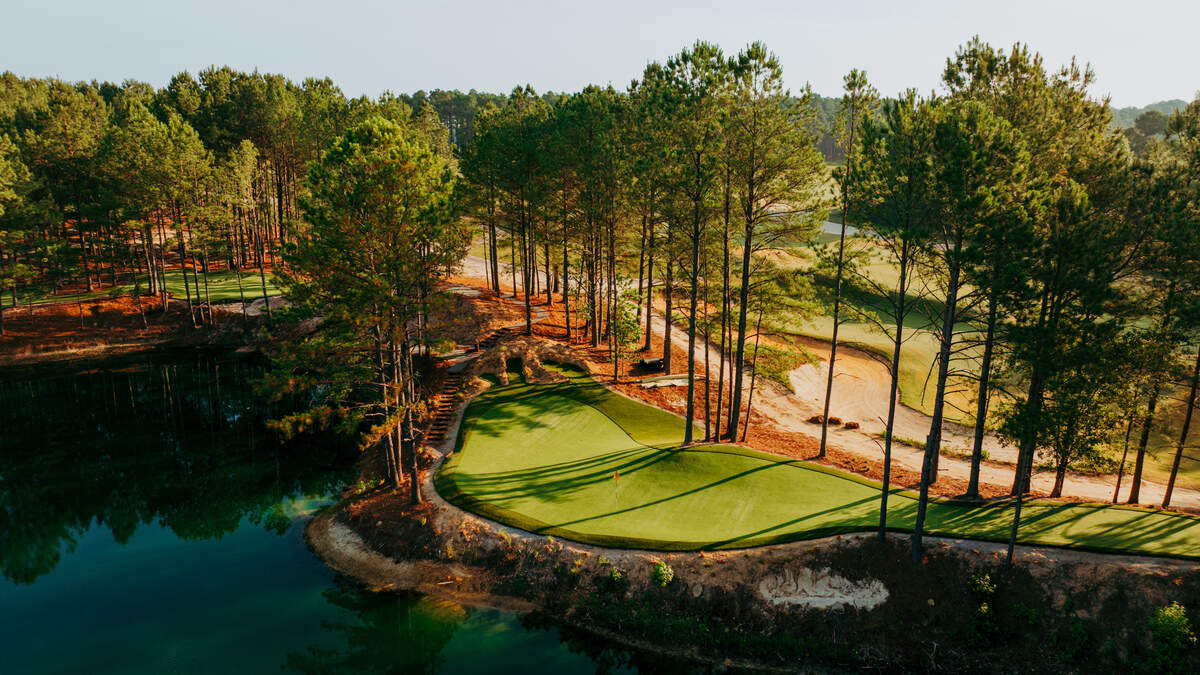
Tobacco Road Golf Club is unconventional, with the Sanford course forcing golfers to navigate around large dunes and dig out of deep bunkers on the site of a former sand quarry.
Proponents of the Mike Strantz design tout its quirks, while critics disparage the entire course as a gimmick.
On Saturday, Aug. 1, Tobacco Road is straying from the norm again as it opens a 12-hole, short course called The Matchbox for public play, just 45 minutes from downtown Raleigh.
Imagined by Justin Carlton and Lee Marshall, and shaped by Mark White — one of the original Tobacco Road constructors — the par-three course will assess golfers’ touch while exposing them to a semi-hidden piece of Tobacco Road’s property.
“It’s kind of like forest bathing to me,” owner Mark Stewart said. “You’re just out in nature, and you got the birds, frogs and everything else. It’s just a great, kind of low-key, low-pressure (course).”
‘One of the coolest walks’
Doubling as a walking trail, Tobacco Road’s latest track requires golfers to place precise shots on 40- to 80-yard holes, several of which force blind approaches. Players will be hitting on synthetic turf, installed to reduce maintenance demands and preserve the tree canopy.
“It’s one of the coolest walks … that you’ll do even if you don’t play golf,” Marshall said.
The Matchbox took inspiration from the main Tobacco Road course, which is ranked the No. 44 greatest U.S. public golf course by Golf Digest. The track gained popularity through its unusual features, gaining a reputation as one of the “most divisive ‘great’ golf courses,” according to LINKS Magazine.
When Tobacco Road first came to life, Stewart trusted the legendary architect Strantz to produce an unconventional design, and he gave similar leeway to the minds behind the short course.
The Matchbox’s ninth hole draws on the mounds from Tobacco Road’s opening shot, which requires golfers to drive their ball between two imposing mounds.
“Mike casts a long shadow over everything we do,” Stewart said. “The success of (his original design) has allowed us to do something else here, so it was only fitting that we take a big nod and a bow and to Mike Strantz for sure.”
Short course uses synthetic turf
Stewart said the short course used synthetic turf because it was the best way to keep most of the trees intact. Plus, he said the material has made tremendous progress in recent years to replicate some of the feel of natural grass.
Marshall said the shapers would have had to clear 50-70% of the trees around The Matchbox if they had wanted to install natural grass, whereas they removed only about 10% while using artificial turf.
Synthetic turf also requires far less maintenance and irrigation than natural grass, as the daily care requires just about an hour to clear off pine straw and other debris with a leaf blower, Marshall said.
Marshall said each hole has multiple tee boxes, with each closer one providing a more difficult shot. While counterintuitive, the tight angles and challenge of holding a ball on the green make the shorter shots more challenging than the back tees.
“You might have 30 different combinations off one shot,” Marshall said, “depending on where the flag’s at. It’s definitely not going to get repetitive.”
Embracing the scenery
Marshall said the course isn’t “hard” because most players can use their highest lofted wedge to get around the entire track. But he suspects it will appeal to golfers who enjoy competing hole by hole.
Adding to The Matchbox’s difficulty, the fifth hole even has a tree growing out of the green, with an option to place the pin directly behind it. The distinctiveness of the feature wasn’t even really planned, the architects said.
“We were just kind of embracing the scenery,” Carlton said. “We’d rather (have) left the tree there than to take it down.”
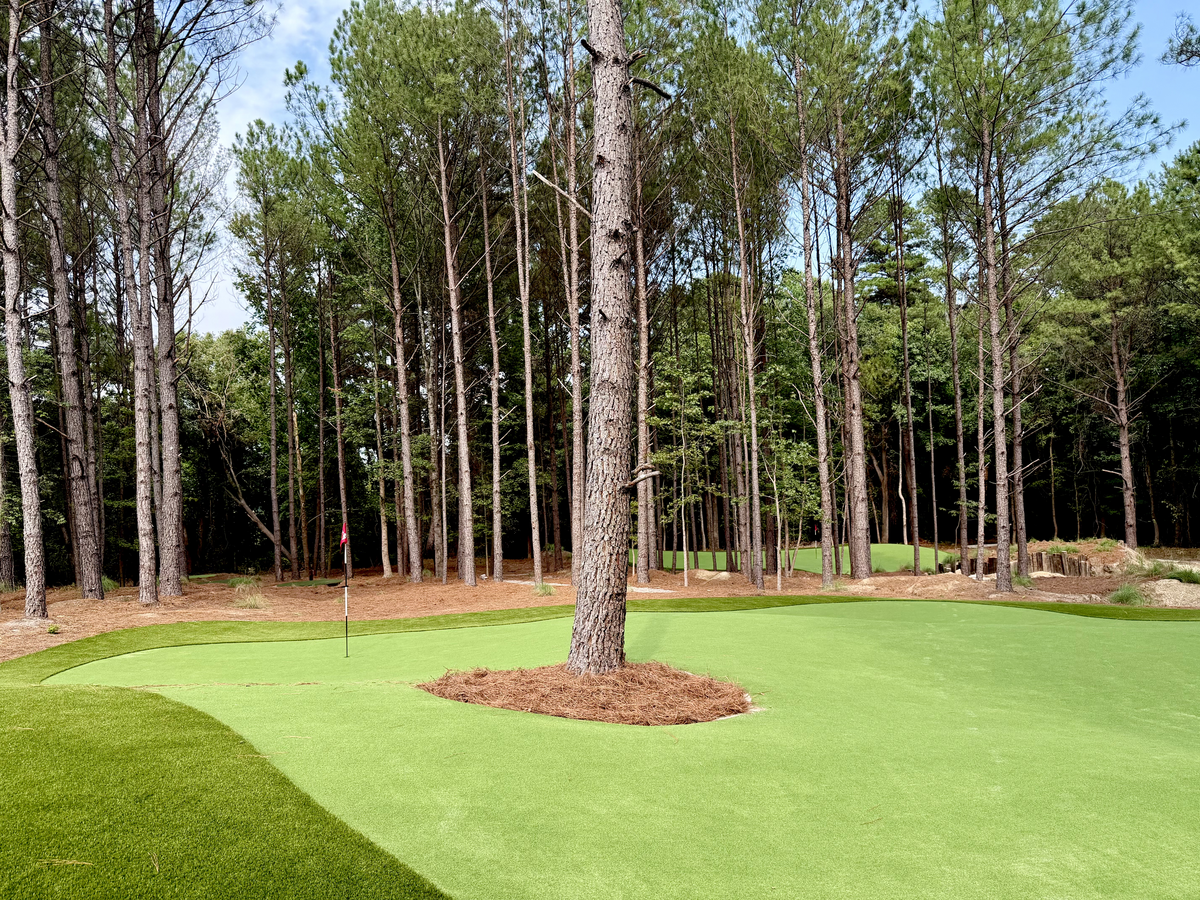 The Matchbox includes holes with trees growing from its greens. Tobacco Road Golf Club. A bonus hole
The Matchbox also has a bonus hole that will allow Tobacco Road golfers to experience the short course during a regular round. Tucked beside the No. 12 and 13 holes of the main course, the short course features a “12.5” hole for golfers to play while waiting on the tee box.
Often, that part of the main course gets backed up, and the architects had extra space to add a hole, so they added the “12.5” hole as another quirk of the short course.
Ultimately, The Matchbox, just like Tobacco Road’s main course, won’t be for everyone. Golf purists, Marshall said, might dislike it. But appealing to traditionalists has never been the main focus of Tobacco Road, and their pitch to everyone is to see it themselves.
Tee times for The Matchbox will open at $75.
“(Tobacco Road) is not even unorthodox,” Marshall said. “It’s a really good design. It’s just something that was deemed as not the traditional golf design 30 years ago, and we tried to emulate that.”
Related Stories from Raleigh News & Observer