
By Chung Li-hua and Jonathan Chin / Staff reporter, with staff writer
The Executive Yuan yesterday approved proposed amendments to the Estate and Gift Tax Act (遺產及贈與稅法) designed to prevent heirs from offloading estate tax on rivals in inheritance battles.
Government officials made the comments at a post-Cabinet meeting news conference in Taipei.
The proposed changes stipulate that beneficiaries of an inheritance must share the tax burden proportionately, backdating to gifts disbursed two years before the decedent’s passing, they said.
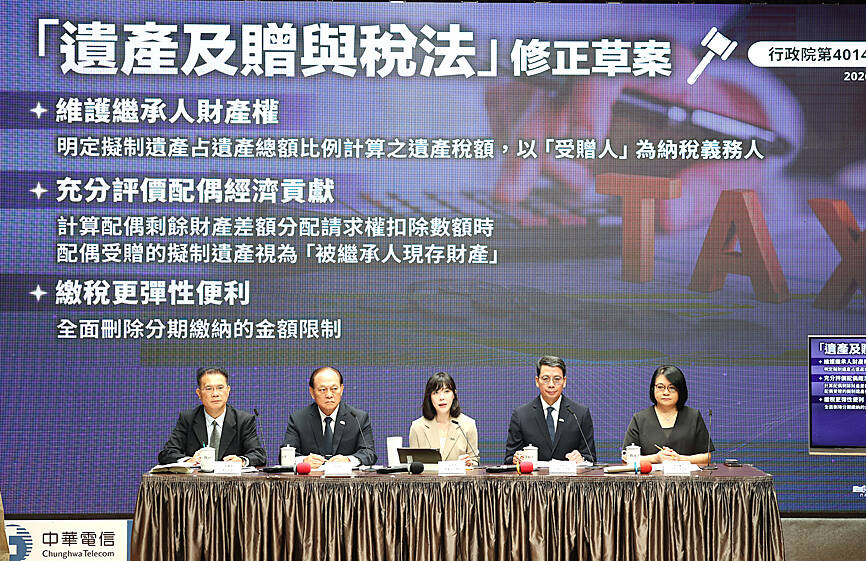
Photo: CNA
The draft amendments were made in compliance with a 2024 Supreme Court ruling on an inheritance dispute, the officials said.
The lawsuit involved the heirs of a man surnamed Chen (陳), who gifted NT$3 billion (US$92.49 million at the current exchange rate) of stock options to his wife and son a year before his death.
The wife and son declined to inherit Chen’s remaining property, enabling them to pass a tax burden of NT$57 million — including those on the stock they already received — to the man’s illegitimate daughter.
The court ruled against Chen’s wife and the son, saying that it was unfair for them to “financially strangulate” the daughter by using wealth that she did not benefit from.
The amendments to Article 6 stipulate that an heir who received a gift from the decedent two years before the latter’s death would be responsible for shouldering the tax burden of that wealth, Cabinet officials said in a news release.
They would change Article 17 to stipulate that the decedent’s gifts to their spouse two years before their death would still be considered the decedent’s property when calculating the spouse’s claim to the surplus, they said.
PricewaterhouseCoopers Taiwan accountant Lee Nan-han (李南漢), who specializes in family business and wealth inheritance, said the proposed amendments signaled an attempt to establish the beneficiary-pays principle in Taiwanese inheritance laws.
The revised law would ensure that beneficiaries of an inheritance shouldered a fair share of the tax burden corresponding with the benefits they received, he said.
The changes do not affect the existing legal framework, which treats gifts made in the last two years of the decedent’s life as part of the inheritance, Lee said.
Ernst and Young Taiwan Family Office coleader Harvey Chang (張?晉) said that under the proposed rules, if a person gives NT$10 million of their NT$40 million fortune to their spouse, who owns NT$25 million, the gift is to be counted as the decedent’s property.
This means the spouse’s claim to tax-free surplus would be NT$12.5 million, or 50 percent of the 15 million nominal difference between the couple’s wealth, he said.
Additional reporting by CNA