
Driving, it only takes 10 minutes to get from the tall conifers on the west side of Carson City to the sagebrush scrubland on the east side. In between stands the downtown core and its urban forest. Life takes many shapes in these different but intersecting ecological zones, making Nevada’s capital a wonderland of vegetation and wildlife.
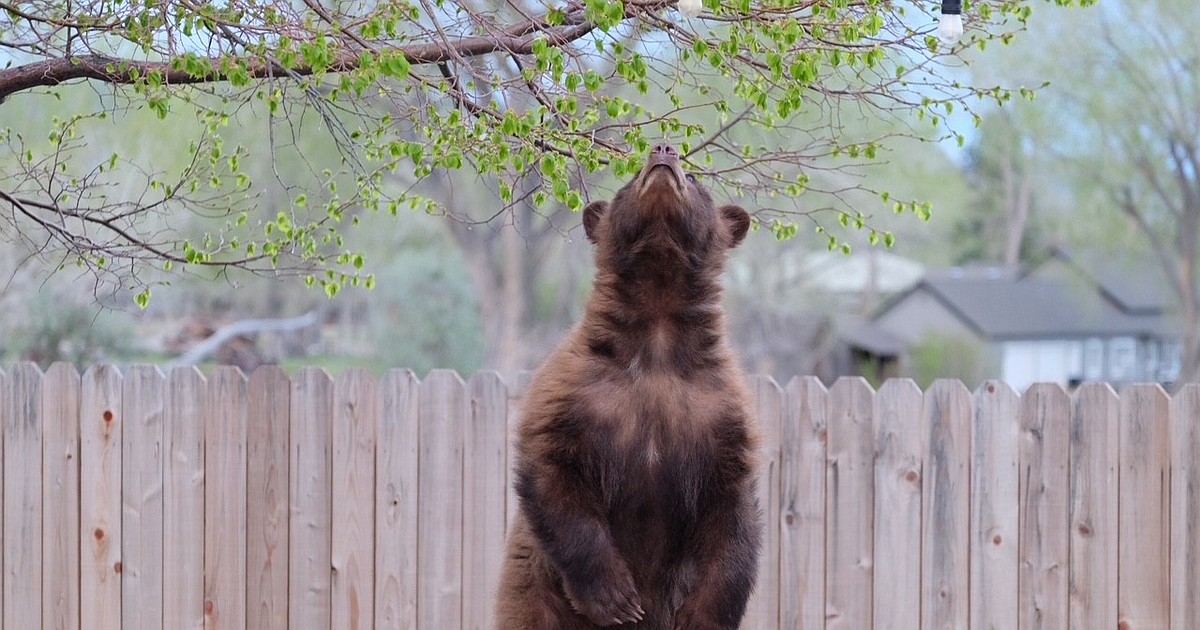
This spring — which went from record highs in March to snow showers in April — Nevada Department of Wildlife Game Biologist Becca Carniello was watching the green-up in the forest of the western slopes. She helps monitor the black bear and mule deer that make Carson City their home along with over 60,000 human beings.
Up Ash Canyon, along the creek that runs through it, she pointed out a game trail, a sunlit path to the water. Just beyond the thicket of alder and willow stood a towering and singed conifer. It appeared to be a Jeffrery pine but, upon further inspection by Carniello, was identified as a ponderosa pine, likely burned in the 2004 Waterfall Fire.
“Prickly ponderosa,” she said, feeling a fallen cone at the base of the tree.
Prickly ponderosa cones contrast with Jeffrey cones, which, she said, leave the impression of a “gentle Jeff.”
At the time, the bears in the foothills were out of hibernation. They were leaving their dens and foraging on new grasses. Later in summer and fall they would move to manzanita berries, huckleberries, rosehips, buffaloberries and pinenuts. Hopefully.
“Eighty-five percent of the diet of black bears is plant matter,” Carniello said of the omnivore species.
There are 600 to 700 blacks bears in the state of the Nevada, she said.
“I’m going to go off a study done back in 2020 that estimated our bear density in the Sierra Nevada at 12.4 bears/38 square miles to guess how many might be along the western and eastern edges of Carson City. I would say there are probably 20 to 30 or so bears that have home ranges that span part of that area,” she said.
Though black bears live permanently in the Carson Range, Pine Nut and Sweetwater Mountains, they wander down into the valleys of Western Nevada in search of food, especially in stressed years of drought or late freezes that disrupt natural food production. Carniello said that calls to NDOW about bears, including many from Carson City, will triple in such years. She pointed out the creeks in western Carson provide corridors straight into town, toward bird feeders, fruit and oak trees and unsecured trash cans.
“They’re weighing the cost and benefit of these things, and they’re trying to be the most efficient,” Carniello said. “We have to take responsibility to make it difficult for them to get our food.”
Bear-resistant trash cans and electric fencing can help, she said.
“I can always help people willing to coexist,” she added.
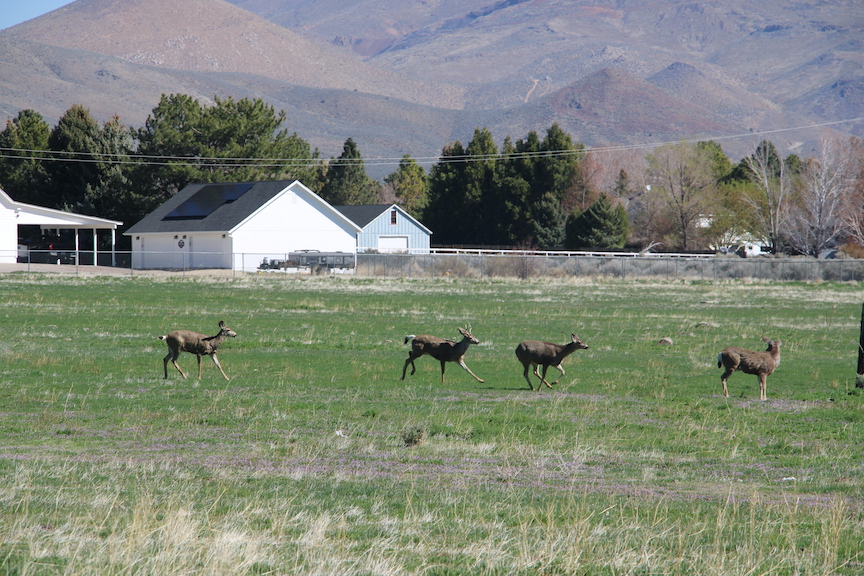
Another creature Carson humans coexist with is the mule deer. According to maps of game management units provided by NDOW, the section of Carson Range that includes western Carson has an estimated population of 1,200 mule deer. For the two units on the eastern side of the city — into Storey, Lyon and Douglas counties — the estimate is around a 1,000 mule deer.
Though some deer winter at lower elevations and head to higher ground in the mountains come summer, “the deer you see in town remain in town because they’re safer from predators.”
“They have everything they need,” Carniello said. “They probably do migrate but probably don’t get too far from town.”
These urban deer can be found in yards and fields on the west side and on the other side of downtown, sometimes blocking traffic on Roop Street. They nibble grass and forbs and woody shrubs and lend themselves to urban legends like the famed late buck called “the King of Carson.” The King is now immortalized in mural form on the back of the community center.
“Honestly, a hungry deer will pretty much eat any type of vegetation,” Carniello said.
 Scott Neuffer
Mule deer in a field adjacent to Ash Canyon Road in west Carson City on March 18, 2026.
Whether bear or deer, the biologist advised keeping wildlife wild. In Carson, this means mountain lions, blue grouse, quail, hawks and eagles, a medley of songbirds and the brook trout in the streams of the west slopes that feed the Carson River, which itself snakes around Prison Hill.
“People also belong in the ecosystem, but that comes with responsibility, and the responsibility is making sure you’re keeping those animals as wild as possible,” Carniello said.
Bob Tonseth, open space maintenance foreman for the city, balances what is wild with what is domestic and cultivated. The Carson City Parks, Recreation and Open Space Department and the Public Works Department share maintenance responsibilities for the city’s urban canopy of over 6,200 trees lining parks and public right of way.
This canopy includes Fremont cottonwoods — a native species — like the Nevada Bicentennial Tree at the corner of West Washington and North Division streets downtown. City officials believe this tree dates to the 19th century. A 1940s photo provided by Public Works shows the tree already reaching impressive stature beside what was then a rail line.
The urban tree inventory also includes transplants like elms, oaks, crabapples, green ash trees and Austrian pines.
Strolling under a canopy of cottonwoods at Mills Park — large trees predating the modern park — Tonseth pointed out neighboring locust trees, maples and a few Scotch pines along the walkways and stream meandering through the greenery. Tonseth is a certified arborist.
“It could be a hundred degrees outside, but walking in here, it’s cool,” he said. “That’s kind of the idea of an urban canopy.”
Urban forests provide shade for humans and fellow creatures and absorb stormwater. They improve property values and enrich one’s mental wellbeing, Tonseth said. For 30 years, the city has been certified with the National Arbor Day Foundation, proving management of its tree inventory.
“The Tree City USA Program recognizes towns and counties across the nation that have implemented successful urban forestry programs,” according to the Nevada Division of Forestry. “Gaining and retaining Tree City USA recognition is an award a community’s citizens and tree workers can take pride in. Equally important is the improved health and longevity of their community’s trees.”
Tonseth, Justin Tiearney — public works operations manager — and others help maintain the city’s century-old cottonwoods. Tonseth oversees the city’s open space trees as well, like the historic grove of elms and cottonwoods at Silver Saddle Ranch in east Carson.
“Trimming, we eliminate hazards,” he said. “We don’t trim the structure. We let them grow naturally.”
The city recently began cataloguing what’s called the cottonwood gallery along the Carson River. The current estimate is for 14,000 to 23,000 cottonwoods within city limits in that area, Tonseth said.
“This includes age ranges from sapling to fully mature trees,” he said, noting their cotton-like, seed-bearing fluff appears in late spring. “I do like the cottonwoods. They’re great at providing habitat. They’re huge, beautiful trees in their own special way.”
From the urban forest to the river fringes, one landmass of Carson City stands out monolithically. Prison Hill looks bleak from the highway, but, according to Carson City Senior Natural Resource Specialist Marenna Lovejoy, the hill is hiding treasures.
“The hillside right now looks brown from this distance. You wouldn’t think there is anything interesting up there,” Lovejoy said on a journey to the west-facing hillside. “But there are lots of beautiful colors in the desert. You just have to know how to find them.”
As yearly precipitation dwindles in the rain shadow of the Sierra, the Prison Hill area, lacking the riparian abundance of the river corridor on its eastern flank, still sees varieties of life quicken, adapt and persist. A cursory inventory would note the clumps of pinyon and juniper as well as shrubs like sage, bitterbrush, desert peach, rabbitbrush, horsebrush and Mormon tea. Squirreltail, needlegrass, Sandberg bluegrass and Great Basin wild rye are some of the bunchgrass species that thrive on the slopes.
On this journey, Lovejoy was too late for monkey flower, which is being studied by state and federal authorities for possible protection, but was not too late for sulphurflower buckwheat, cushion buckwheat, Hooker’s balsamroot and desert paintbrush. Dabs of yellow and red seemed suspended in larger textures of brush. From a stand of rabbitbrush, tiny, elongated bells of rock cress emerged delicate and tremulous. In the Prison Hill saddle just north of Stegosaurus Ridge, lupine revealed itself as purple fire.
Lovejoy pointed out native brushes create their own microclimates. In the individual understories, in the warm season, one can see bunchgrass and wildflowers interwoven.
“The wildflowers occupy different spaces, little niches,” she said. “Native pollinators rely on this diversity of flora.”
As opposed to a monoculture, the unique species in Carson City create a resilient landscape, Lovejoy maintained. A landscape that survives fire and flood, that carries its human and nonhuman inhabitants into the future.
“It’s hard not to be happy when you’re outside looking at this,” she said.