
 Press enter or click to view image in full size
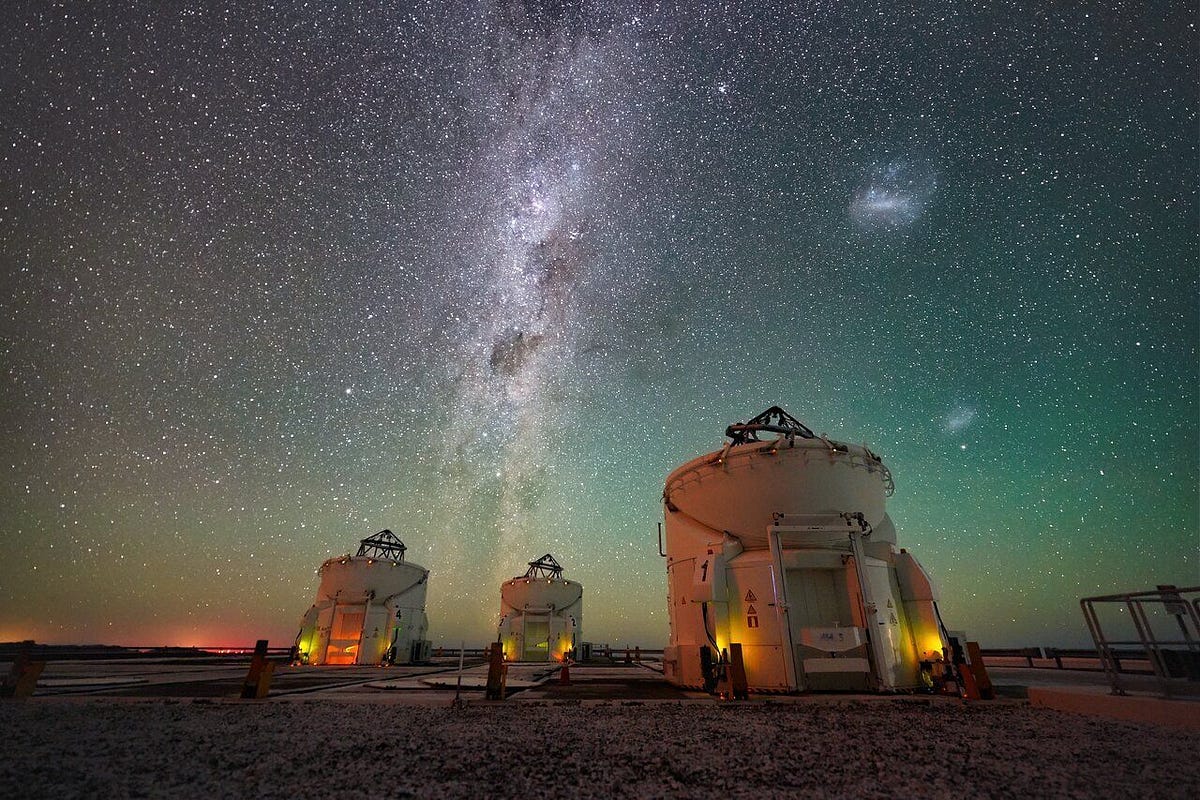
The stunning night sky above three of the Auxiliary Telescopes at ESO’s Paranal Observatory, in Chile’s Atacama Desert, with the band of the Milky Way, as well as the Large and Small Magellanic Clouds, visible to the unaided eye. (Image Credit: ESO/N. Schafer)
We are about to throw dust in the air and claim that we cannot see anyone else. SpaceX Starlink, Amazon Leo, and international rivals plan to deploy tens of thousands of new communication satellites in Low-Earth Orbit in order to achieve global broadband and direct-to-smartphone connectivity.
Furthermore, on July 9, 2026, the U.S. Federal Communications Commission (FCC) granted a license to the California-based startup Reflect Orbital to launch and operate its first demonstration satellite, aiming to provide `sunlight on demand’ by beaming a five-kilometer-wide spot of sunlight down to Earth after dark. The experimental satellite, named Eärendil-1, will feature an 18-meter by 18-meter deployable mylar film reflector. Reflect Orbital wishes to ultimately deploy a constellation of 50,000 or more mirror-craft by 2035.
Over centuries, astronomers constructed observatories on mountain peaks, as far as possible from light pollution in cities. Now, space entrepreneurs have plans to put lights in our night sky in the form of satellites that reflect sunlight towards every place on Earth. The orbital time of a Low Earth Orbit is between 90 and 127 minutes, with each light source completing 11 to 16 trips around the Earth every day.
The best way to avoid a sense of cosmic modesty is to ignore the rest of the Universe and insist that Elon Musk is the most accomplished space entrepreneur who emerged over the past 13.8 billion years after the Big Bang.
I do not think so. As I said publicly here in the U.S. senate on June 25, 2026, I am willing to bet with Elon about this proposition.
However, settling the bet requires the ability to observe the cosmos. It would be ironic if the only reason for believing that we are at the top of the cosmic food chain would be that we cannot see the technological products of any other civilization due to our own light pollution. I urge Elon to settle the bet before it will be too late because of the light pollution that his company generates.
This state-of-affairs compounds the resistance of the mainstream astronomy community to invest billions of dollars also in the search for technological signatures and not only in the search for bio-chemical signatures of primitive lifeforms like microbes. It is easy to maintain our ignorance about other technological civilizations by avoiding the search that may enlighten it.
The main threat to cosmic modesty in the search for extraterrestrial life stems from false negative, not false positives. A false negative is a test result that is wrongly interpreted as if something is not present when it is actually there, based on a risk-averse mindset. This was highlighted in a recent Nature paper here in the context of the search for primitive forms of extraterrestrial life on Mars and beyond. For example, methane is regarded as a primary bio-signature in exoplanet atmospheres, but is completely neglected as a potential bio-signature in the case of anomalous interstellar objects, like 3I/ATLAS — as discussed in the recent paper I posted here. The same bias exists in the search for technological signatures of extraterrestrial civilizations.
If our night sky on Earth becomes too polluted with light, we will have no choice but to construct new astronomical observatories on the Moon, Mars or outer space, in order to find out whether we are not alone. Without searching, we will obviously not find anything.
Half a millennium ago, the Italian philosopher and astronomer Giordano Bruno proposed that the universe is infinite, has no center, and is populated by countless stars that are actually distant suns orbited by their own planets like the Earth which could host life. He insisted that all planets and stars are made of the same fundamental physical elements, at a time when the popular view was the Earth holds a special place at the center of the cosmos. Because his cosmological ideas undermined the Church’s spiritual narrative — which placed humanity at the center of God’s creation — they were viewed as deeply dangerous. In 1600, after an eight-year trial by the Roman Inquisition, Bruno refused to recant his philosophies and was burned at the stake in Rome.
Gladly, I am at no risk of being burned at the stake for extending cosmic modesty to the technological realm. The sky is not classified. In fact, the U.S. government asked me recently to chair a UAP Science Advisory Council (https://uapsac.com/) to study Unidentified Anomalous Phenomena which are routinely recorded by the Pentagon, FBI and the intelligence agencies. In addition, the U.S. National Academies of Sciences, Engineering and Medicine, created a new “hero” webpage here which summarizes my scientific legacy as follows:
“Dr. Avi Loeb is a theoretical physicist and astrophysicist whose work traverses the vast and often controversial frontiers of the cosmos… he has dedicated much of his career to one of humanity’s most fundamental questions: Are we alone in the universe? His pursuit of this mystery has led him to challenge conventional wisdom, embrace the unknown, and navigate the skepticism of his peers with unwavering conviction … Loeb is no stranger to controversy, his bold hypotheses about interstellar objects and the potential for extraterrestrial artifacts have often been met with resistance, yet he remains steadfast in his commitment to following the data wherever it leads. His work spans black holes, exoplanets, and cosmic origins, but he is perhaps best known for his leadership in the study of ‘Oumuamua, the first known interstellar object detected in our solar system. Unlike many of his colleagues, he has openly entertained the possibility that ‘Oumuamua may not be a purely natural phenomenon but rather a potential artifact of extraterrestrial intelligence. This willingness to challenge orthodoxy, to propose ideas that unsettle and provoke, has made him both a respected and polarizing figure in modern astrophysics. Loeb’s approach is one of boundless curiosity and intellectual rigor. He does not seek controversy for its own sake but rather believes that science should be an open-ended inquiry, one that embraces uncertainty rather than dismissing it. His willingness to cross disciplinary boundaries, to engage in dialogues that others might avoid, is what makes his work so compelling. Thoughtful, fearless, and always questioning, Loeb continues to push the boundaries of what we know, urging us to consider that the universe may be far stranger, and more wondrous, than we have ever imagined.”
Giordano Bruno would have been glad to read this narrative.
ABOUT THE AUTHOR
Press enter or click to view image in full size(Image Credit: Lotem Loeb, May 22, 2026)
Avi Loeb is chair of the UAP Science Advisory Council to the White House, Pentagon, FBI and intelligence agencies, director of the Galileo Project, founding director of Harvard University’s — Black Hole Initiative, former director of the Institute for Theory and Computation at the Harvard-Smithsonian Center for Astrophysics, and the former chair of the astronomy department at Harvard University (2011–2020). He is a former member of the President’s Council of Advisors on Science and Technology and a former chair of the Board on Physics and Astronomy of the National Academies. He is the bestselling author of “Extraterrestrial: The First Sign of Intelligent Life Beyond Earth” and a co-author of the textbook “Life in the Cosmos”, both published in 2021. The paperback edition of his new book, titled “Interstellar”, was published in August 2024.
Professional website:
https://lweb.cfa.harvard.edu/~loeb/
Social media:
https://avi-loeb.medium.com/
https://www.youtube.com/@ProfessorAviLoeb
https://open.spotify.com/show/1zhndXkvSY2b8FdjspFpCd
https://x.com/ProfAviLoeb