
When Canada announced earlier this year that it would allow a token number of Chinese-made electric vehicles into the country, the gesture didn’t seem so much about climate action as a sop to ease Chinese tariffs on Canadian canola.
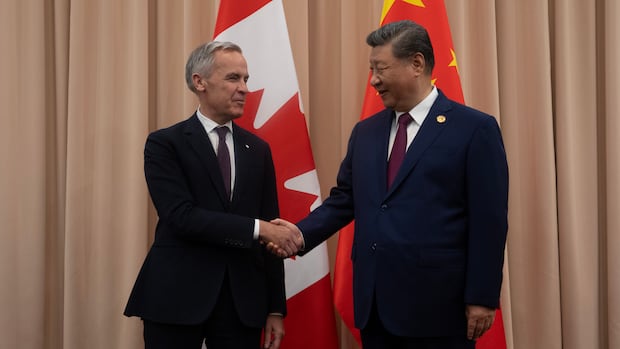
Now, it very much appears like the opening gambit in a deeper engagement with China on clean energy. Following up on Prime Minister Mark Carney’s momentous meeting with Chinese Premier Xi Jinping in January, Industry Minister Melanie Joly was in Beijing last month to discuss the feasibility of Canadian-Chinese EV ventures.
Meanwhile, the Canada China Business Council is organizing a cleantech mission to China in Beijing in November.
While Carney has gone to great lengths recently to placate Canada’s fossil fuel industry — most notably by promising a new pipeline to the B.C. coast — some experts suggest a new relationship with China could provide an efficient way to get back on track with the clean energy transition that much of the rest of the world is already undertaking.
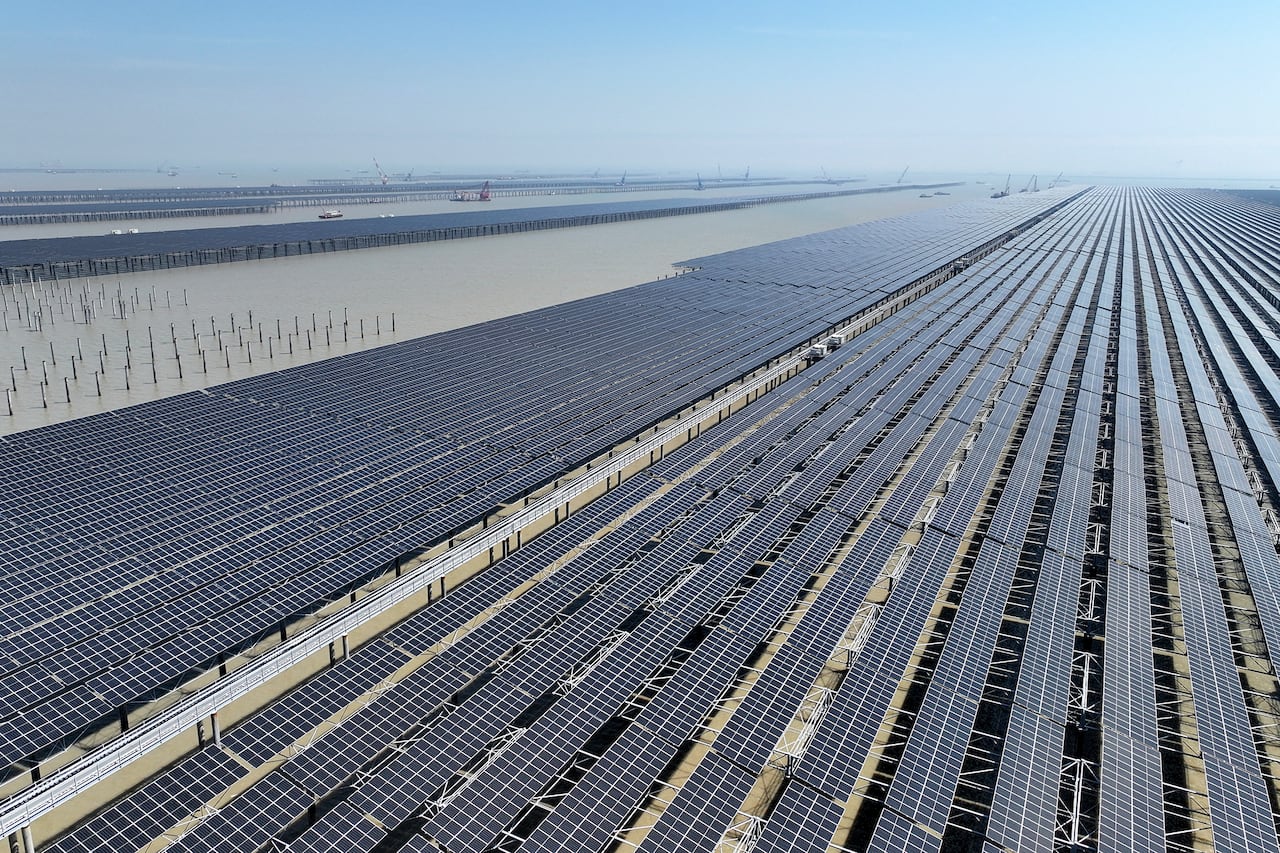 An aerial view of the solar panels at the CNNC Tianwan tidal flat photovoltaic power plant in Lianyungang, in China’s eastern Jiangsu province, on April 19. (CN-STR/AFP via Getty Images)
“China is a global clean energy superpower,” said Rachel Doran, executive director of Clean Energy Canada, and given the size and sophistication of China’s sector, Canada “can’t have a strategy around the transition that the world is experiencing without having a strategy around China.”
“I think that has motivated some of what the [Canadian] government has tried to do.”
China as clean-energy partner
China’s dominance in clean-energy manufacturing is staggering. It’s responsible for around 80 per cent of the world’s solar panels, 60 per cent of wind turbines and 75 per cent of electric vehicles and their batteries, according to the Climate Action Tracker.
Earlier this year, Chinese manufacturer BYD surpassed Tesla in global EV sales for the first time. To illustrate its rapid rise, China went from exporting 28,000 EVs in June 2019 to exporting 316,000 in June 2026.
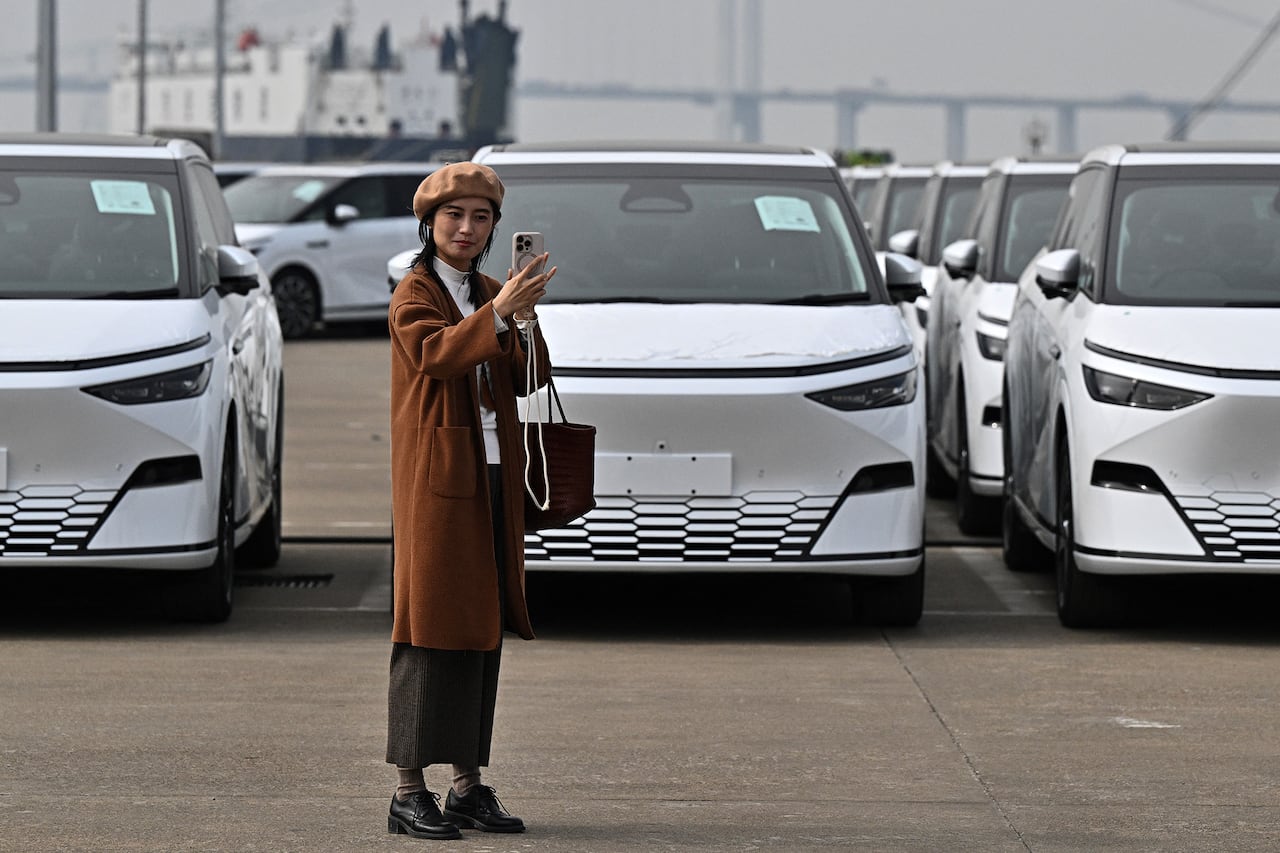 A woman takes a selfie in front of electric vehicles by Chinese EV manufacturer XPeng in the Port of Guangzhou, China’s southern Guangdong province, in February 2025. (Pedro Pardo/AFP via Getty Images)
China is already partnering with other countries on clean energy — such as a venture with the United Arab Emirates to build out wind and solar projects in the Global South.
According to Bijan Ahmadi, executive director and COO of the Canada China Business Council, there are opportunities for Canada to align “with China’s manufacturing scale, capital and ability to deploy technology rapidly.”
“The new Canada-China strategic partnership provides a foundation for this work, specifically identifying clean technology, batteries, solar, wind and energy storage as areas for potential cooperation,” he said.
Back in 2024, Canada imposed 100 per cent tariffs on Chinese EVs, largely at the behest of our southern neighbours. Moe Kabbara, CEO of Canadian non-profit Transition Accelerator, thinks Carney’s decision to allow a small number of Chinese EVs into the country was a smart overture.
“It recognizes that Chinese electric vehicles are going to be unavoidable for the North American market,” he said. “That should be applauded, in terms of departing from the U.S. on a very important trade policy issue.”
WATCH | Trump says he doesn’t need Canada as Carney heads to China: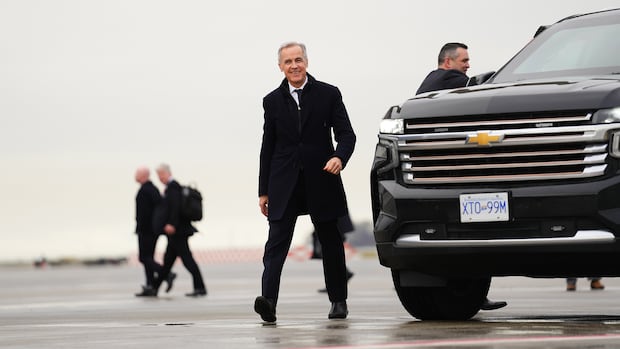
Trump says he doesn’t need Canada as Carney heads to China
As Prime Minister Mark Carney heads to China to ease trade tensions, President Donald Trump reiterated that the U.S. doesn’t need Canadian goods or the CUSMA. Carney was also urged by Ontario’s premier to not back down on tariffs for Chinese EVs.
Kabbara says it also telegraphed a strategy: Rather than letting Chinese EVs overwhelm the domestic market, the Canadian government is trying to find ways to make it mutually beneficial.
During her recent trip to Beijing, Joly met with five Chinese EV companies in order to negotiate a way to trade selective exposure to the Canadian market for information-sharing and potential joint ventures that, as Kabbara put it, would “allow us to have an auto sector that continues to be vibrant and prosperous.”
He said it’s a bit of a role reversal.
“The Chinese used the model of joint ventures and tech transfers and IP transfers in the ’80s and the ’90s to build up their auto sector with Western automakers. Now, the script has flipped, where we have an opportunity to actually learn from the Chinese when it comes to electric vehicles, battery technology and supply chain optimization.”
Critical access to minerals
Canada’s oil and gas is obviously of interest to a country with a population as large as China’s, but Kabbara said that’s a short-term advantage.
In the longer term, he said, one thing that makes Canada an attractive partner to China is our critical minerals — such as copper, cobalt and chromium — which would allow us to establish domestic supply chains for clean-energy manufacturing of solar panels, wind turbines and batteries.
Industry players say the attitude between the two countries has changed. Wenran Jiang, president of the Canada-China Energy and Environment Forum, wrote last month in the Edmonton Journal that “after years of frosty diplomacy and mutual suspicion, Canada and China are quietly getting back to business in the energy sector, and they are doing it with a refreshing sense of pragmatism.”
WATCH | China looking for trading partners that ‘don’t use energy for coercion,’ Hodgson says: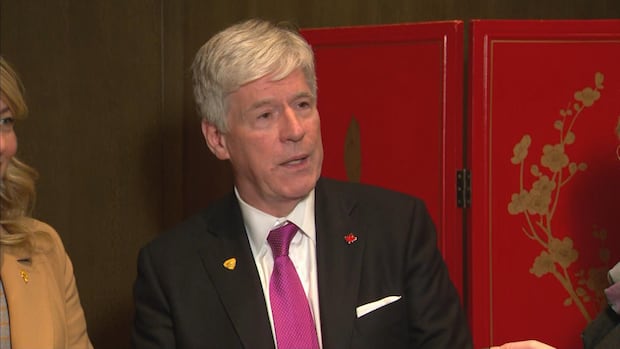
China is looking for trading partners that ‘don’t use energy for coercion,’ Hodgson says
Minister of Energy and Natural Resources Tim Hodgson, who took questions alongside Industry Minister Mélanie Joly during a trip to China, did not offer specific details when asked about potential energy exports to China but said officials there are looking for reliable partners and ‘want more of what we’ve got.’
For one thing, China offers Canadian cleantech businesses a market that’s already much further along in the energy transition. In May, China’s Envision Energy and Canada’s Cape Breton China Corp. announced a strategic partnership with plans to develop a hybrid wind and battery storage project in Sydney, N.S.
Ahmadi from the Canada China Business Council says the cleantech mission to Beijing this fall was developed “in response to growing interest from Canadian clean-technology companies seeking opportunities in China’s low-carbon economy.”
The aim of the mission is “to help Canadian companies assess the market, meet potential customers, investors and partners, build commercial relationships and diversify their export opportunities.”
Addressing security, privacy risks
While China is leading the way on this transition, relying on the country too heavily for Canada’s clean energy solutions is not without its challenges — or critics.
The EV imports, minimal as they may be, have spooked many auto industry insiders over fears that cheap Chinese EVs would undercut the domestic market already threatened by Trump’s ongoing tariff strategy.
Detractors also raise worries about security and privacy issues in integrating Chinese-made technology. Kabbara says one possible advantage of better relations with China is that “we can have Canadian software on Chinese hardware that mitigates security concerns.”
Doran from Clean Energy Canada says doing more business with China — which remains a one-party state — is an acknowledgement that geopolitical calculations have changed.
“There are signals that Canada is trying to think of China in new ways,” said Doran. “We know we want to move towards electrification, and we need to think about doing that cost-effectively and in a smart way as a smaller country, so that we can benefit from the world as it is, and not the world as we want it to be.”