

Chris Russo is the NBA’s chief real estate and facilities officer, a title found in no other major American sports league’s central office.
The NBA doesn’t own any arenas. But Russo’s five-person group serves two roles for a league focused on its competition’s venues: maintaining 100-plus pages of arena standards and consulting on team arena projects.
The arena standards are less of a restriction and more of “a framework, an approach,” said architect David Manica, who has known Russo since the early 2000s. “They’ll talk about their work as a partnership, as opposed to a policed role.”
During Russo’s 30 years at the NBA, he forged strong relationships with commissioners David Stern and Adam Silver and created the venues group, which is analogous to the NBA’s other sports business-famous creation, Team Marketing and Business Operations, better known as TMBO. Both act as a central resource for NBA teams while growing and strengthening the league’s business.
There has never been a more important time for the group Russo leads. In addition to 30 domestic arenas — and potentially two more, soon, once the NBA expands to 32 teams — buildings are being designed and built in Oklahoma City, Philadelphia, San Antonio and Dallas. Many more teams are renovating. And the creation of NBA Europe will bring more venues — most of which already exist and will need to be brought up to NBA standards — into the league’s fold.
The vetting effort will be led by the humble, calm, soft-spoken Russo, who’s worked on more than 200 NBA arena projects of varying sizes.
“For a league to have a venues group that can advise and focus on the design and construction of venues,” he said, “I don’t think there’s any more critical time to have that available.”
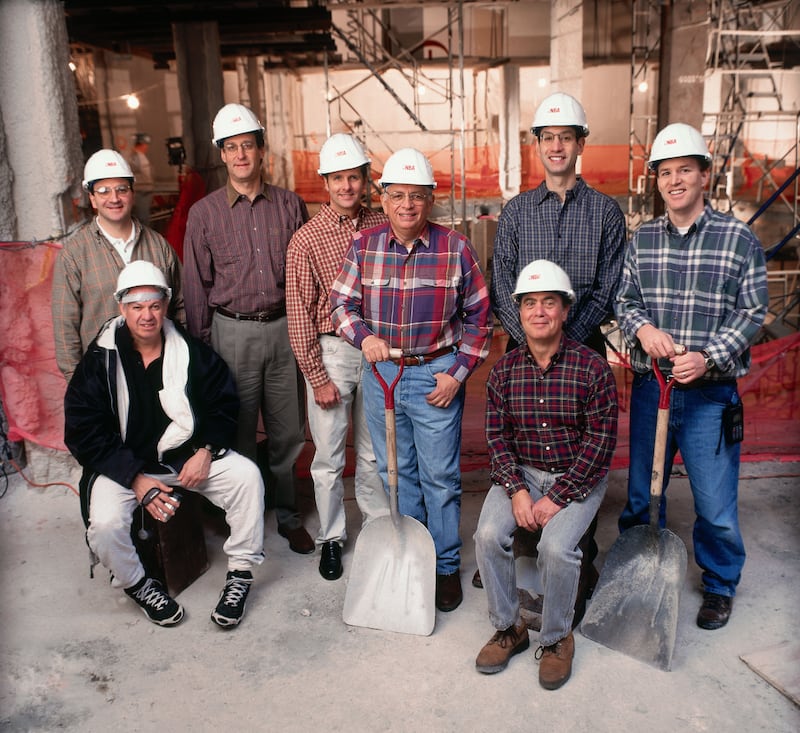 Chris Russo was central to the 1998 completion of the first NBA Store. Standing (left to right): Russo, Russ Granik, Rick Welts, David Stern, Adam Silver and Bill Daugherty. Seated: Richard Altuna (the store designer) and Harvey Benjamin. Chris Russo, NBA Focus shift
The arc of Russo’s three decades with the NBA mirrors the league’s changing thinking about its — and its teams’ — real estate.
Russo’s professional career began at Turner Construction in the early 1990s, and he later created the Department of Design and Construction for New York City’s then-mayor, Rudy Giuliani.
In that role, Russo met NBA Commissioner David Stern, who later hired him in 1996 to help design, build and open the first NBA Store in Manhattan. The league then teamed with Hard Rock on an NBA restaurant that fizzled out but was indicative of its pioneering inclination to project its brand through real estate.
“I always said for years, David was a closet real estate and construction nerd,” said Russo.
Russo’s focus shifted toward the NBA’s arenas around the turn of the century. The venue standards were created during a wave of new NBA arena openings, establishing the league’s basic requirements for every aspect of buildings where NBA games were played, ensuring competitive balance and the highest-quality TV and in-person product. The arena standards were later applied in China as part of the NBA’s attempts to expand into the country in conjunction with the 2008 Summer Olympics.
By the 2010s, the NBA venues group had subtly shifted toward a more consultative role.
Teams sought its help studying contracts, evaluating vendors and even sitting in on architects’ final presentations. Recently, Russo and Erin Schnieders — who joined as Russo’s right-hand woman in 2008 and is now the league’s senior vice president and head of venues — vetted the LA Clippers’ ambitious Intuit Dome plans, including the first-of-its-kind Halo Board. Once convinced, Russo and Schnieders advocated for it inside the league office.
“People are starting to see and realize the value of our group,” Schnieders said, “and I think Chris had a lot to do with that.”
Spurring development
In Year 30 at the NBA, Russo sits seamlessly between the league’s business and the venue development world.
“He’s just a guy that speaks the language they speak over at 645 5th Ave., which is high-level global brand strategy,” said venue development expert David Carlock, who worked with Russo in China. “But he also knows how to get his hands dirty and knows how the development process works.”
Russo’s even keel is valuable during venue project roller coasters and has made him a reliable sounding board for Schnieders. After nearly 20 years together, she can alternately speak to him as her boss, mentor or friend.
“That somebody can be all three of those is a difficult thing to comprehend, and to be,” Schnieders said.
The group’s responsibilities continue to expand. It oversees 18 global NBA offices and convenes regular note-swapping meetings for arena GMs. While their work happens behind the scenes, Russo and company are centrally involved in examining the arena proposals of groups bidding for North American expansion teams and NBA Europe franchises.
It seems likely that NBA Europe will place more importance on a franchise’s market than the state of its arena. That means many of the arenas that will be used already exist and will need upgrading to NBA standards.
“In the long run, you’ll see that both the expansion of the game and the elevation of that level of experience is going to spur some development in particular markets,” Russo said, without saying the word “Europe.” “Some will be harder than others to get that development done. But we’re very optimistic about it.”
3 questions with Chris Russo
Favorite non-NBA venue
Co-op Live in Manchester, England. “The execution of what they did there — integrating premium spaces and the thought process they put into everything an artist would need — was pretty impressive.”
Favorite NBA venue
The next one.
Influences?
Russo’s dad was a gym teacher for four decades, but good with his hands and taught Russo how to build or fix things. One grandfather was an airplane mechanic, while the other went into facilities management after a long NYPD career.
In his teenage years, Russo pushed brooms around New York City construction sites, “just fascinated by how buildings were built,” he said.