
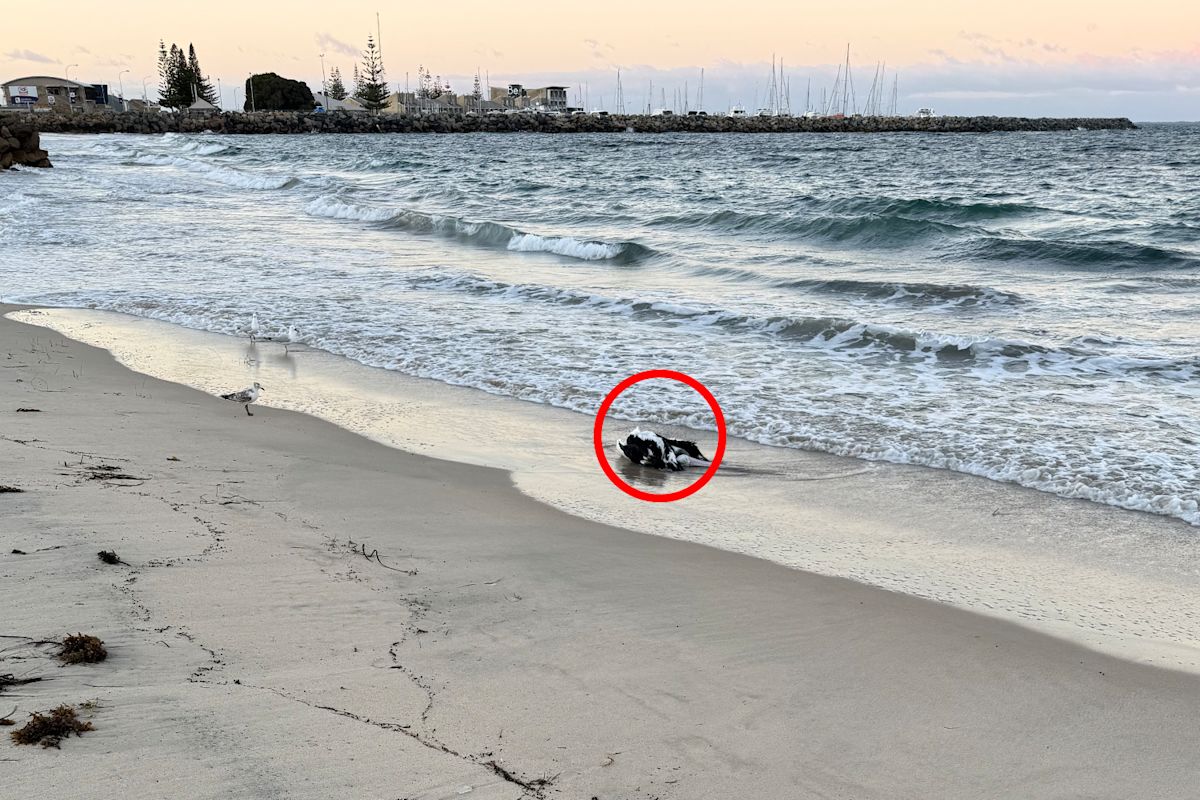
A dog walker’s stroll along a quiet Australian beach this week took an ominous turn after he spotted a dark mass on the shoreline.
At first, David Parker thought he’d spotted “someone’s old coat” being pummelled by the waves at Bathers Beach in Fremantle.
“I only realised what it was as I got closer,” he told Yahoo News.
Lying on the sand was the broken body of a dead pelican.
“It was confronting… I’ve never seen a dead one before,” he said.
Ordinarily, it would have been a sad find, but the confirmation that H5 bird flu has arrived in Australia added a sinister tone.
Do you have a story about bird flu? Contact newsroomau@yahoonews.com

The pelican was reported to the government’s disease hotline.
(David Parker)Why concern around a dead pelican is heightened
To date, the virus hasn’t been detected in Australian pelicans, but overnight, the federal government released its risk assessment list and revealed it poses a “very high” risk to the species.
Overseas, the disease has been catastrophic for pelicans, with around 40 per cent dying in Peru alone.
In Australia, the virus has resulted in mass die-offs of greater crested terns, and it’s also spread to seagulls.
The pelican in Fremantle was confirmed to have been reported to authorities for testing via the 24-hour Emergency Animal Disease Hotline on 1800 675 888.
Disease with similar symptoms to bird flu
For now, what killed the pelican remains unknown. But there have been several mortalities elsewhere in the state from botulism, a soil-borne illness caused by a bacterium that’s been more prevalent than usual due to unseasonably hot weather.
Distinguishing between the two illnesses can be challenging, as both can cause similar neurological symptoms in birds, including an inability to stand and difficulty holding their heads up.

It’s the first time David Parker has seen a dead pelican.
(David Parker)Public helping to detect bird flu
Sources indicate that the pelican has been tested and removed from the beach, but the Department of Primary Industries and Regional Development (DPIRD) will not comment on suspected cases.
RELATED:
In a statement, it said reports from the public are helping it respond to the virus threat.
“It is important to include the exact location and detailed observations — if you are unaware if it has previously been reported, please make a report,” a spokesperson said.
“These reports are triaged by DPIRD based on the risk of H5 bird flu and are prioritised for further investigation or testing.”
You can also follow us on Facebook, Instagram, TikTok, X and YouTube.