
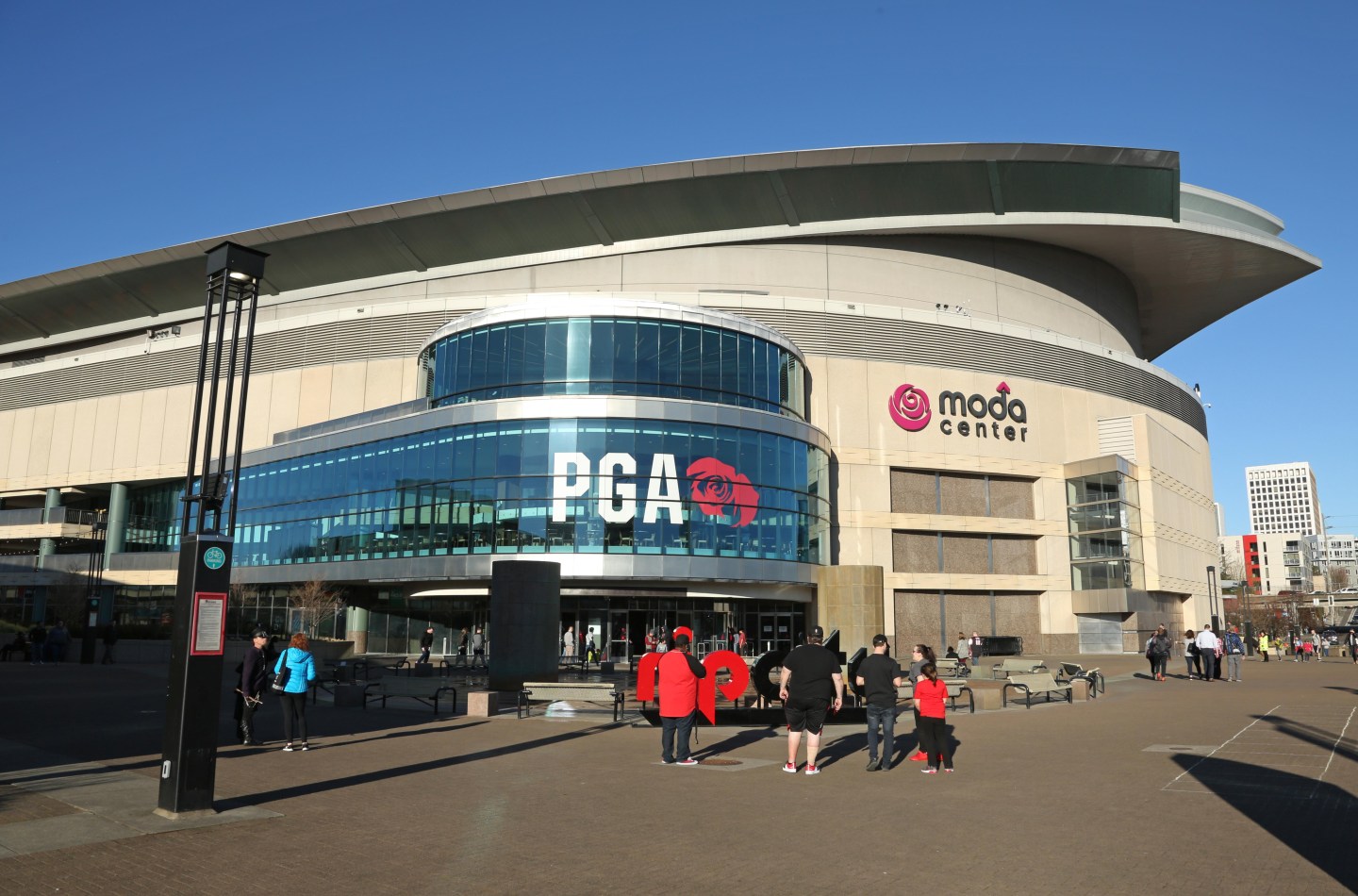
For anyone who holds to the belief that sports fans are mindless boosters who want their elected officials to keep their beloved team owners (or just beloved team’s owners) happy no matter what the cost, I present you with Blazer’s Edge, the SB Nation fan site for the Portland Trail Blazers. Site editor Dave Deckard yesterday did something that the rest of the local media hasn’t yet: He assigned a reader/contributor who goes by the handle BlazerTag (possibly Ryan Whitledge, who used to host a podcast by that name) to investigate whether the Blazers leaving town would really result in an economic and fiscal catastrophe for Portland, with the city left with “a skeleton building, unused and rotting.” And the answer is: If the experience of other cities is to be believed, Portland would be just fine.
The former NHL home of the Arizona Coyotes has been without its anchor tenant since 2022; they’ve moved onto the greener pastures of Salt Lake City. To see how bad the finances got in the immediate aftermath, let’s hear from Glendale City Manager Kevin Phelps.
“The venue (Desert Diamond Arena) smashed its all-time record for revenue after the (Coyotes’) departure,” Phelps said. “The next year, they beat that number by almost $10 million.”
Glendale, you may recall, had an especially horrific lease with the Coyotes, under which the city had to pay the team to play there. Portland, meanwhile, has an especially horrific lease with the Blazers, under which team owner Tom Dundon doesn’t pay any rent or share any arena revenues.
At the peak of their popularity, the Warriors left Oracle Arena in Oakland for a new facility in San Francisco: the Chase Center. So what happened to Oracle (now called Oakland Arena) when the Warriors left? It had its best fiscal year ever and reduced its operating deficit by 97% between 2019 to 2023.
The Bay Area doesn’t have a ton of arenas — it’s basically the Warriors’ new arena in San Francisco and their old one in Oakland (not counting San Jose, the South Bay is really a different market [EDIT: or maybe one market but a really sprawly one or 1.5 markets or something, see comments if this is important to you]) — so getting the Warriors out of the way has been a blessing in disguise for the Oakland arena. Nobody ever talks much about San Francisco as an NHL expansion or relocation market despite its huge population, and this is likely one of the reasons. (The last attempt going extremely poorly would be another.)
KeyArena turned a bigger profit than it ever did with the Sonics. It happened the same way it did in Glendale and Oakland when their anchor tenants left: by freeing up the stadium revenue the sports teams were hoarding for themselves.
It goes on like that, but you get the idea. This is, in fact, a common theme in arena finances: Having an anchor tenant for 40 nights a year is nice, but not so nice when they’re not paying rent and are taking away dates that could be used on concerts that would. It’s still not especially likely that Dundon moves the Blazers, but it does seem that he needs Portland more than Portland needs him.
BlazerTag then summed up with a couple of paragraphs that reflect a position I’ve heard over the years from lots of sports fans who are all too aware they’re also taxpayers:
I’m aware of the sorrow that awaits if no Moda deal is struck. I understand the emotional stakes, but I won’t let them blind me to the cold, hard financial truth.
“Moda Center will crumble without the Blazers” is Stockholm syndrome reasoning from a fanbase being held hostage by ownership. It’s misinformation that I will not suffer.
Blazer’s Edge also did some tea-leaf reading recently of the recently revealed internal Blazers emails in which team lawyer Zandria Conyers suggested just not answering city questions publicly, because “I don’t think our public answers will be well-received.” Deckard noted that while the pissiness was not great, “it was not the kind of nonchalant dismissal one would expect if the organization had already checked out of the process,” which is very true. “The good news: the Blazers do appear to be seeking public funding for the arena for real, which means moving doesn’t seem to be their first option,” concluded Deckard, and while that’s probably stretching the meaning of “good news,” it does argue against the conspiracy theory that Dundon bought the team just to move it, which is better than nothing.