
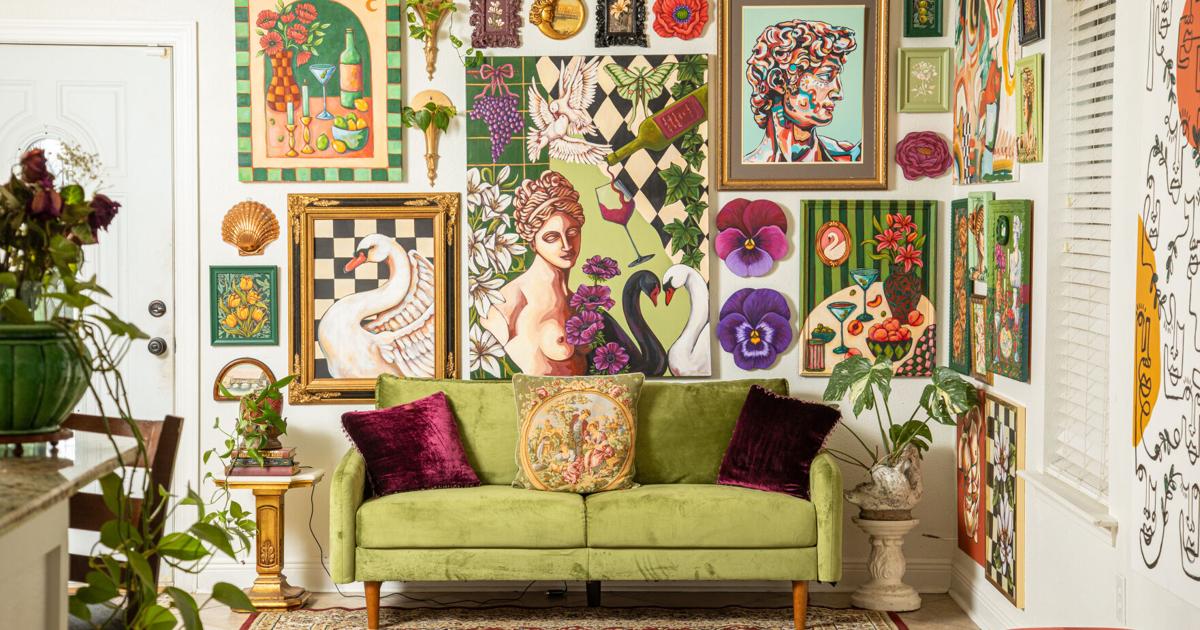
If you’re looking to make a decorative statement, a wall loaded with frames and art pieces can be quite striking. After all, a plain wall is a blank canvas, so why stop at hanging a singular piece?
Gallery walls have surged in popularity over the past few years in all areas of the home, but they are especially common in living rooms and along staircases.
Local artist Morgan Gray is a gallery wall maven, creating not only beautiful art pieces but a stellar way to display them. A maximalist, Gray gravitates toward layered color palettes, florals, celestial themes, Greek and Roman-inspired art, swans and vintage motifs. Dark and light academia, as well as bohemian accents, manifest throughout her work.
Originally from Berwick, Gray moved to New Orleans in 2017 after graduating with a Bachelor of Fine Arts degree from LSU. As a self-employed artist, sharing her creations online has garnered her quite the following, nearing 130,000 followers on Instagram, @morganpaintsstuff.
Gray exhibits a lot of her own work on her walls, constantly rearranging as pieces sell.
“When I have a new collection, I will sometimes redo an entire gallery wall to show off my new work and be able to photograph it so that my customers can visualize my work in their homes,” she said.

Incorporate a variety of frame styles and sizes when designing a gallery wall. This adds visual interest.
KAT KIMBALL
At its core, a gallery wall is a cluster of frames, artwork and/or decorative objects hung together. These arrangements can vary in size, from a small vignette above a credenza to a large installation over a couch.
A gallery wall usually contains an assortment of horizontal and vertical frames. However, there is always a sense of balance. You do not want the display to feel overwhelming or cluttered. This does not mean there needs to be exact symmetry, as mixing and matching is highly encouraged. Rather, focus on combining pieces that complement one another or tell a story.
Keep in mind that gallery walls can vary in different areas of the home. For example, a display in a home office may include family photos and school degrees, while one in a kitchen may feature mounted plates or even a vintage cast-iron skillet.
In Gray’s studio, she displays a lot of her own art for inspiration and to use as references.
“I also have some of my older works hanging, so my studio is a collection of all of my phases of artwork from college to now,” she said.
Where to begin
Gray recommends choosing a color palette and having a “certain vibe in mind.” In the spot where you plan to conquer a gallery wall, think about what colors and furniture items already exist in the space. Are there varying hues or objects you can pull inspiration from? This can help create cohesion as you continue into the arranging process.
Morgan Gray’s living room gallery wall features shades of blues and oranges.
KAT KIMBALL
Gray’s two main gallery walls are pleasing to the eye as they both follow a color scheme. The one above her green couch has shades of rich greens and plums, while the other sits above a pale blue couch and is warmer, including various orange hues, which is complemented by flanking fringe-trimmed and stained glass lamps.
Next, gather pieces you may want to use. Don’t be afraid to round up more than you may need, as you can play around with the layout and narrow things down. Large-scale items can be pinpointed first, as it’s easier to fill in the gaps with smaller items.
“I will usually have a larger piece that serves as the focal point and map out the other pieces around it,” Gray said. “Sometimes I lay out the pieces on the floor beforehand, but I always end up moving pieces around until my brain decides everything looks good.”
In terms of must-have materials, Gray recommends using a variety of frame styles and sizes. “I never want anything to look too uniform,” she said.
Gray gravitates toward using tacks because she tends to move things around so often, but nails are necessary for heavier items. A few other things to have on hand include a leveler and a ladder for hard-to-reach places.
Don’t forget to personalize
Growing up thrifting with her mom, Gray frequently incorporates secondhand frames and fabrics into her artwork. Throughout her home’s gallery walls, she has mixed these pieces with preowned trinkets and treasures.
She’s drawn to one-of-a-kind items that can’t be found at typical home decor stores. “I love the idea of giving items a second chance at life and transforming things that would usually be overlooked or thrown away into something new and exciting,” she said.
Mountable planters, candelabras and antique plates are a few examples of thrifted items you could integrate throughout your display. “I also have sentimental items like art from my travels or photos of friends and family,” Gray said.
Don’t be afraid to use something unexpected. For example, a retro wooden racket could be a playful, yet polished, supplemental piece for a tennis player. Mardi Gras krewe members could frame doubloons from their parade. Audiophiles could display their favorite vinyl records.
Due to her frequent thrifting and antiquing trips, Gray will add or replace items if she finds new objects she wants to show off. You can get creative, as repositioning items is always possible. You can also switch things up depending on the time of year. Mirrors, clocks and sconces are easy additions that are ready to mount.