
Some stories find you when you’re not looking for them.
Our trip to Vancouver had come together at the last minute — no itinerary, no plan, just a quiet decision to visit my brother and his wife and surrender my schedule entirely to them. They brought us to Grouse Mountain on a clear sunny morning, and we followed without expectation. I had my camera in my bag, open to whatever the day held. I did not know that by the time we descended, something in me would be changed.
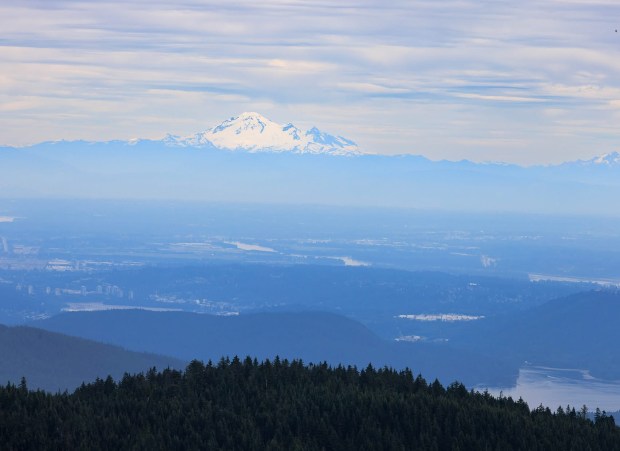 The views from Grouse Mountain in Vancouver. (Photo by Jay Tamang)
The trail rises steeply from the base of the mountain, cutting through a cathedral of old-growth trees so tall they seemed to hold up the sky. For two hours we climbed — my family and I — breathing in the cool, resin-scented air, pausing to notice a few wildflowers scattered along the path like quiet punctuation.
The forest had a presence to it, the kind that slows your thoughts without effort. Wind moved through the canopy above us in long, soft waves, and the sound it made — a low, unhurried whisper threading through hundreds of years of living wood — was unlike anything I have heard in a city or a room. I have photographed wild places for more than two decades.
At the summit of Grouse Mountain, the world opened. Mount Baker floated above the horizon, white and immovable, and the valley of Vancouver stretched below in a soft haze of green and silver. We stood at the edge for a long time, not photographing — just receiving. Then I asked visitors if they saw any grizzly bears along the trail. Someone said, “You should go see Coola and Grinder.”
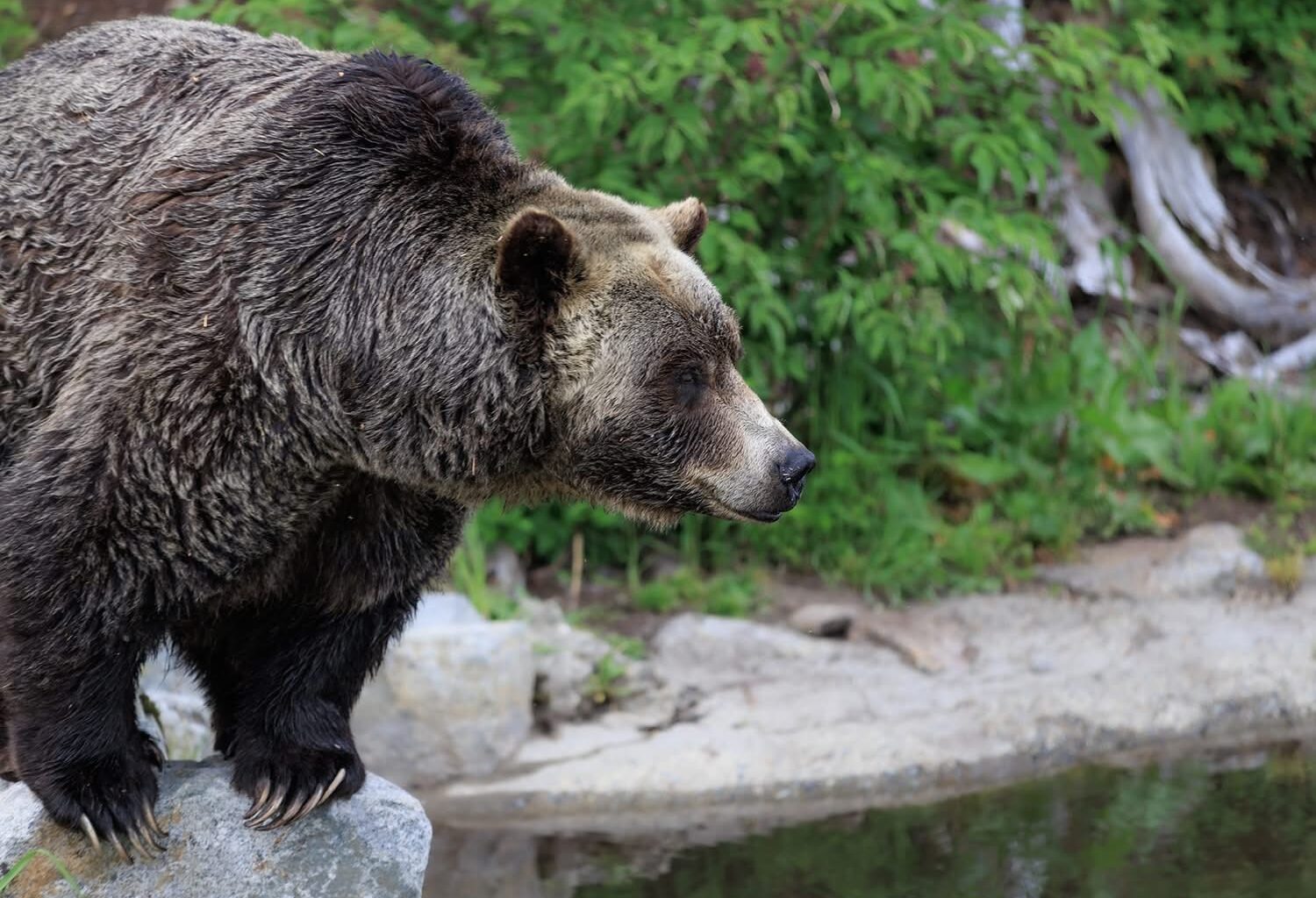
I do not photograph captive animals — not in zoos, not in sanctuaries and not behind fences. My lens belongs to the wild — to the unrehearsed, the untamed, the free. It’s a line I’ve held for years without question. Coola and Grinder, rescued as orphaned cubs, grew up on a 5-acre natural mountain habitat, serving as ambassadors for wildlife conservation and educating millions of visitors.
A staff member told us their stories. Coola was a cub walking through the wilderness with his mother and two siblings — a small family belonging entirely to the world they were born into. They were doing what families do: moving together, living together and trusting the land and each other.
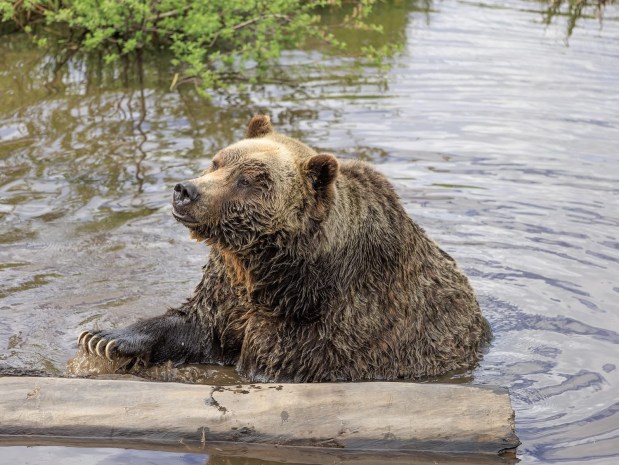 Marin resident Jay Tamang recently photographed grizzly bears in Vancouver. (Photo by Jay Tamang)
His mother and other siblings were hit and killed by a truck. All of them together in a single, senseless moment — and Coola alone remained. Just a cub. No mother and no siblings. No map for survival. The Grouse Mountain team found him and gave him a home on the summit where strangers now climb a mountain to stand before him and, if they are paying attention, feel the full weight of what he has carried ever since. I raised my camera, not because of his size or his beauty — though both are extraordinary — but because of his story.
(Grinder, also an orphaned cub, had been rescued a few weeks earlier in 2001 from Invermere, British Columbia. He died in late July. He was euthanized after he developed a spinal condition that was rapidly paralyzing the back end of his body.)
Some things deserve to be witnessed. Because bearing witness is its own form of love. How do you survive losing everything in a single moment? I do not know. But Coola and Grinder lived every day on this mountain, serving as quiet ambassadors for a wild world that is more fragile than we allow ourselves to believe. They don’t ask for sympathy. They simply exist fully and without apology, offering their presence as a kind of teaching moment to anyone willing to receive it. I thought about my own mother and what it means to move through the world feeling held — and what it would mean to suddenly not be. I thought about the truck driver, who may not have seen them in time, or may have been moving too fast, or simply forgot that roads sometimes cut through living places and not merely through scenery. I thought about all the families — human and animal alike — that have been broken by a moment of inattention. And I thought about how rarely we slow down long enough to consider any of this until something forces us to.
Coola and Grinder did not choose to become a symbol. They did not choose any of this. But here they are, survivors of the unsurvivable, living proof that life continues even when it has been cracked open, carrying their loss with a dignity that shames our carelessness and quietly calls us to something better.
I’m a photographer. I have spent my life learning to see — really see — what most people pass without noticing. And what I saw on that mountain was not just grizzly bears. I saw a mirror. I saw every wild thing we have displaced without thought. Every family we have fractured with our speed and our noise and our refusal to believe that the natural world has stakes as real as our own. I saw the cost of forgetting that we are guests here — that the forests and the mountains and the creatures that inhabit them were not made for our entertainment, but are living their own complete and sacred lives, deserving of our care. So I am asking everyone — gently, but with urgency — to carry something from this story into your daily life.
Slow down when you drive through wild country. Look up from your phone when you walk through a forest. Remember that the silence between the trees is not empty — it is full of lives you cannot see. Give back, in whatever way you can, to the natural world that gives us everything.
Their story is real. Their loss is real. And the reminder they offer — to love and protect our natural world — is one I hope travels far beyond that mountain summit.
Jay Tamang’s photographs of California and beyond — from ancient forests to towering mountains to misty coastlines — can be seen at the Corte Madera Library from Oct. 25 through Dec. 3. A reception will be held from 2 to 4 p.m. Oct. 25.