
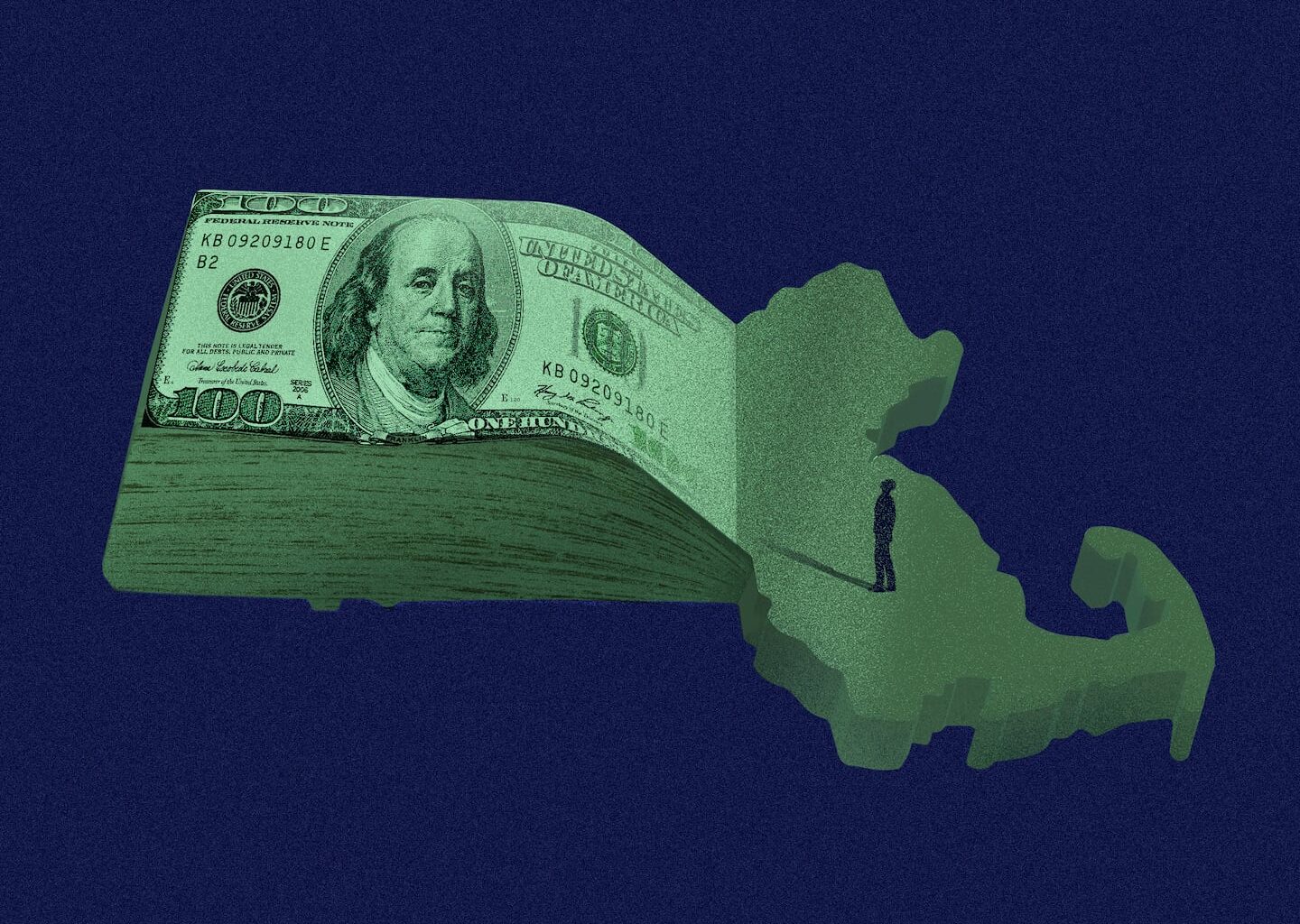
And again, the results show a staggering wealth gap.
The new report, released Wednesday, found Latino families in Massachusetts have a median net wealth of just $1,200; Black families have only slightly more, at $7,800.
White families, on the other hand, have a median net wealth of $549,200, while Asian American, Native Hawaiian, and Pacific Islander families are at $305,000.
It also highlighted the power of homeownership in a part of the country where extraordinarily high real estate prices are making the dream of home buying increasingly unattainable, especially among the state’s Black and Latino population.
Get Starting Point
A guide through the most important stories of the morning, delivered Monday through Friday.
Those racial and ethnic disparities reflect centuries of discrimination in societal norms, financial practices, and public policy that have restricted the accumulation of wealth in Black and Latino households, research shows. Even in Massachusetts, where the overall median net worth is $374,000, deep structural inequities persist.
“It’s the proverbial tale of two economies,” said Jim Rooney, president of the Greater Boston Chamber of Commerce.
The new Boston Fed study is based on a 2025 survey of more than 5,000 Massachusetts residents, thought to be the first statewide effort to provide a comprehensive picture of families’ financial situations by examining assets and debts in a single dataset. Wealth is critical for families dealing with unexpected expenses and trying to invest for the future, according to the report, and this data can help the region “move toward an economy in which everyone has a chance to participate and contribute.”
The researchers determined net wealth by examining people’s debt compared to their liquid assets such as savings accounts, mutual funds, and cash, as well as the equity people have in their homes and cars.
Along with revealing stark racial wealth gaps, the new report highlights factors associated with high net wealth, including living in a rural area, owning a home, and having a graduate degree.
City-dwelling families have $110,000 in median net wealth, for example, compared with rural families with $465,000. This, in part, is because of the higher number of renters in cities.
Overall, wealth is growing for people across the country, but it’s growing much faster for people who had wealth in previous generations. Nationwide, according to the 2022 Federal Reserve’s Survey of Consumer Finances, median wealth was roughly $45,000 for Black families, $62,000 for Latinos, $285,000 for white people, and $536,000 for Asians.
“Wealth begets wealth,” said Andre Perry, senior fellow at the Brookings Institution. “And the historic denial of wealth to groups comes out in the wash of current data, not to mention present-day discrimination as well. If your grandfather owned a home, it’s much more likely that you would have a nest egg to pass on to children.”
Samuel Gomes Rodrigues Jr.’s parents own their home in Brockton, and the 29-year-old Northeastern University security guard is living with them because he can’t afford a place of his own. His take-home pay is $800 a week, but it doesn’t cover his expenses, including high health care costs and student loan debt. He even rations his medication to make it last longer.
Black and Latino residents have long been blamed for their own financial situations, he said: “You constantly hear that the plight of people of color is because of people of color.”
Homeownership is perhaps the single greatest driving force behind the wide racial wealth gaps in the state.
Some 70 percent of white households here own their homes, according to census data, compared with 39 percent of Black households and 32 percent of Latino households.
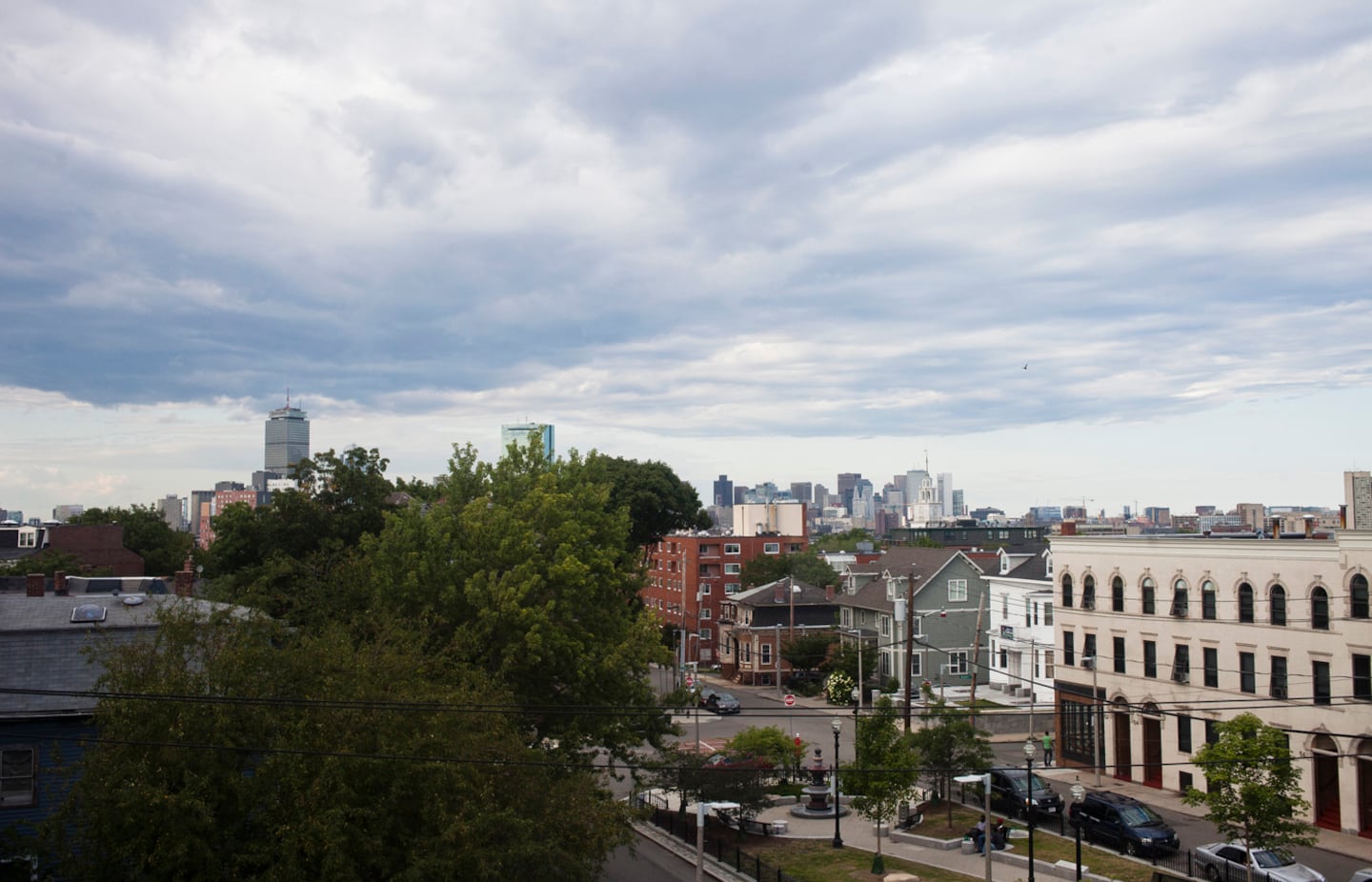 The Boston skyline is seen from the top floor of the historic Alvah Kittredge house built in 1836 in Roxbury, on Aug. 9, 2014.Zack Wittman for The Boston Globe
Those disparities, said Tom Callahan, executive director of the Partnership for Financial Equity, trace back decades to racist lending policies like redlining, the practice by which banks refused to issue home loans in neighborhoods with large minority populations, and racial covenants that prevented homes from being purchased by nonwhite families.
“Now you have many white families who got into homeownership decades ago and are sitting on a million-dollar house that they purchased for a tenth of that price,” said Callahan. “And if you weren’t part of that wave — as many Black and Hispanic households were not — you’re relegated to being a renter, and there’s no home equity to gain from being a long-term renter.”
Indeed, roughly 40 percent of renters in Massachusetts held zero or negative net wealth, according to the study, compared with just 1 percent of homeowning families.
James Jennings, an emeritus professor of urban planning at Tufts University, said closing the racial wealth gap cannot simply be defined by raising homeownership rates. That’s important, he said, but policies like redlining also had broader effects, such as creating economically segregated neighborhoods across the state.
“Have we solved the racial wealth gap if the Black homeownership rate reaches 65 percent?” Jennings said. “I think it is far more layered than that. Solving the racial wealth gap means boosting community wealth in other ways, too, like improving the quality of education, and the quality of jobs and health care.”
More immediately, Boston Fed data show more than a third of families in Massachusetts don’t have enough money on hand to cover a $400 emergency expense. Among Black and Latino families, two-thirds can’t afford that unexpected cost.
Even Black families’ overall median net worth of $7,800 isn’t enough to start a business or get a college degree without going into debilitating debt, said Nicole Obi, president of the Black Economic Council of Massachusetts, which started in response to the 2015 Fed wealth study.
Nearly a third of Black families have zero or negative wealth, which means they can’t even afford a simple car repair.
“We’re not positioning these populations for success,” Obi said. “That will ultimately bode very poorly for the Commonwealth of Massachusetts.”
The immense gap between Latino and white wealth is disconcerting, said Betty Francisco, chief executive of Boston Impact Initiative, a nonprofit impact investment fund. And it’s not just an issue in Massachusetts. Latino wealth as a share of national wealth shrank by over 20 percent from 2016 to 2025, according to an analysis of Federal Reserve data by Americans for Tax Fairness.
Latino families are disproportionately working class and have been hit hard by the rising cost of living and stagnant wages, said Pablo Willis, director of Latino Outreach at AFT. Many Latinos are single parents, and a number of them face language and financial literacy challenges, added Belinda Román, an economics professor at St. Mary’s University in San Antonio. Immigration status is also a barrier, particularly under the Trump administration, as are reductions in social safety nets.
“Those programs gave people support in a way that allowed them to participate in the economy more fully, and now they can’t,” Roman said.
Last year, the financial well-being of most adults held steady, but declined for Black adults, who were more likely to experience layoffs, according to the Economic Policy Institute. The biggest decline among Black people was for those who are college-educated.
President Trump’s signature economic legislation, passed last summer, could also widen the wealth gap, according to a Boston Foundation report. The bill cut Medicaid, SNAP, and Pell Grants, which will further undermine struggling families’ incomes by forcing them to pay more for health care, food, and education. At the same time, the report states, the law’s tax benefits are a boon to wealthy families.
But with more attention being paid to people’s economic struggles, there’s hope that wealth disparities will come under more scrutiny.
Conversations about affordability and the struggle of the middle class to make ends meet — “impacting people who we deem have made it in society” — have opened the door to addressing structural barriers to building wealth, said Perry, of the Brookings Institution.
The data from the Boston Fed also helps.
The report reveals wide socioeconomic disparities within ethnic groups, including Asian Americans, Native Hawaiians, and Pacific Islanders, for instance, whose net wealth was $14,200 at the 25th percentile — meaning a quarter of this population has net wealth at or below this amount.
“Oftentimes we have to kind of swim against the dominant misconception of the model minority — that most Asians are highly educated and have a lot of wealth,” said Angie Liou, executive director of the Asian Community Development Corporation, which serves families in Greater Boston.
Addressing the structural barriers that contribute to these wealth gaps takes commitments from the federal government, she said. Think back to the stimulus checks during the pandemic: They went out quickly and helped alleviate poverty during a global crisis when millions of people were out of work.
“We’re taught that you have to rely on yourself and your family to save for everything,” she said. “It’s not unimaginable that the country can come up with sweeping solutions that can get at a lot of these structural problems.”
This story was produced by the Globe’s Money, Power, Inequality team, which covers the racial wealth gap in Greater Boston. You can sign up for the newsletter here.
Katie Johnston can be reached at katie.johnston@globe.com. Follow her @ktkjohnston. Andrew Brinker can be reached at andrew.brinker@globe.com. Follow him @andrewnbrinker. Mara Kardas-Nelson can be reached at mara.kardas-nelson@globe.com.