
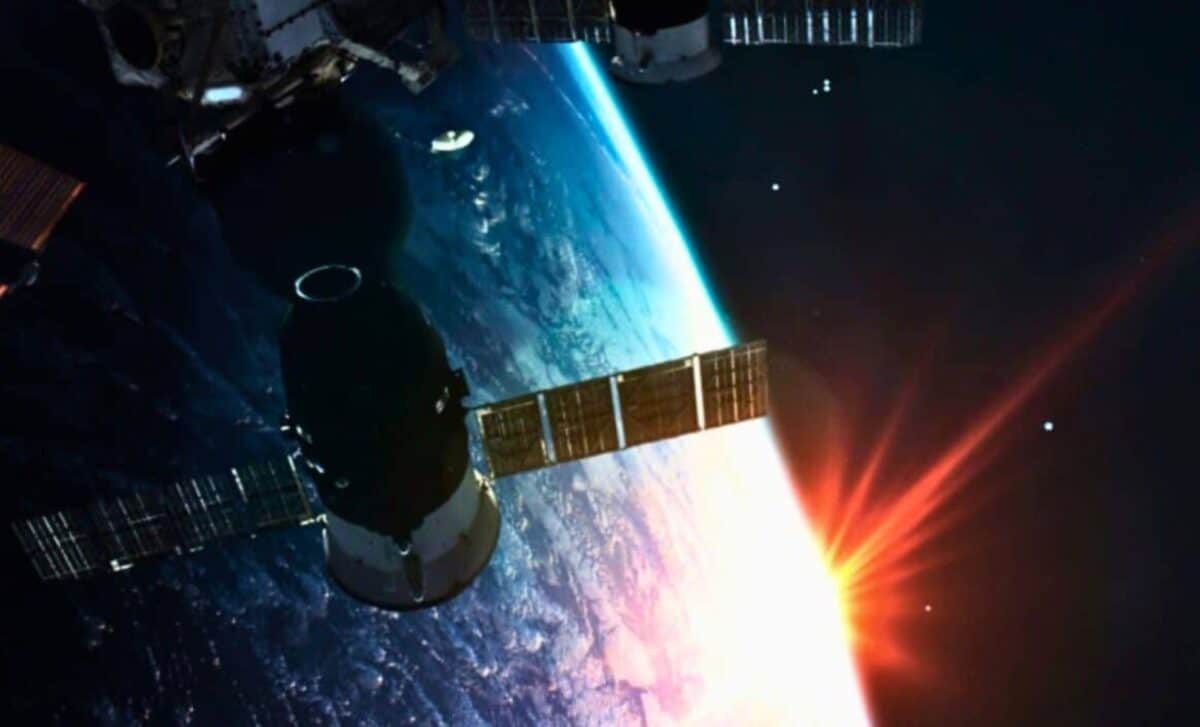
A laser beam sent from geostationary orbit has to travel roughly 36,000 km before it reaches Earth. Yet distance is only part of the problem. Near the end of the journey, the beam must cross a turbulent atmosphere that can bend and scatter its light until the signal arriving on the ground is faint and blurred.
Chinese researchers tested a way to recover more of that signal instead of relying on a single optical correction method. Their experiment combined two techniques designed to deal with different effects of atmospheric turbulence, allowing the receiver to work with light that would otherwise be difficult to decode.
The result was a 1 gigabit-per-second downlink from a satellite in stationary orbit using a laser transmitter rated at just 2 watts. The South China Morning Post reported the experiment on June 17, 2025, describing the recorded data rate as five times faster than Starlink in its comparison.
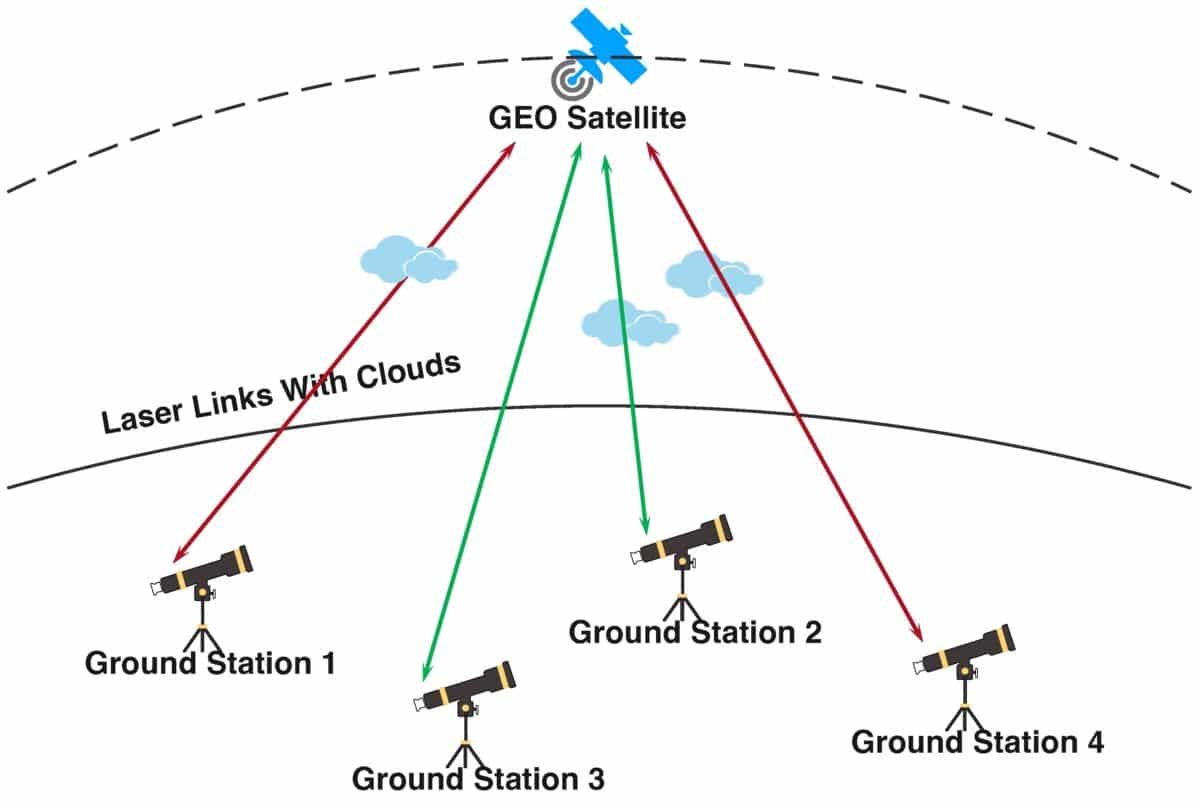 An SGLC system containing one GEO satellite and four candidate ground stations with a scheduling period of one time slot. Credit: Lyu, P., Zhao, K., & Zhao, H. (2025)
The comparison comes with an important difference in distance. Starlink satellites operate hundreds of kilometres above Earth, while the Chinese signal originated from stationary orbit more than 60 times higher.
Atmospheric Turbulence Breaks up the Incoming Laser Signal
Laser downlinks can carry data quickly, but the atmosphere creates a difficult final obstacle. Turbulence scatters the incoming light, producing extremely weak and fuzzy patches by the time the beam reaches the ground. The South China Morning Post reported that those patches can spread across areas hundreds of metres wide.
Researchers have previously approached the problem in two ways. Adaptive optics, or AO, attempts to sharpen light that has been distorted as it passes through the atmosphere. Mode diversity reception, known as MDR, is designed to capture useful information from light that has already been scattered.
Under strong turbulence, however, neither method was sufficient on its own. The Chinese researchers instead combined them so that one stage could correct part of the distortion before the second worked with the scattered signal that remained.
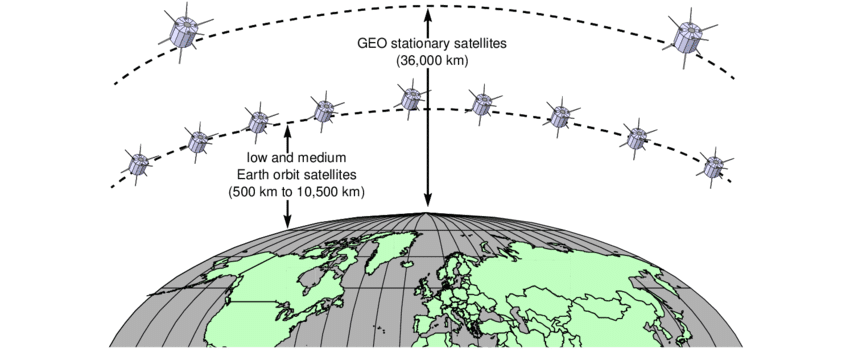 Geostationary satellites orbit the earth at 36 000 km while the emerging breed of low and medium earth orbiting satellites (LEOs and MEOs) orbit the Earth at heights ranging from 500 km to 10 500 km. Credit: Don Clarke
Wu Jian, a professor at Peking University of Posts and Telecommunications, and Liu Chao of the Chinese Academy of Sciences led the work. Their team called the combined technique AO-MDR synergy.
Rather than asking either method to handle the entire problem, the system divided the task. Adaptive optics first reduced distortion in the arriving beam. Mode diversity reception then recovered useful signal from the light that remained scattered.
Combined Receiver Raises the Usable Signal Rate to 91.1%
The difference appeared in the amount of usable signal reaching the receiver. According to the published research, the combined system raised the reported usable signal rate from 72% to 91.1%.
With that improved reception, the researchers recorded the 1 Gbps downlink while using the 2-watt laser transmitter. The result paired a relatively low-power optical transmitter with a receiver designed specifically to cope with strong atmospheric turbulence.
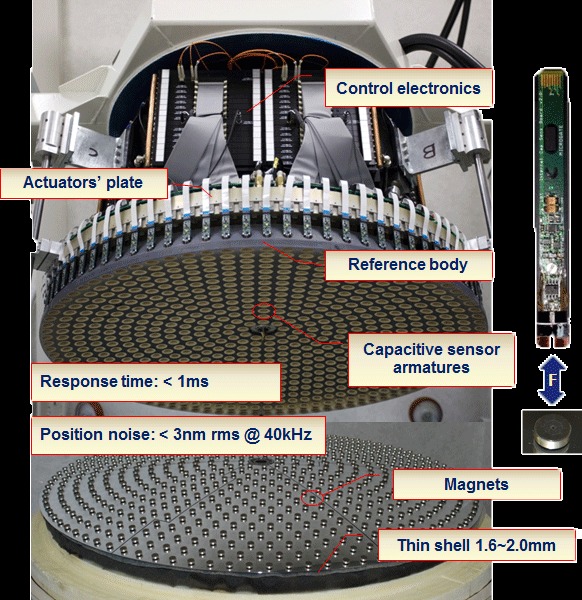 Components of an adaptive secondary mirror for a telescope, which uses actuators to control a thin mirror’s shape. Credit: Microgate
The researchers wrote that the method “effectively prevents communication quality degradation caused by extremely low signal power,” according to the South China Morning Post’s account of the paper.
The Starlink Comparison Is About Recorded Data Rate
The five-times-Starlink figure refers to the reported transmission speed, not to two identical networks tested under identical conditions. Starlink operates in low Earth orbit, while the Chinese experiment sent an optical signal from a satellite positioned more than 36,000 km above Earth.
The experiment also focused on the problem of getting a laser signal through turbulent skies to a ground receiver. It was not a test of two consumer satellite services using the same equipment or transmission method.
What the researchers recorded was narrower and more specific: a 1 Gbps optical downlink from geostationary orbit using a 2-watt laser, achieved with a receiver that combined adaptive optics and mode diversity reception. The research paper reports that the usable-signal rate reached 91.1% under the combined approach.