
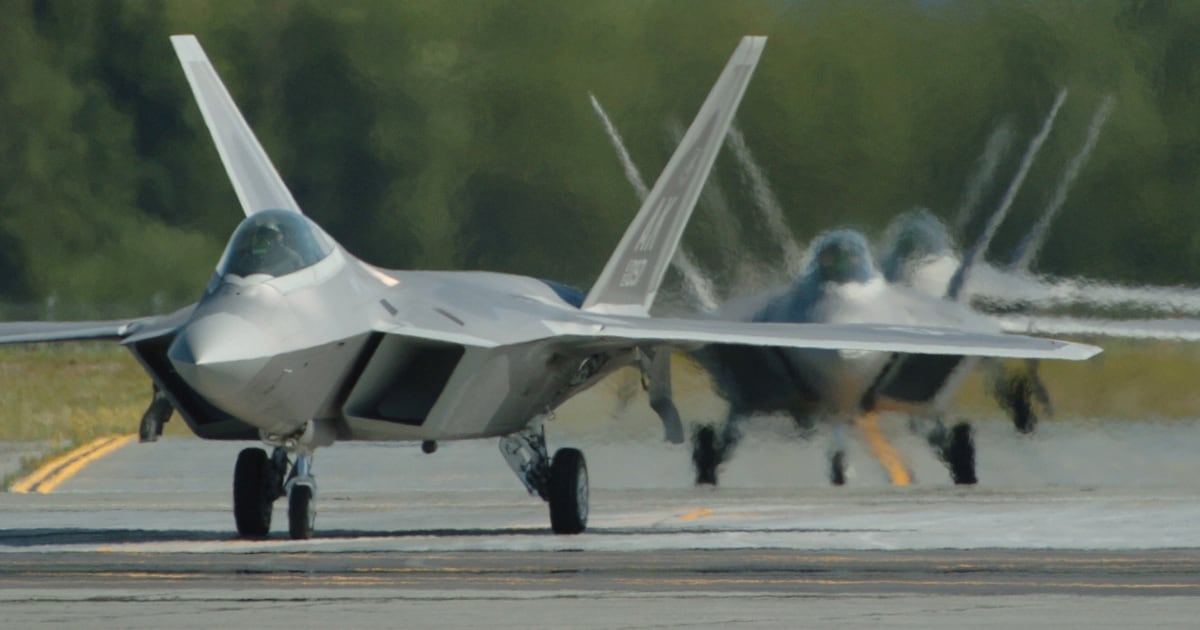
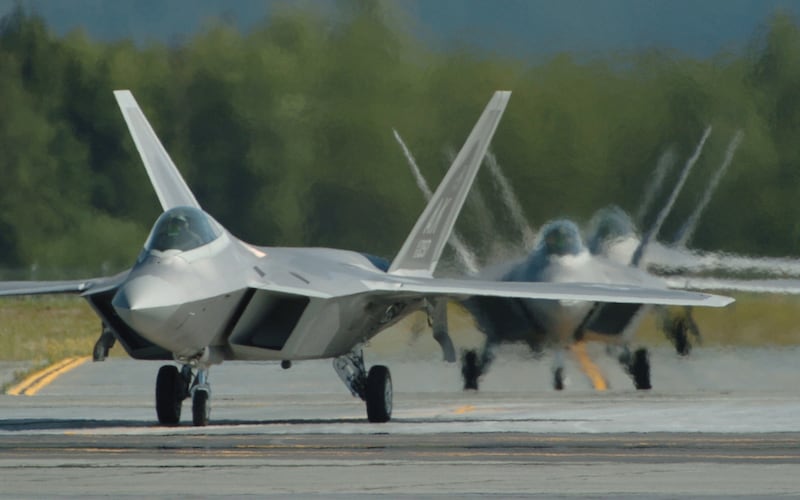
 The first official wave of F-22 Raptors for the 90th Fighter Squadron arrived on Aug. 8, 2007, during a welcoming ceremony at Elmendorf Air Force Base. Elmendorf, now part of Joint Base-Elmendorf-Richardson, was the second operational base for the aircraft. (Bill Roth / ADN archive)
Officials in Alaska have started readying for a tranche of military money to flow into the state in the years ahead.
Though many of the details and exact figures are uncertain, politicians, economic development analysts and businesses are talking about $2 billion in federal dollars that could be spent on projects at Joint Base Elmendorf-Richardson next year, and close to $7 billion over the next several years.
The spending is part of what’s being called the “Fightertown Recapitalization” program, referred to as FTR or “Fighter” in defense and federal budget documents.
“The project functions primarily as a major installation expansion. There will be many new structures with many of the old facilities needing tearing down and rebuild,” said Amanda Coyne, spokesperson for U.S. Sen. Dan Sullivan, in an Aug. 12 email.
It’s far more Pentagon spending than Alaska typically sees, with the potential to buoy the local economy, according to Sullivan’s office, both in the form of new construction projects as well as services to accommodate an influx of new military personnel. Despite that, many details remain outstanding. The funding itself is part of a federal defense budget bill that has not yet passed, even as local officials have started trying to figure out what it will mean for the local workforce, economy and tax base.
[Report: Anchorage economy faces headwinds but also opportunity with JBER investments]
In an interview Wednesday, Sullivan said that “the programs that are coming are classified for now,” but noted that the U.S. military overall is adjusting its posture toward the Indo-Pacific region and the Arctic.
“The Air Force is not spending $7 billion to recapitalize JBER if they are not planning to bring additional assets and additional personal to Alaska,” Sullivan said. “What kind those are, that’s gonna be answered in due time. They want to do this soon.”
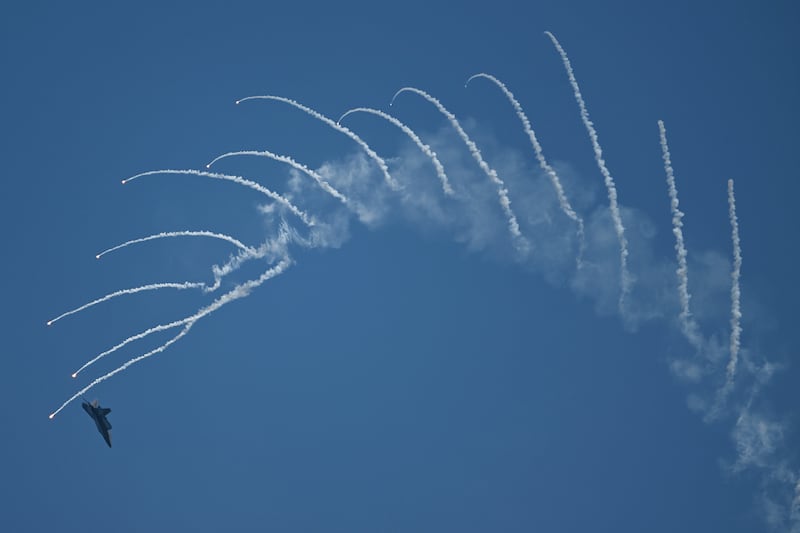 A U.S. Air Force F-22 Raptor deploys flares while performing at the Arctic Thunder Open House on Joint Base Elmendorf-Richardson on Sunday, Aug. 9, 2026. (Bill Roth / ADN)
That is prompting officials in Anchorage to figure out how they might expand services, infrastructure and accommodations to absorb the forthcoming surge in new residents and construction.
“Ensuring an adequate supply of housing for military families and Municipality of Anchorage residents alike is essential to maintaining economic stability, workforce availability, quality of life, and military readiness,” states a resolution from Mayor Suzanne LaFrance submitted to the Anchorage Assembly earlier this month.
What is certain is that the military wants to build a lot of new infrastructure at JBER in a relatively short amount of time, and is proposing to do so not only with a huge infusion of capital but also by relaxing contracting rules to allow construction to happen faster than normal for defense projects.
“We’ve got a big heavy lift to get this done,” Neil Murray, with the U.S. Army Corps of Engineers, said during an information session for industry groups in June.
What is a ‘Fightertown Recapitalization’?
In military jargon, “recapitalization” is an official term for the “restoration, modernization, or replacement of facilities or their structural components,” according to the Defense Department.
A notice in June on the federal government’s contracting website named the Fightertown Recapitalization program and cited the potential for $7 billion to be spent in the coming years in order to build new airplane hangars, dormitories, airfield infrastructure and more.
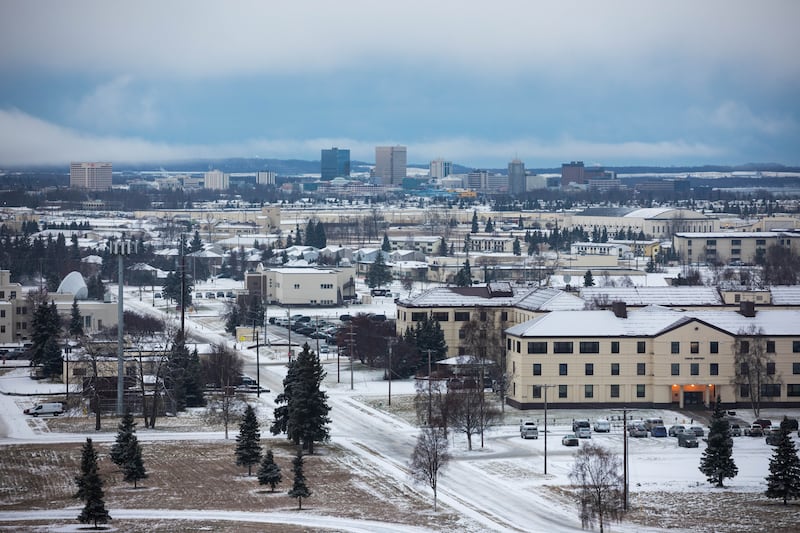 Joint Base Elmendorf-Richardson and downtown Anchorage are seen from the JBER air traffic control tower on Dec. 7, 2018. (Loren Holmes / ADN archive)
In late June, 230 businesses and individuals attended a virtual event hosted by the U.S. Army Corps of Engineers sharing general information about the Defense Department’s intention to partner with local firms on what one presenter called the “massive new (military construction) program here at JBER.”
“We are doing a complete campus overhaul on the northeastern part of the flight line at JBER to recapitalize existing mission functions because the current structures cannot meet mission needs,” said Murray, according to a transcript of the June 30 session. “The big goal is to find a way to start construction next summer, in 2027.”
Under the version of the defense bill passed by the Senate Committee on Armed Services in June, Alaska will received $2.6 billion in military construction projects. All most all of it — $2.066 billion — is for the Fightertown project at JBER.
Public details about what could be built are in an Air Force budget document outlining military construction projects within the National Defense Authorization Act for fiscal year 2027, which has not yet been approved by the full Congress.
According to the document, the Air Force anticipates spending $6.964 billion on the program in the coming years, with construction expected to be complete by 2035.
“JBER will be the most strategic Air Force base on the earth. That’s the vision,” said Sullivan, who sits on the committee.
Sullivan, who is campaigning for a third term in this year’s election, described the spending as “historic.” In a June press release about the defense legislation making it out of committee, he called the tranche of military spending “a grand-slam home run,” and “by far the largest investment ever in our great state.”
The money, as outlined in the Air Force budget, will pay for a lot of new buildings and expanded infrastructure: more paved taxiways and aprons for aircraft, utility extensions to additional buildings, flight simulator, dormitories, warehouses, dining facility, munitions and fuel storage, as well as other structures and improvements.
The document also lists multiple new aircraft hangars, some for maintenance, as well as two separate “9-bay flowthrough hangars to provide weather protection for aircraft and support the generation rates of an operational squadron.”
The Air Force declined to say whether these will be for planes that are already stationed at JBER or accommodate new squadrons of fighter jets or other airframes.
“The Air Force uses its strategic basing process to determine the location for future missions and will use this process to determine any future basing decisions,” Air Force spokesperson Ann Stefanek said. She did not specify when that decision could be made.
As for why this investment in JBER is happening now, and on an aggressive timeline, Sullivan pointed to increasing concern about imminent conflicts with other military powers in the Pacific.
“I think there’s no doubt this is a response to the threats we face from Russia and China,” Sullivan said. “And I would say particularly China.”
A spokesperson for the Ted Stevens Center for Arctic Security Studies, which falls under the Defense Department and is based at JBER, referred an inquiry into the Fightertown expansion to the Pentagon, which did not respond to an email seeking comment.
New ways to spend money
The Fightertown program is noteworthy not just for the amount of money it could bring into the Alaska construction sector, but the speed with which military officials want to put those funds to work.
It took the Army Corps of Engineers and Air Force about eight years to build facilities for two new squadrons of F-35s at Eielson Air Force Base outside of Fairbanks, at a cost of roughly $600 million, lasting from 2016 until 2024. The JBER program anticipates spending more than triple that amount in just one year.
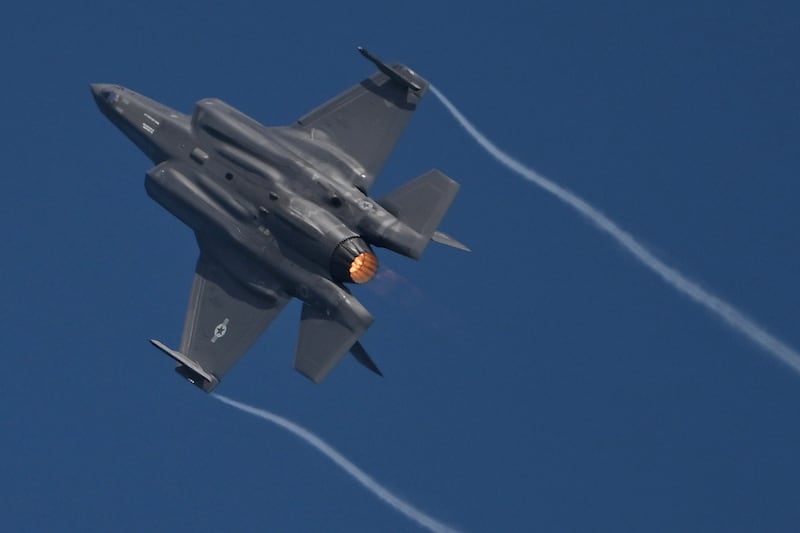 A F-35 Lightning performs during the Arctic Thunder Open House on Joint Base Elmendorf-Richardson on Aug. 9. (Bill Roth / ADN)
Military construction is notoriously slow and bureaucratic. But defense officials are relying on a number of tools that were approved in last year’s defense spending bill that grant them greater flexibility and discretion. Those protocols include the “Other Transaction Authority” and employing a “progressive design-build” methodology for complex projects. The tools, which were authorized by the Republican-controlled Congress, allow some defense projects to avoid traditional procurement policies and procedures under the Federal Acquisition Regulation, according to a “playbook” outlining the new provisions published by the USACE’s contracting directorate.
“This playbook provides a flexible, sequential framework for a collaborative and streamlined alternative to traditional contracting,” states the document, which was published in June. “This demands a pivot from rigid, regulatory compliance to a focus on commercial agility, problem-solving, and shared risk to deliver best value solutions. … (The) model is justified for projects where traditional methods are not optimal, particularly when facing challenges of urgency, specialized expertise, and complexity.”
The Air Force echoed the same rationale in its military construction budget: “OTA/PDB execution will capitalize on the construction industry’s expertise and innovation while avoiding costly and time-consuming federal contracting regulatory burdens.”
It also makes the final budget figures a moving target, since “using this approach, the cost estimate will continue to be refined and will differ from the original government estimate due to the early and ongoing involvement of industry experts,” the budget says.
Local bonanza
In Anchorage, there’s enthusiasm for the anticipated windfall, but also concern that an influx of personnel could strain existing services, and that lucrative federal contracts could poach tradesmen and laborers from the local private sector.
“The JBER multi-year recapitalization will bring a huge infusion of funding into our economy from construction. This will bring good jobs in construction, engineering, and other services to support recapitalization,” LaFrance wrote in an Aug. 10 email. “Though long term it will benefit Anchorage by making JBER more competitive for additional missions, in the short term it will put pressure on our already stressed housing market.”
LaFrance said she has regular meetings with JBER commanders to discuss ways the municipality can support the base and vice versa. The two entities have considerable overlap, particularly when it comes to energy and infrastructure needs.
LaFrance said the construction boom on base will mean more cargo flowing through the Don Young Port of Alaska, generating more revenue from surcharges on freight. The base will also require more power, which could incentivize defense officials to collaborate on financing or constructing the waste-to-energy project that the administration is pursuing at the Anchorage Regional Landfill “to provide stable-priced power to JBER and Anchorage,” LaFrance said.
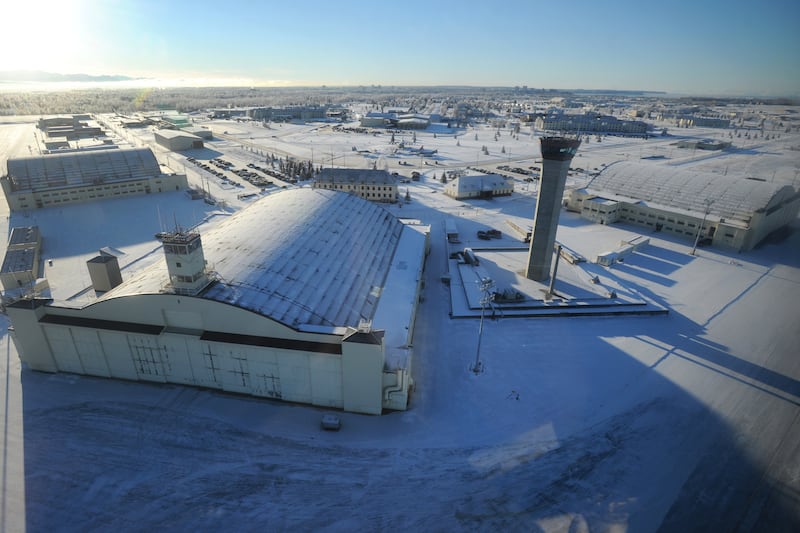 Aerial view of World War II-era hangars and the air traffic control tower at Joint Base Elmendorf-Richardson from an HH-60 Pave Hawk helicopter on Jan. 21, 2015. (Bill Roth / ADN archive)
[Anchorage eyes waste incinerator system that could ‘fundamentally transform’ local utilities]
Though the Fightertown plan calls for building new dormitories, the base is already facing a housing shortage. According to figures from the mayor’s office, 98% of the family housing units on JBER are occupied. Between active-duty personnel, civilian support staff and family members, thousands of new positions could be added in the years ahead, with limited housing options either on base or in the municipality to absorb newcomers.
“It is a huge add,” said Bob Doehl, director of Community and Economic Development for the municipality, during a July meeting with the Assembly.
According to a recent report on local business trends by the Anchorage Economic Development Corp., the recapitalization program would likely produce financial benefits that ripple far beyond the base gates.
“Continued military investment presents significant opportunities for Anchorage’s economy. Planned construction projects, increased housing demand, and growth in local procurement are expected to create jobs, support local businesses, and generate long-term economic activity. JBER estimates that unmet housing demand from incoming personnel could generate nearly $10 million in monthly rent and mortgage payments, benefiting the housing market and related industries,” states the report, which was published earlier this month.
The first tranche of $2 billion for the Fightertown program cannot be spent until Congress approves the defense spending bill.
“While the precise funding timeline is uncertain, the likelihood of securing the requested amount remains exceptionally strong,” said Coyne, the spokesperson for Sullivan. “Because this represents a baseline Department priority rather than a congressional earmark, Congress rarely ignores or significantly alters major service-driven requirements.”