
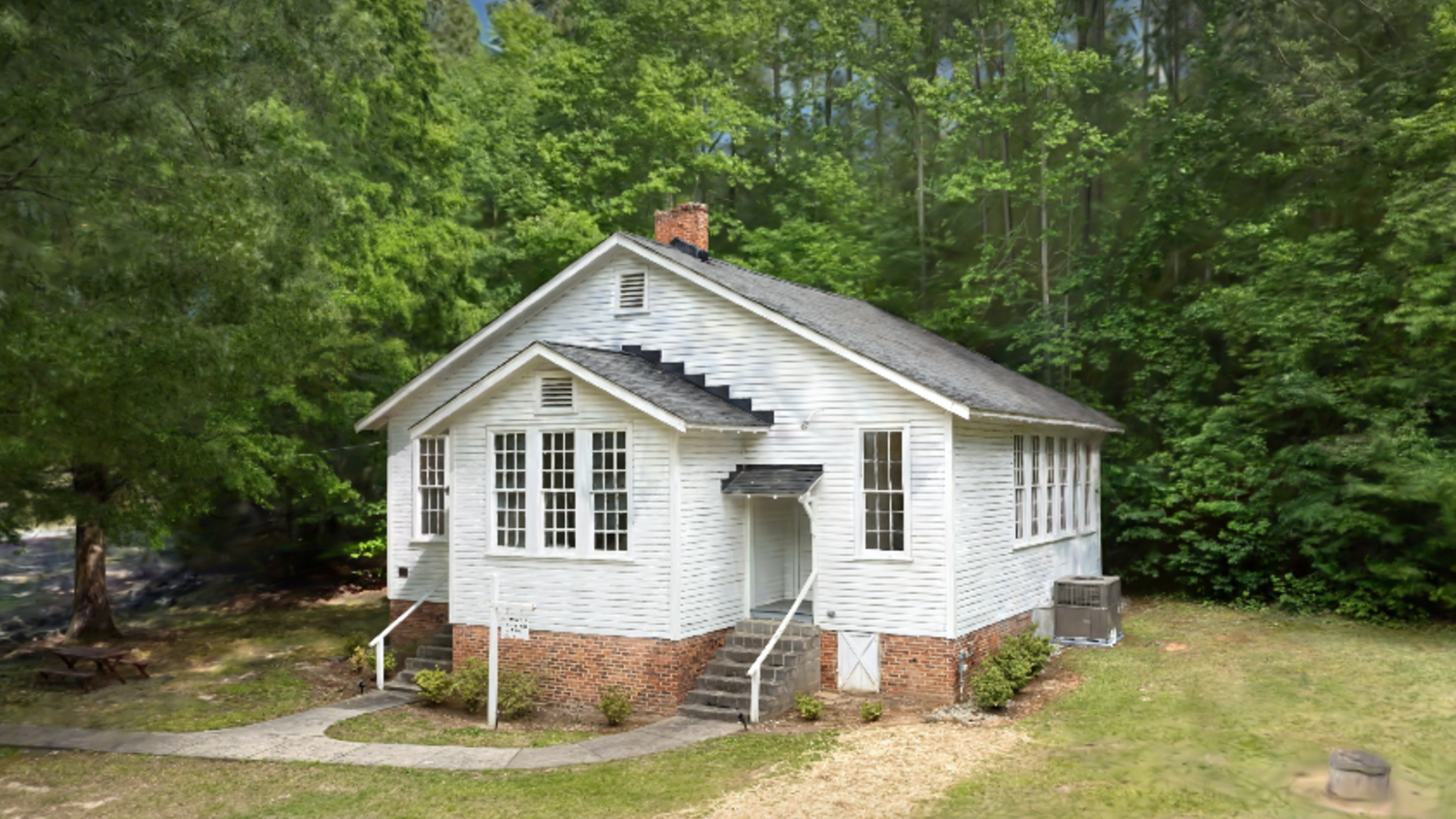
Place-based learning can help put history in context for learners, adding layers that may not be possible through reading documents alone. However, it is often difficult and cost prohibitive for educators to actually plan trips to physical locations.
Professor of Learning, Design, and Technology Kevin Oliver; Associate Professor of Literacy Education Angela Wiseman; Associate Teaching Professor of Social Studies Education Micha Jeffries and Assistant Professor of Social Studies Education Amato Nocera are bridging this gap through their work digitally showcasing the Historic Russell School.
The Russell School is one of about 125 remaining Rosenwald Schools – schools for Black students built across 15 states in the early 1900s through philanthropic donations – and the last of its kind in Durham County, North Carolina.
Oliver and Wiseman previously co-created a virtual tour of the Russell School, with the aid of a DELTA virtual tours grant, in order to relay that community’s story. They were recently able to expand upon that work through a CYARK Heritage Amplified Grant and a new tour that will inform users about the broader Rosenwald Schools program.
“While residents of 15 southern U.S. states may find a physical Rosenwald School near their community to visit, this new tour benefits those living in other U.S. states or around the world who cannot,” Oliver said. “This resource opens up the opportunity for any educator to virtually take their students into a Rosenwald School and access related resources.”
To develop the CYARK virtual tour, Oliver, Wiseman, Jeffries and Nocera worked alongside representatives from the Russell School to share the themes of the location they felt were most important to showcase as well as identify archival and human resources that could be used to complement the story.
While NC State supported the design, content and quality review of tour prototypes, CYARK captured 360-degree images of the Russell School and produced the finished tour, which was one of three physical locations in the United States showcased on the CYARK website in July as part of the organization’s recognition of the U.S.’s 250th anniversary.
Through the virtual tour, Wiseman said, educators and students are able to understand historically significant elements of the building that would not necessarily be appreciated through other sources. For example, on the virtual tour, students can see that the windows of the Russell School were built in a way to let in extra light and that heat was provided by coal stoves – both because the building did not have electricity.
“Virtual access allows educators and students the opportunity to understand the historical significance from anywhere. Unfortunately, our understanding of the historical significance of the Russell School is not emphasized in social studies and history curricula, and people can live down the street from the Russell School and not even know its significance,” Wiseman said. “The Russell School is really special and an amazing resource right in Durham. It’s an unmodified, original two-classroom structure at a moment when most of its peer schools have been altered, lost or are in poor condition.”
As part of the project, faculty in the College of Education will help disseminate the CYARK virtual tour as a resource for K-12 educators and develop standards-aligned social studies and literacy lesson plans to support implementation.
This work, Jeffries said, is especially important in elementary schools, where teachers frequently report having less instructional time to devote to social studies and often have limited access to high-quality resources that help students engage with local history in a meaningful way.
“By pairing the virtual tour with carefully designed literacy and social studies lessons, teachers can help students develop historical thinking skills while also strengthening reading, writing, discussion and evidence-based reasoning,” she said.