
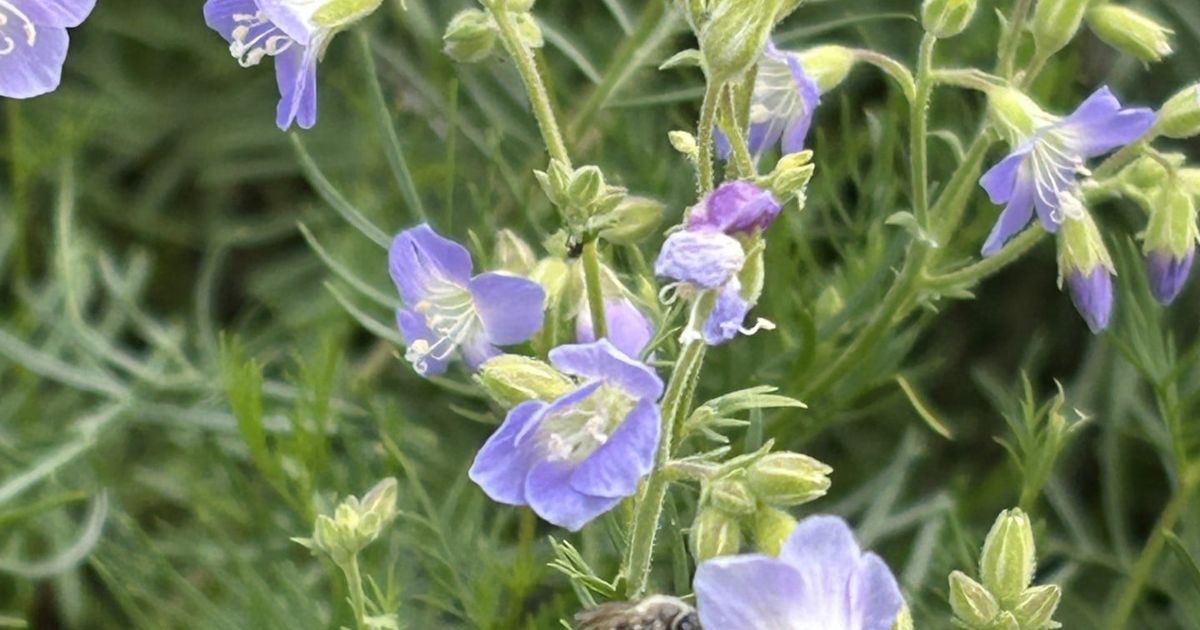
Washington Jacob’s Ladder has existed on the Columbia Basin for thousands of years. Now, scientists say it’s at risk of extinction.
The Center for Biological Diversity has petitioned the U.S. Fish and Wildlife Service to protect the plant under the Endangered Species Act.
Mark Darrach, a researcher at the University of Washington Burke Museum, principal at Corydalis Consulting and contract researcher for the Center, and Gwendolyn McManus, a staff scientist at the Center’s endangered species program who has petitioned for around five different species this year, authored the petition.
If the plant is granted protection, it will “unlock more funding for its protection, more research – just kind of get more attention on it,” McManus said. “It can also help raise awareness for landowners who have those plants on their land, and in some cases can help landowners get additional help if they want to conserve the plants.”
There are currently 892 flowering plants in the United States classified as endangered by the Fish and Wildlife Service.
The effort to classify the plant as endangered began when Darrach surveyed populations of the plant, something he and a field partner do with a different plant each year. Together, they assess plants with declining populations to determine whether they believe a petition is warranted.
“A lot of them haven’t been visited for decades, sometimes many decades,” he said.
Even before the survey, Darrach was aware that Washington Jacob’s Ladder was “on its way out.”
“We knew it was rare,” he said. “It’s got a very limited profile as far as its habitat preferences go. It requires moisture, which in central Washington, north of I-90, is pretty limited.”
A decline in water sources is a significant contributor to the plant’s rarity.
“The biggest factor overall, I think, has been the loss of groundwater, because there’s so much groundwater that’s being pumped out of that area for irrigation,” Darrach said.
Washington Jacob’s Ladder needs bare soil to grow. Historically, bare soil in central Washington has been a function of floodplains, areas of land near flowing bodies of water that regularly flood. Recently, however, streams in the area have been straightened for agricultural purposes.
“So, during spring floods that might occur, or particularly large rainstorms that might occur on occasion, those floodplains really aren’t there anymore,” Darrach said.
Without the bare soil, Washington Jacob’s Ladder has difficulty reproducing. Because of this, many populations consist mostly of very old “zombie plants,” as Darrach called them.
“Most of the populations are only mature adults, and there’s very little seedling recruitment,” McManus said. “There are very few young plants.”
Without younger plants, most populations of Washington Jacob’s Ladder cannot survive into the future.
“They’re just going to live out their lifespan, and then the population disappears,” Darrach said. “There’s only three, possibly four populations that are still viable over a fairly long-term period, we think.”
Fires are also a threat to the plant, though Darrach said they haven’t had much of an impact yet.
“The heat from a wildfire could potentially destroy the plants,” he said. “We didn’t really have a very good sense of how much risk the plants are at as far as fire goes, because we didn’t really see any wildfire evidence. But it’s just a matter of time until some of them burn up.”
Darrach said despite the low number of plants, Washington Jacob’s Ladder is an important part of the central Washington ecosystem.
“It’s a plant that has real importance to pollinators – the bees, our native pollinators,” Darrach said. “And it’s in full bloom at a time when the blooms of other plants in that area tend to be waning. … And then it provides a lot of nectar and a lot of pollen, so it’s an important species ecologically.”
Once a petition for a flowering plant like Washington Jacob’s Ladder is submitted, it can take several years for a decision to be made. The process is lengthy: An initial review takes 90 days, and then, if a listing “may be warranted,” an additional yearlong review will occur before a decision is made.
If the Fish and Wildlife Service does not meet these deadlines, the Center for Biological Diversity will file a lawsuit.
“That is something we have to do pretty often in order to get the federal government to actually move forward on these petitions,” McManus said.
The U.S. Fish and Wildlife Service did not respond to a request for an interview.
A major reason that plants like Washington Jacob’s Ladder become endangered is climate change and agricultural pressures, McManus said.
“You have plants that live in really specialized habitats,” said Dr. Jeremiah Busch, a professor of ecology, evolution, and population genetics at Washington State University. “And then, when folks are using those lands, it’s difficult for the species to persist in the long term.”
“Water is becoming more scarce across the spectrum, and it’s definitely starting to cause problems,” McManus said. “But I think a lot of those consequences are still ahead of us, because you have plants like Washington Jacob’s Ladder that live for a really long time. So, I think that there’s a good chance we’re going to see accelerating rates of extinction and endangerment for plants in the coming decades.”