
The most fortunate buyers in the car market right now are those with a reasonably nice trade-in–like a 2019 Honda Accord–who want a reasonably nice new car. The least fortunate might be those looking to buy anything under three years old in decent condition.
Politics guides the car market, and the industry is going through a dramatic switch from an administration that believed consumers would quickly embrace EVs to an administration that believes it can both stoke job creation while also making it more expensive to build cars in the United States. A big sticking point between the USA and Canada is cars, and it won’t seem to unstick.


Making it more expensive to build cars outside the United States doesn’t magically create more jobs inside the United States, and the result of the current president’s policies might mean fewer jobs than under the last guy. What’s going on there?
And, finally, one of the best racing magazines will be no more, as magazines continue to be less of a thing.
The Average Transaction Price For A 3-Year-Old Used Car Is A Record $32,461
Before I get into The Morning Dump, a big thanks to Thomas for covering for me last week so I could spend my week covering Monterey Car Week. Most of the cars sold there were older than three years and the average price was probably $200,000, depending on the auction you visited.
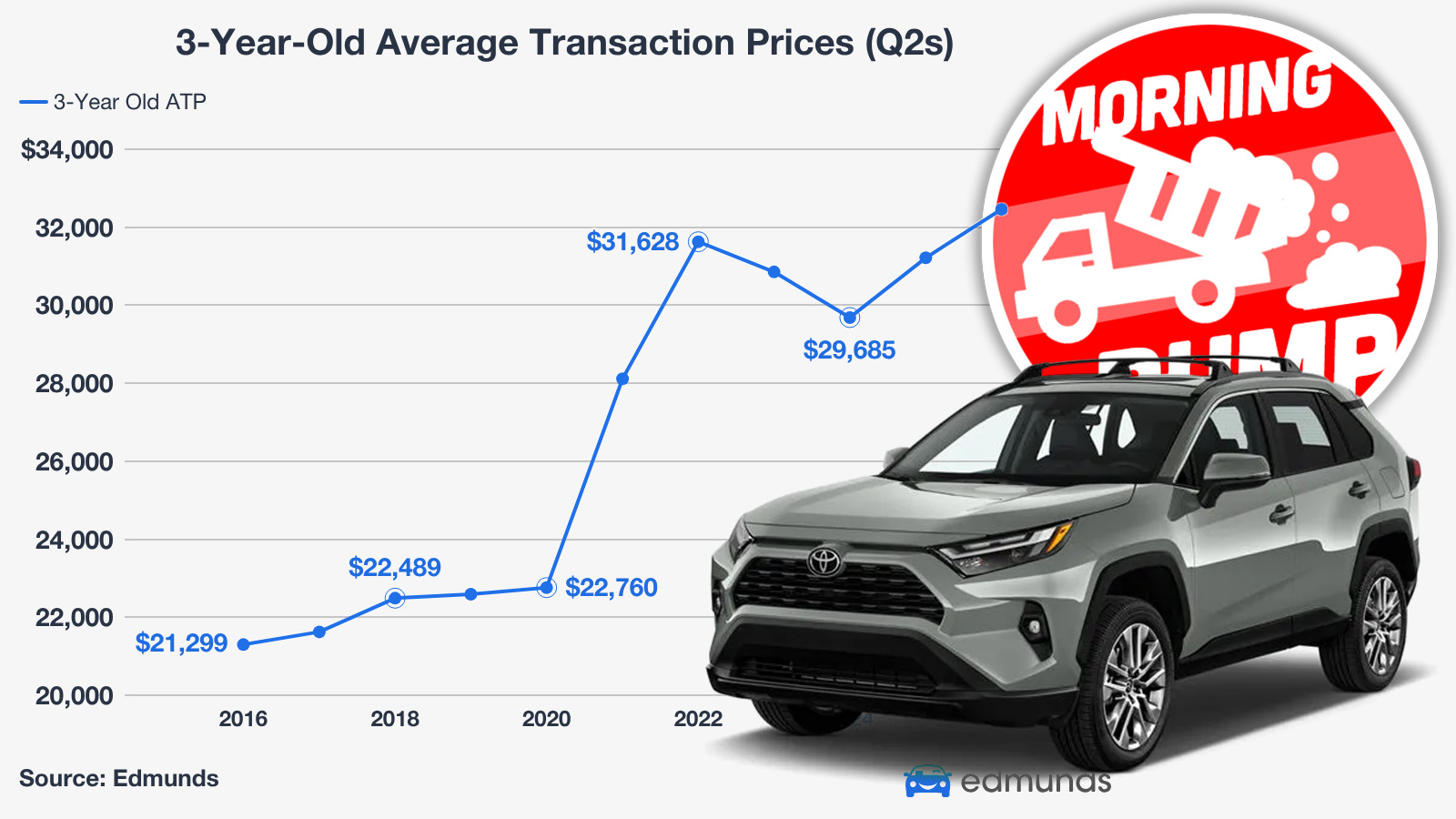
Prices aren’t that high right now outside of Monterey, but you can see how bad it’s gotten in the chart below.

This comes from Edmunds, which reports that the 3-year-old transaction price in Q2 rose to $32,461, which is a record, and even worse than the pandemic surge. The vehicle shortage that resulted from the pandemic semiconductor shortage seems to have permanently repriced the used car market.
While progress was beginning to be made as more inventory came online, the 3-year-old used car market is, by definition, on a lag. The cars that were too expensive in 2023 are now still quite expensive in 2026, and new cars are also way more expensive. Can I blame trimflation for this? It’s definitely a factor. With limited ability to build cars, automakers prioritized making higher trim models.
Automakers are offering more base models now, and 2023 might be the absolute peak of trimflation. In addition to trim-level limitations, model preference plays a huge factor. People are buying fewer small sedans new, which means there are fewer small sedans on the used market. All of these factors drive up the price simply because of the inventory mix available.

As Edmunds points out, the worst result for affordability is the lack of lower-priced options:
In Q2 2026, the average vehicle sold in the $10,000-$15,000 range was 8.7 years old and carried 98,222 miles. In Q2 2019, that same budget bought a 4.7-year-old vehicle with 58,250 miles. In other words, a $10,000-15,000 budget now buys a vehicle that’s four years older and has roughly 40,000 additional miles on the odometer.
The trend extends across every affordable price range in the used market. In the $15,000-$20,000 price range, the average vehicle age has climbed from 3.4 years to 6 years, while the average mileage has climbed from 41,851 to 71,192. Even vehicles priced between $5,000 and $10,000 are getting older, with the average age rising from 8.1 years to 10.7 years and typical mileage now exceeding 120,000 miles.
That sucks for used car buyers, and all this goes to explain how Americans managed to add $211 billion in new auto loans in Q2. For new car buyers, it’s a little better and Cox Automotive data shows that affordability for new cars stayed roughly static this summer.
As I wrote last month, the flip side of this is that someone with a reasonably nice trade-in has a lot more power to reduce the cost of a new (or used) car purchase.
Canada And The United States Square Off Over More Than Hockey
 Photo: MDOT
I’ve already written ad nauseam about the importance of Canada and Mexico to carmakers and consumers in the United States. The linchpin of the whole thing is the USMCA, which is an imperfect yet completely operable set of rules that allows for reasonably free trade of cars and components between the countries.
If there’s one thing this current White House hates it’s an imperfect yet completely operable set of conditions, though its ability to improve upon imperfection has been questionable at best. For carmakers (and car buyers), the weird result has been that it’s suddenly more efficient for some to build cars outside the United States than inside.
An interim set of exemptions was granted to try to cover for this, but President Trump has proposed new rules that go into effect at midnight tonight.
Negotiators have been working for days to try to craft an agreement that would avert 50% duties on a range of US imports from Canada, including milk, beer, plywood and hockey equipment. Both sides are also seeking to reduce existing tariffs and trade barriers they have on each other.
[…]
Trump put a 25% tariff on foreign cars and trucks last year, but offered Canada and Mexico a partial break based on US parts in the supply chain. A vehicle assembled in Ontario with half US content would have an effective tariff rate of 12.5%, for example.
Canada has pushed to reduce the headline tariff rate on autos to 10% or expand the exemption, according to people with knowledge of the discussions who spoke on condition of anonymity. But the Trump administration has held firm to a minimum 15% rate, the people said.
I’ll have an update in the morning.
Where Are The Jobs?
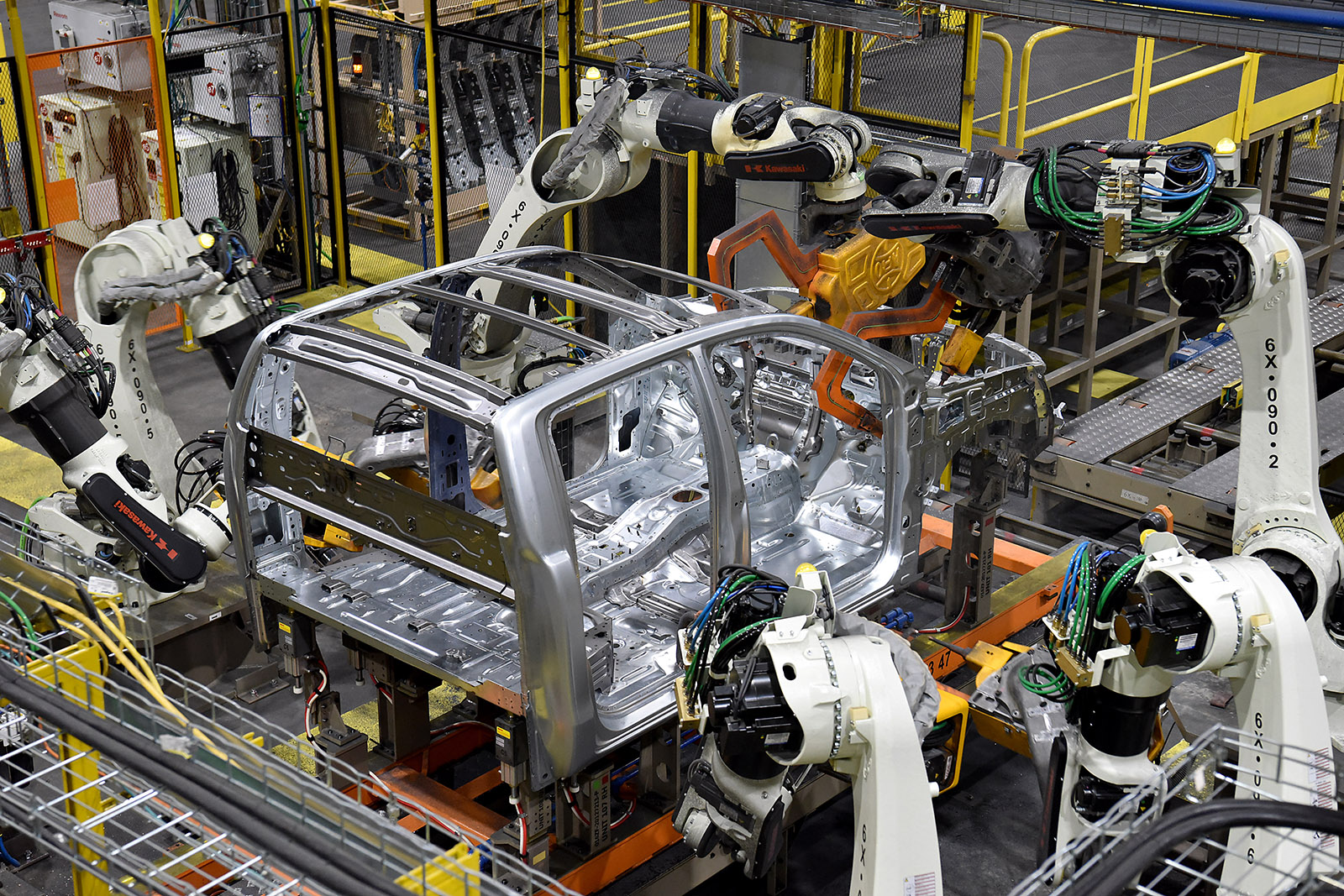 Photo: Ford
For all the talk from this White House about bringing back manufacturing jobs, the reality is that under President Biden there were more people employed at motor vehicle and parts facilities in the United States.
Why is this happening? Some of it is the EV headfake, as plants that were being built or being planned are suddenly not needed. Some of this is the trade war, which has left automakers and parts suppliers to deal with huge tariff bills and a need to save money.
Assuming those costs stay high, this might have the knock-on effect of driving the industry towards automation even faster as Automotive News reports:
A closely watched index from the Institute for Supply Management shows economic activity in the manufacturing sector expanding in July for the seventh consecutive month. July also saw the index’s highest reading since May 2022.
But more manufacturing activity has not translated to more jobs.
That indicates the growing use of automation for auto suppliers. The artificial intelligence boom is driving record gains in the stock market, but it’s also made it easier for manufacturers to turn to robots on the line to drive output.
The article goes on to point out that re-shoring will maybe, eventually bring more jobs to the United States, and I assume that’s what will happen. I’m just not sure it’ll be as many jobs as in the past and I wonder what happens if we have a new administration that gets rid of a lot of the trade barriers.
RIP Racer Magazine
 Photo: Racer
After 34 years and 341 issues, the print edition of Racer magazine has been “axed with immediate effect” according to the magazine’s now-former EIC David Malsher-Lopez.
This is an unfortunate trend in the industry, with most of the major print car magazines either eliminating or reducing the number of print issues.
It seems like the digital version of the publication will continue.
What I’m Listening To While Writing TMD
Edgar Wright is out doing showings of Scott Pilgrim v. The World and I just rewatched it on a plane, so here’s Sex Bob-Omb with “Garbage Truck.” When you listen to it you can definitely hear that Beck wrote it.
The Big Question
What’s the best used car deal these days?
Photo: Edmunds/Toyota