
GRAND FORKS — NASA launched Artemis I in 2022, the first in a series of missions to return to and explore the moon, with the eventual goal of a human-crewed mission on Mars.
For years before that, the University of North Dakota was considering — and still is considering — human exploration to the moon and Mars, and the challenges that come with being so far from Earth.
“There are many, many things that can go wrong,” said Pablo de León, professor and chair of UND’s Department of Space Studies. “And the advantage that we have here at UND is that we have been thinking about these problems for 20-some years before there was a specific mission to return to the moon.”
UND recently began testing a
mobile wastewater treatment system
built at the Kennedy Space Center, partnering with NASA to see if the Divergent Deployable Wastewater Treatment Facility can work as a potential prototype for a system astronauts could use for liquid and solid waste on a lunar base. The facility is attached to UND’s Integrated Lunar/Martian Analog Habitat, one of the university’s forays into exploring human spaceflight.
The ILMAH is part of the Human Spaceflight Laboratory, which has been in action since 2004. The lab’s research is focused on the design and production of space suit and habitat prototypes. According to its website, UND is the first university with a NASA-funded lab dedicated to designing and making space-exploration and planetary surface exploration suits, as well as the first university to have two fully operational spaceflight simulators.
UND also has an annex of its lab at the Kennedy Space Center, de León said. Master’s and Ph.D. students working on their dissertation or thesis also can work on different projects with NASA.
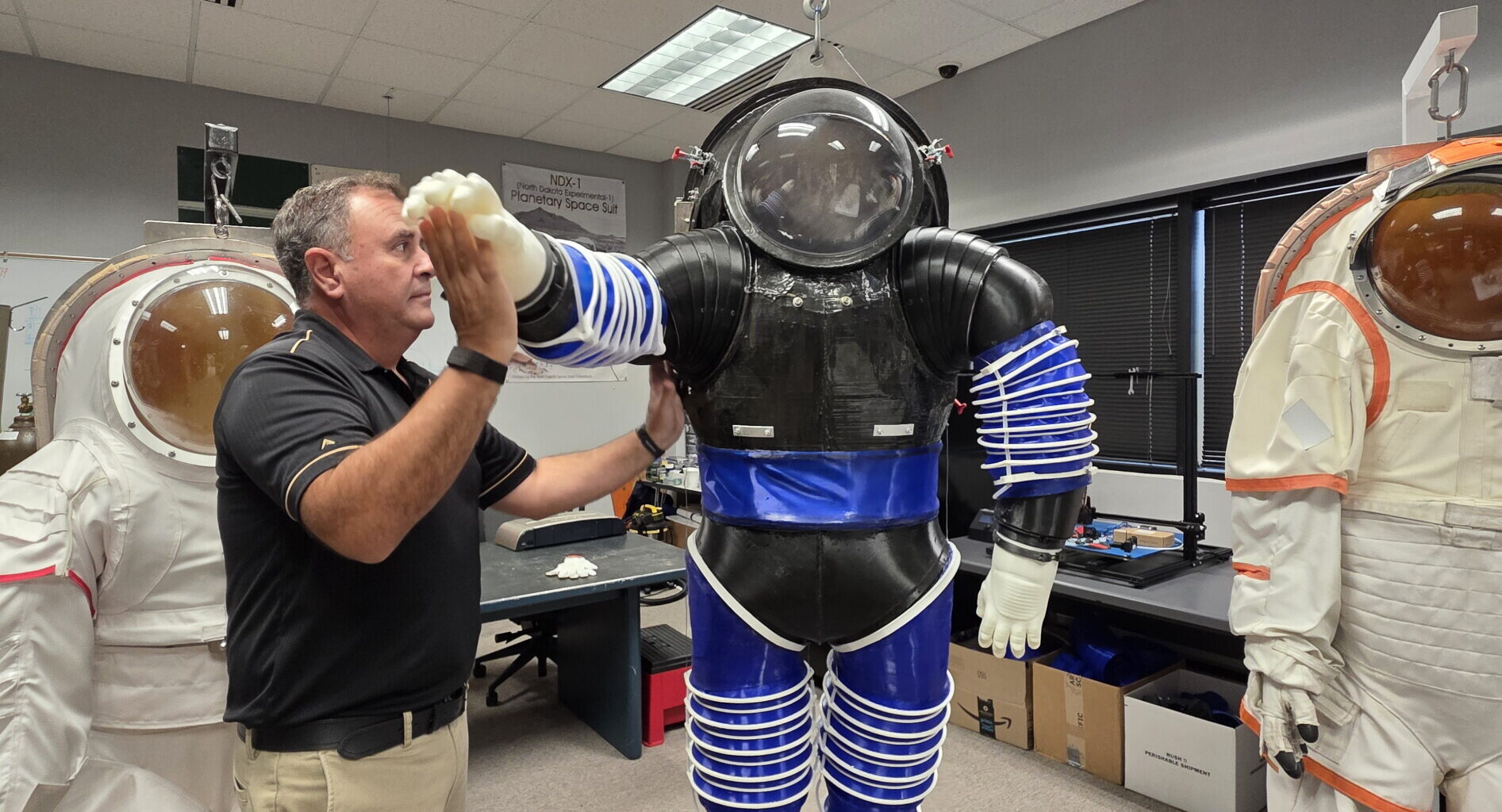
One NASA-funded project upon which the Human Spaceflight Lab is working is a 3D-printed space suit. While fabric suits come in specific sizes and can only be worn by astronauts who fit them, a 3D-printed suit can be made by scanning the astronaut’s body and building it specific to their measurements. The prototype printed suit has flexible filaments and more rigid areas. The idea, de León said, is that future astronauts could take the 3D printing machine with them and print out parts, or even a full space suit if they need to.
“Then you reduce the dependency on the Earth,” he said. “You have to become Earth independent as much as possible to reduce the costs.”
Independence is important. While astronauts on the International Space Station may take a few hours to get back on solid ground due to orbiting around the planet, any issues that come at a greater distance from Earth can be critical, de León said.
UND has been thinking about these problems for years, he said. When the Human Spaceflight Lab was set up, people asked why.
“‘The only thing that we are doing is going in the Space Shuttle, and now we are building the space station, but you guys are working for the moon and Mars. That’s way in the future,’” de León recalled. “And that future is now.”
American innovation, universities and companies can be the difference in getting Americans back on the moon first. Though no country can claim the moon, there are resources concentrated in specific areas that are first come, first served. While Russia was the competitor for getting the first human on the moon, America is now racing China to get back to it.
China has the benefit of no elections and doesn’t have to change its space program plans every few years, but NASA has the benefit of working with universities and companies that have their own projects. For example, in the 1960s, the Massachusetts Institute of Technology developed the first digital guidance computer that was critical for the Apollo astronauts, de León said.
UND’s projects and connection to NASA put the university “in a special position to help NASA go back to the moon before China,” he said.
It has been quite a ride for de León, who watched the moon landing as a child on a black-and-white TV in his family’s kitchen in Argentina. It propelled him to do what he does now, and he hopes to have plenty more years contributing to human spaceflight, “which, I think, is the most interesting thing that someone can be doing in the 21st century.”
“It’s just remarkable, the journey of humanity. I think that the best is yet to come,” he said.

Otto is the University of North Dakota reporter for the Grand Forks Herald.