
5:30 P.M.
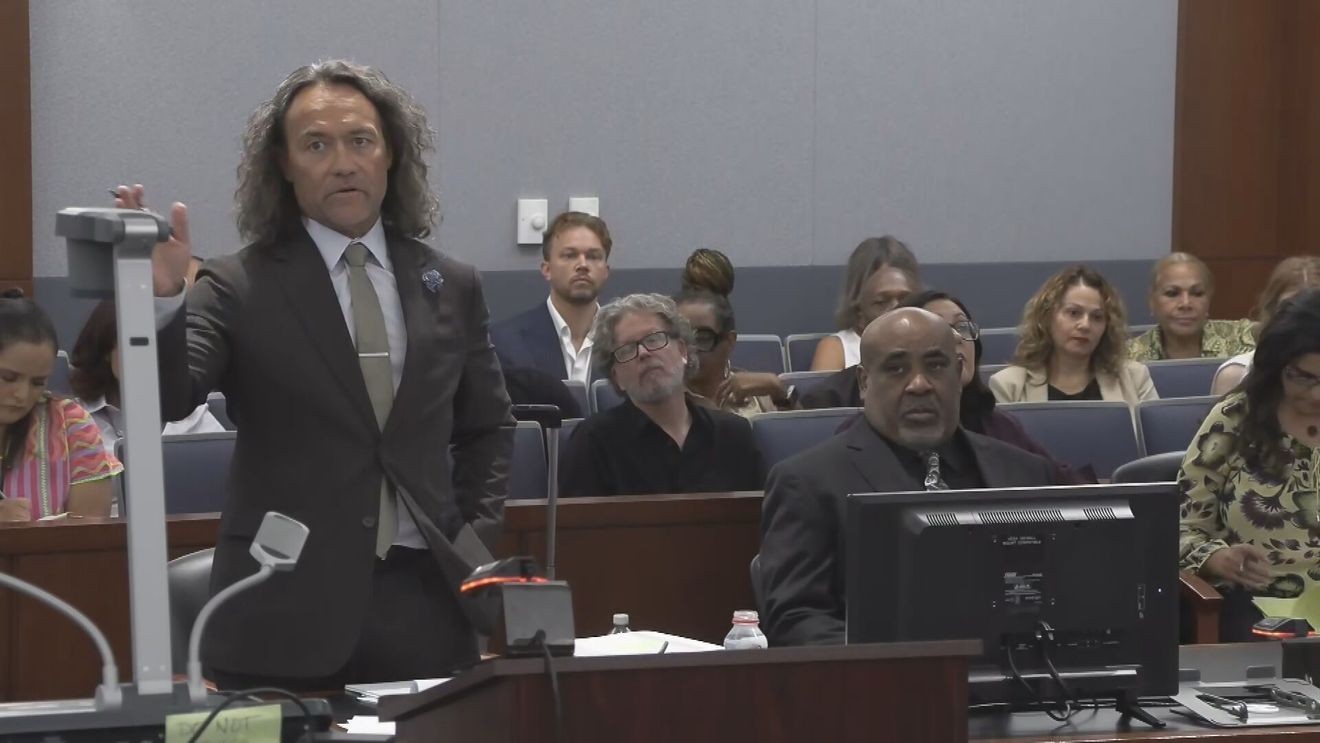
LAS VEGAS (KSNV) — During cross-examination, Sanft continued challenging the depth and reliability of Dorsey’s research, emphasizing that Dorsey relied on material supplied by former LAPD detective Greg Kading.
Sanft established that Dorsey received the 2008 recording from Kading, then questioned Dorsey about other possible areas he had not investigated, including civil litigation involving Tupac’s estate and Death Row Records. Sanft raised alternative theories involving Tupac and Death Row Records, including whether Tupac wanted to leave the label or requested an audit. Dorsey said there were conflicting accounts about Tupac’s future with Death Row and characterized some of Sanft’s questions as based on “conspiracy theories”, saying he had never seen evidence of an audit.
Sanft also questioned Dorsey about Death Row security on the night of the shooting, including Reggie Wright Jr., and whether off-duty or former police officers were working security. Dorsey could not confirm several of the details Sanft presented.
The defense then went through portions of Davis’ book, Compton Street Legend, to test whether Dorsey independently verified the details Davis claimed about his 1996 Las Vegas trip.
Those details included Davis buying an expensive Versace suit, renting rooms at Caesars Palace, attending the Tyson fight, and photographs Davis identified as being from the trip. Dorsey acknowledged he had not independently verified several of those details.
One detail Dorsey said he did research involved Davis’ claim that the group stopped at a “Liquor Barn.” Dorsey said he found old news articles and advertisements indicating a liquor store fitting that description existed around Flamingo, though he did not check the Secretary of State’s office or Clark County licensing records.
The exchange became contentious at times, with Dorsey and Sanft talking over one another. Prosecutors objected to Sanft’s commentary, and the court instructed him to ask his question and allow Dorsey to answer.
Sanft questioned whether searches of Davis-associated properties after Tupac’s murder produced a .40-caliber gun or evidence establishing Davis was in Las Vegas.
Sanft ultimately emphasized that much of Dorsey’s testimony depended on what other people told him rather than physical evidence he personally collected.
Sanft ended by pointing jurors to a disclaimer in Compton Street Legend stating the authors and publishers assumed no responsibility for errors, inaccuracies, omissions or any inconsistencies.
Prosecution redirect
Prosecutors returned to the Liquor Barn issue and suggested the location may have been connected to what became Lee’s Liquor. Dorsey said that may have been how he originally discovered it.
Prosecutors also highlighted a detail they argue Davis knew that wasn’t previously public, regarding the Chrysler Sebring that was there at the time of the shooting. Dorsey testified that, as far as he knew, Davis was the first source to identify the specific model of the girls’ Chrysler as a Sebring in the 2008 statement.
Dorsey’s testimony concluded after two days on the stand, though he remains subject to recall. Court recessed for the evening.
3:30 P.M.
Michael Dorsey takes the stand. Dorsey says he has worked in true-crime television for roughly 20 years and began researching the Tupac/Biggie cases around 2012 after learning about former LAPD detective Greg Kading’s Murder Rap. He eventually helped make the Murder Rap documentary and later worked as a contractor on Death Row Chronicles.
Dorsey says his research included books, news archives, interviews and access to extensive investigative files, including thousands of reports, roughly 100 hours of audio, photographs and other material.
Sanft questioned Dorsey to establish that Dorsey is not a detective and did not interview LVMPD detectives while initially conducting his documentary research, despite Las Vegas police having responsibility for investigating Tupac’s murder.
Dorsey said after Death Row Chronicles aired, he contacted LVMPD and eventually communicated with a Metro detective. He says he continued forwarding Davis’ subsequent public interviews to investigators as Davis kept talking.
Dorsey acknowledged that during Davis’ Death Row Chronicles interview, Davis did not know Dorsey was in another room listening and communicating with the interviewer. Dorsey says he texted information/questions to the interviewer.
Dorsey also confirms he put his phone near a speaker and recorded the entire conversation, including material that never appeared in the finished BET production. He maintains he did not need separate permission to make that recording because it was part of his job on the production.
Court is given a recess. Attorneys argue about questions defense can ask Dorsey outside the presence of a jury.
Defense’s Position:
Prosecutors argue Sanft is going too far and effectively trying to attack Greg Kading’s character even though Kading has not testified. The state says they never elicited an opinion from Dorsey about Kading’s credibility or quality as a detective, so the defense should not get to introduce alleged acts of misconduct to attack him.
Judge Kierny said the defense can question Dorsey about whether the investigative files were complete and how they were obtained, because that bears on the reliability of Dorsey’s research. But she agrees with prosecutors that Sanft cannot simply attack Kading’s character without laying the proper foundation.
1:40 P.M.
After the recess, second interview from Death Row Chronicles played in court for about 40 minutes before lunch. It was recorded in July 2017. Dorsey remained on the stand listening.
In the audio recording, Davis discussed his relationship with Sean “Puffy” Combs. When pressed about what Puffy allegedly wanted regarding Suge Knight, Davis says, “I guess he wanted the big guy taken care of.”
Davis said he didn’t need Puffy financially, claiming he already had significant money at the time.
When talking about Orlando Anderson, Davis calls his nephew his best friend, his “everything.”
The Lakewood Mall incident is brought up. Davis said another man, Marcus, fought Death Row associates and took a chain. Davis said Anderson was in the mall.
When talking about Las Vegas, Davis said he and others traveled to Vegas for the Mike Tyson fight, not because they expected to confront Suge Knight. He says he saw Suge the day before without incident.
MGM fight: Davis said he was at an MGM café after the fight when East Coast Crips came in and told him his nephew had been jumped. After the beating, Davis described what happened next, including the group going to Club 662 looking for Suge, Tupac and others who beat up his Anderson but they never showed up after waiting for an hour.
Davis said, “ We went to see what it was about, you know what I’m say. I wanted to talk to Suge because I’ve known him since I was 9 years olds-t. Plus, I helped him get his record business going. S-t, you know what I’m saying. You going to bite the hand that feed you, s-t.” Davis said he never went into the club.
That became the break point, and court was dismissed for lunch around 12:20 p.m. Court resumed just after 1:30 p.m.
9:40 A.M.
The court began with a discussion of whether or not portions of Dorsey’s recording can legally come before the jury. Dorsey worked as a contract technical consultant for the production company behind Death Row Chronicles, not directly for BET.
The defense challenged Dorsey’s recording because it continued capturing audio during breaks in the formal interview, including conversations involving Davis and his attorney, Wayne Higgins.
Dorsey said Davis and Higgins remained inside the studio and other production personnel were present. He estimates roughly half a dozen people could have been in the room.
Dorsey also recalled Davis at one point warning, “this is a hot mic.”
Dorsey said he was in an office down the hall and could not see the studio, but listened to the live studio audio through headphones and recorded it on his phone.
On cross-examination from defense attorney Michael Sanft, Dorsey confirmed he deliberately avoided running into Davis that day and watched him walk past. Davis was seen shaking his head as Dorsey said this.
Dorsey said he made the recording because Davis arrived for the first interview unprepared, and Dorsey knew the interview would need a second day. He said he wanted the recording so the production team could ask the appropriate follow-up questions.
Judge Carli Kierny ruled the conversations were not privileged. She pointed to the presence of third parties, the recording-studio setting, a signed release and microphones in the room.
Defense attorney Michael Sanft raised concerns about jurors hearing evidence involving unrelated criminal conduct, including references to other shootings/crimes and the murder of Christopher “Biggie Smalls” Wallace.
The court distinguishes between material previously ruled admissible and an unrelated 2015 incident, which prosecutors say will be redacted before the recording/transcript goes back to jurors. The judge noted the jury has been told there is no indication Davis had anything to do with Biggie Smalls’ murder. Both sides agree to a limiting instruction.
Dorsey stayed on the stand as prosecutors continued playing his recording of Davis during the Death Row Chronicles production.
Dorsey later confirms that some of the recording captured audio in July 2017 before the formal recorder had restarted, making his recording potentially broader than the official production recording.
Interviewers repeatedly pressed Davis about Sean “Puffy” Combs and money. They tried to get Davis to state clearly that money had been offered.
Later in the recording, Davis says he tried calling Puffy’s house several times, but his calls were not returned, saying he believed Puffy was trying to “wash his hands” of them.
When asked whether he received money afterward, Davis says no, explaining the situation was “hot” and that a person could not simply “jump out there like that.”
Interviewers push Davis to discuss his nephew Orlando “Baby Lane” Anderson, noting Anderson was dead and could no longer face consequences regarding the shooting of Tupac. They specifically ask whether Anderson went after Tupac that night. Davis answers: “No, he didn’t. No, he didn’t go after Tupac.”
Davis repeatedly indicates he wants to wait until he receives approval/a “green light” before discussing certain details.
Later, when asked whether the events would have happened without the MGM confrontation involving Anderson, Davis said yes, he would have left it alone, and talked about his prior friendship with Suge Knight.
Davis also expresses anger that his name became publicly connected to the case as “Keffe D’s nephew”, saying the attention affected his life.
Davis spoke extensively about his belief that law enforcement was aligned against his side of the conflict. He described tensions involving Compton police.
Later, Davis complained that people were siding with Tupac’s side while his side was the one “catching it,” and alleged information was being passed to authorities.
The interview shifts to rapper Christopher Wallace, aka “Biggie Smalls,” murder. Davis denied involvement, saying they had nothing to do with Biggie’s killing and describing Biggie as a friend.
He said people suspected him and the Crips because of money allegedly owed by Sean “Didddy” Combs.
Davis said he learned Biggie had been killed while he was in a parking garage after attending an event at the Peterson Automotive Museum in Los Angeles, when people ran back and announced the shooting.
When asked why he originally agreed to tell his story to police, Davis answered essentially: to save his life. He described cooperating as part of protecting himself and others from potentially significant prison exposure.
Interviewers asked Davis about allegations that Suge Knight had relationships with police officers. Asked whether it was widely known that Suge was hanging around or protected by cops, Davis answers yes, saying “everybody” knew.
Davis also discussed Suge’s position around gang members, suggesting money gave Suge power and influence.
Around 11:25 a.m., the court released for a break after Davis informed the court he needed to use the restroom.
Original Story:
Monday will mark the start of a second week of witness testimony in the trial of the only man charged in the murder of rap icon Tupac Shakur.
Duane “Keffe D” Davis is expected to return to the courtroom as prosecutors continue to present their case to 12 jurors and four alternates.
Last week’s proceedings reviewed the fatal 1996 shooting that claimed Shakur’s life, with testimony from witnesses to what happened, the first officers on scene, the detectives who originally handled the case, and former gang-affiliated people who described the bloody feud between rap labels.
Jurors also heard audio from Davis’ interviews with law enforcement in 2008 and 2009, in which he discussed details of the shooting and how he wanted retribution for a fight involving his nephew, Orlando Anderson, inside a Las Vegas Strip casino.
In the recordings, Davis tells investigators that he provided the gun used to fatally shoot Shakur. He also says that he would have fired the shots himself had Shakur and Marion “Suge” Knight been on his side of the vehicle on Flamingo Road.
Davis has pleaded not guilty to the murder charge. His attorney has argued that Davis’ comments were fiction created to make money from television appearances and book deals.