
Much of the discussion around Indian outbound wealth is framed by market conditions, a weaker rupee, softer domestic equity returns, strong performance in the United States. Yet for advisers who work with Indian families from outside India, the pattern looks rather different. The desire to build wealth beyond the home market has been visible for years, running steadily beneath the cycle rather than responding to it. What changes with market conditions is the size of the allocation, not the intention behind it.
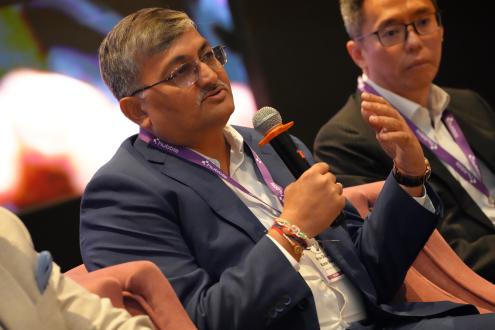
At the Hubbis India Wealth Management Forum 2026, a panel chaired by Brett Kennedy, Managing Director for Investments at Hubbis, examined how appetite for global investing becomes robust, compliant and well-structured reality. Nirav Dinesh Kumar Shah, Founder and Managing Director of FAME Advisory DMCC, offered a Dubai-based perspective drawn from two decades of advising Indian and Indian-origin families, arguing that the driver is not performance but optionality, and that the practical routes available to families are narrowing at precisely the moment demand is widening.
Key Takeaways
The Trend Runs Independent of the Cycle: Strong Indian markets reduce the offshore allocation, but they do not remove the need for one.
LRS Is Becoming Narrower: For families with meaningful surplus, the remittance route alone no longer answers the question.
ODI Is the Practical Route for Business Families: Expanding the core business footprint overseas generates capital that can then be deployed with far greater flexibility.
Structure Follows Objective: The right jurisdiction depends on the size of the corpus and what the family ultimately wants to achieve, not on a default answer.
Efficiency Matters at the Asset Level: Allocations into the United States and the United Kingdom require attention to structure, not just selection.
A Trend That Predates the Rupee
Shah opened by placing the current surge in context. His firm, a boutique tax advisory practice based in Dubai, has been working with Indian families for twenty years, and the pattern he describes is not new.
“We have been consistently seeing Indian families aspiring to go global,” he said, “and this global Indian trend is irrespective of the market performance of India.”
That framing sets him slightly apart from the market-driven explanations offered elsewhere on the panel. His point is not that performance is irrelevant, but that it changes the proportion rather than the principle. “If the market does perform, yes, you get lower allocation, but you still need an allocation overseas,” he said.
For families whose children are studying abroad, whose businesses have international customers and whose consumption is already global, an offshore component is simply part of how the balance sheet is expected to look. Fellow panellists made the same observation from different angles, with one participant noting that education has become a significant global connector across nearly every family in the segment.
Where the Routes Are Tightening
Shah’s more pointed observation concerned the mechanics. Demand may be broadening, but the channels available to satisfy it are not keeping pace.
“LRS is becoming more and more narrower,” he said, referring to the Liberalised Remittance Scheme. For families with modest offshore ambitions the scheme remains workable, but for those with substantial surplus capital it is increasingly a partial answer rather than a complete one.
In his view, the more meaningful route for business-owning families lies elsewhere. “ODI is the only plausible option to look at it from expanding your core business footprint,” he said, describing a sequence in which overseas direct investment establishes a genuine operating presence, that presence generates income and services offshore, and the resulting capital can then be deployed with far greater latitude than a remittance-based approach permits.
The distinction matters for how advisers frame the conversation. A family asking how to move money offshore and a family asking how to build a business offshore are asking related but different questions, and the second often unlocks options the first cannot.
Structure Follows the Objective
On the structuring question itself, Shah resisted the idea of a default jurisdiction, describing instead a process that starts with the family’s own objectives.
“We have facilitated families to set up structures, be it UAE, be it outside UAE, depending on the kind of wealth corpus that they want, the objective that they want to achieve ultimately,” he said.
Two variables therefore drive the answer: scale and purpose. A family building a modest offshore sleeve for diversification has different requirements from one preparing for a partial relocation, a business expansion or a multi-generational succession plan. Applying the same structure to all three tends to produce something that works adequately for none of them.
This aligns with a theme other panellists raised. One participant, speaking on the legal and exchange control side, emphasised that families expecting the next generation to relocate should begin planning well before the move, because the capacity available after a change of residence is narrower than most assume. Another highlighted the institutional depth and established regulatory environment of Singapore as a reason it continues to feature prominently in these conversations.
Surplus Capital and the Case for Optionality
Perhaps the clearest articulation of why families are doing this came when Shah described what happens to capital released from operating businesses.
“The surplus is being generated, which is not required technically to be deployed back into business,” he said. “Families are looking to externalise their wealth so that they get more and more options.”
He returned to that word repeatedly. “It’s more about having options to invest and not having constraints around those investments,” he said, “and having that free will to deploy that family pool to the extent that they can. That’s the main objective and core thinking that Indian families are coming up with.”
It is a useful corrective to the assumption that offshore allocation is primarily a currency hedge or a performance chase. For many of the families Shah advises, the objective is simply to remove constraints on where capital can go, so that when an opportunity appears, in whichever market or asset class, the family is in a position to act on it.
That view was echoed by a participant who noted that the depth and diversity of product available internationally, particularly in sectors with few investable domestic proxies, is itself a significant part of the pull.
Serving the Diaspora, and Getting the Detail Right
Shah also drew attention to a client base that sits outside the standard Indian outbound narrative: families of Indian origin already based elsewhere in Asia.
“In addition to Indian families, we have served Indian-origin families based in Hong Kong, Singapore,” he said, “and we have structured their entire wealth around that properly and used it for different purposes.”
For these families the question is not how to get capital out of India but how to organise wealth that is already offshore, often accumulated across several jurisdictions and generations. That is a distinct advisory challenge, and one the panel identified as a growing opportunity as well as a responsibility.
Finally, Shah touched on the asset-level detail that can undermine an otherwise sound plan. “We also try to help allocation in the US and UK,” he said, describing the work of ensuring that exposure to those markets is held in a way that does not create avoidable inefficiency. It is a reminder that structuring does not end once capital is offshore. How assets are held, and through what wrapper, can materially affect what eventually reaches the next generation.
From Aspiration to Architecture
Shah’s contribution served as a useful counterweight to the cyclical framing that dominated much of the panel. The rupee and relative market performance may explain the timing of the current wave, but they do not explain its persistence. Families with global children, global businesses and global consumption were always going to want globally deployed capital.
What determines whether that aspiration becomes a durable structure is the work done at the outset: understanding the objective before choosing the jurisdiction, recognising which routes genuinely support that objective, and attending to the structuring detail at the asset level rather than treating it as an afterthought. As Shah made clear, the families that succeed are those seeking options rather than shortcuts.