
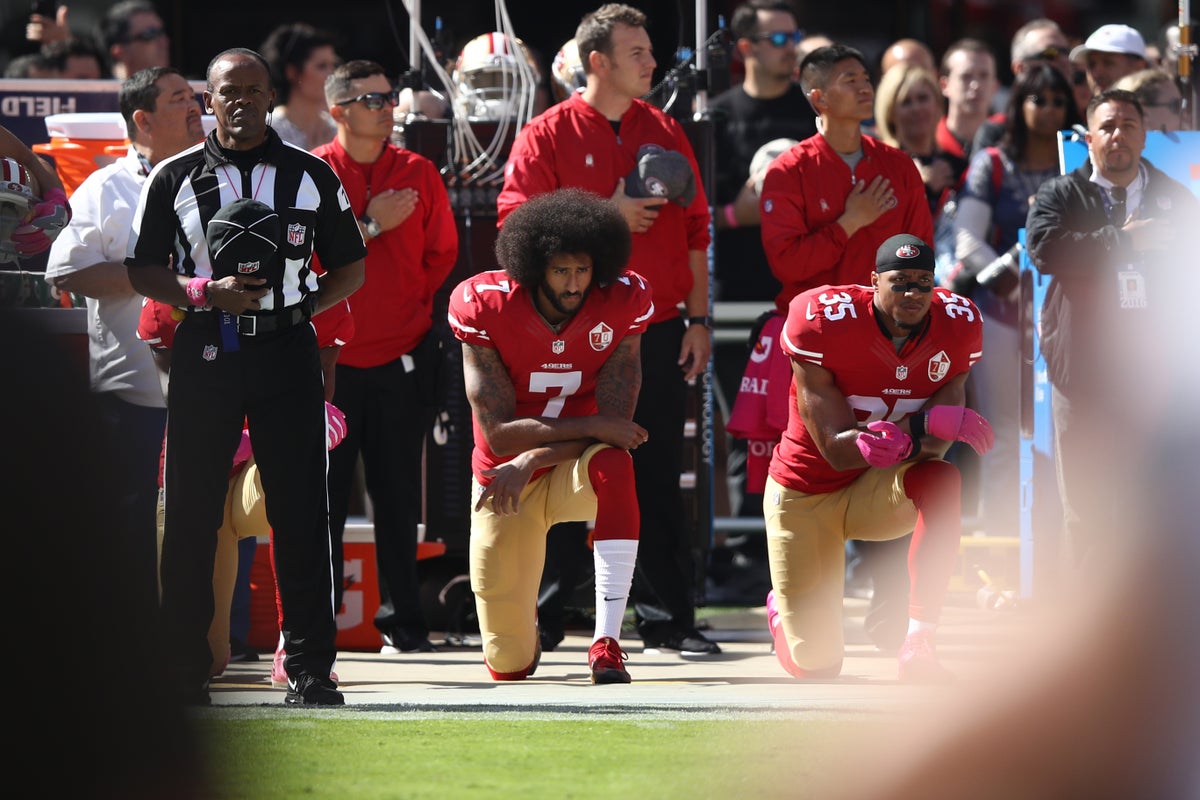
Ten years ago this week, Colin Kaepernick sat during the national anthem before a preseason game, and almost nobody noticed. He had done so in silence for three games, and if not for the attentiveness of NFL Network reporter Steve Wyche, the former San Francisco 49ers quarterback may have persisted in speechless protest.
Kaepernick desired no news conference, no PR guru to prepare a statement, no assistant to pre-write a social media post. He sat because his conscience told him to do something. He did not talk about it until Wyche asked. Then he explained that he was objecting to police violence against Black Americans by refusing to stand for a country that wasn’t standing for everyone. His explanation came in service of his act. It was not a substitute for it.
About two weeks ago, in the same quiet way, Kaepernick’s Know Your Rights Camp renewed its $1 million pledge to the local communities, celebrating this 10th anniversary with the same financial commitment he made in 2016. It barely registered on our news radar. No victory lap. No media tour. No ceremony. Just service.
With an earnest approach, Kaepernick took a stand, and through all the noise — all the debate and demonization, all the hijacking of his message — he has never abandoned that approach. It makes him a frustrating figure, a man who rarely talks and never strays from his point. But after witnessing the behavior of sports figures who have sprinted to the microphone over the past decade, you have to admire Kaepernick’s conviction and lack of interest in celebrity.
In the moment, most of society wasn’t ready to listen to Kaepernick. Ten years later, it’s fitting that the sports world is applying lessons that the Kaepernick example didn’t even teach. The quarterback lost his career because, as he once said, “It would be selfish on my part to look the other way.” The sentiment has morphed into an “I’m gonna use my platform” slogan, words that strip away the part that made Kaepernick’s actions so bold.
Because he refused to look the other way, he was willing to lose his football career. His protest, which became taking a knee instead of sitting because former Green Beret and NFL player Nate Boyer suggested it was more respectful, spawned a strange era of noise and empty messaging and approved group-project athlete activism to signal virtue during divisive and hateful times. And when the clouds clear, people moonwalk their social-justice gestures. And every time the clouds return, it becomes clearer that empathy continues to suffer from retrenchment.
Then the attention economy takes over, unleashing too many athletes who speak freely to better themselves rather than a select few who speak bravely to better society. The latter do so with appropriate fear for the cost of raising their voices. The former see only the benefits of enhancing their relevance.
In modern athlete activism, Kaepernick stands alone. He is far from beloved, but his stance is aging well. The prominent athletes of the past 10 years have mishandled what they should’ve treated as a precious legacy. With their conceit, the clout chasers have turned his courage into a template without asking what made the original worth copying. They have used their platforms to become fluent in the language of audacity, but when it comes to action, they are nearly illiterate.
‘It’s about caring’
Earlier this year, I asked former Chicago Bulls guard Craig Hodges whether he wishes more athletes would speak out against injustice. His answer made me think harder.
“It depends whether you were raised right,” said Hodges, who was 31 when he played his last NBA game in 1992, losing his career partly because of his activism. “When John Carlos and Tommie Smith raised their fists, the position they took was from the heart. If you’re speaking truth to power, go ahead, I’ll be sitting back, eating my popcorn, watching like a movie. But if you’re magnifying yourself instead of the issues? Not interested. It doesn’t matter if you happen to bring a little attention to the cause if you’re getting in the way of the cause.”
Our call dropped. Two minutes later, he called back and spoke as if he hadn’t been interrupted.
“You have to think about the freedom and magnitude of wealth that today’s athlete has,” Hodges said. “It’s capitalism versus people, man. Is it their responsibility to care? From an individual standpoint, no. Do they have a greater opportunity than most to try to change the world? Yes. But it can’t be something that they think they should do. It’s not a career achievement. It’s about caring about people, man.”
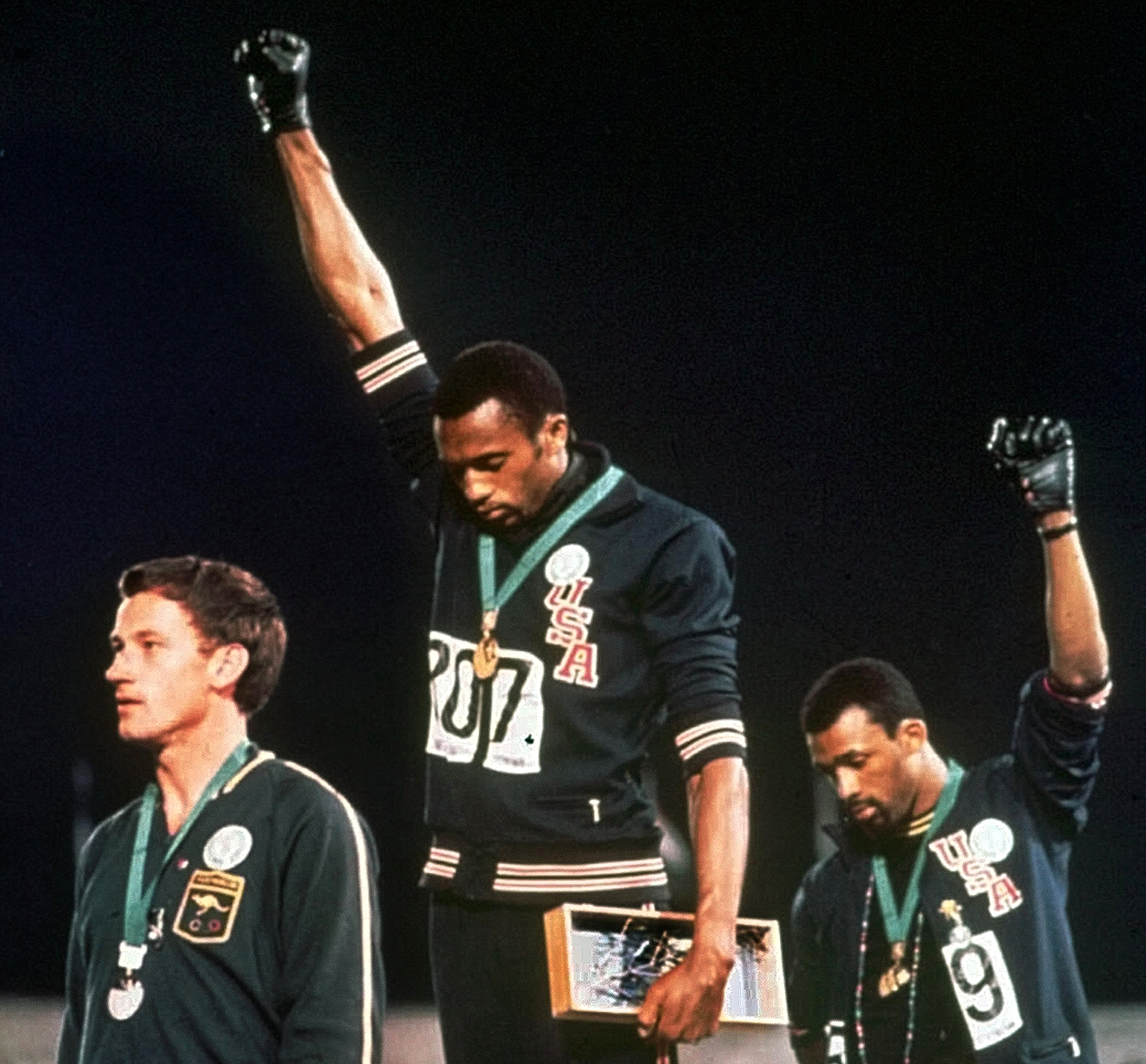
Americans Tommie Smith, center, and John Carlos raise their gloved fists in a human rights protest at the 1968 Summer Olympics in Mexico City. (Associated Press, File)
Activism is different from speech. Kaepernick jolted the sports world from a state of indifference. What he actually did was narrow and specific. He was a lone wolf with a clear concern and a plan from which he would not deviate. He demonstrated before every game during a two-minute patriotic window, and he was willing to risk it all to pull attention to his cause. But over the following years, many extracted the wrong takeaway: Look at the value of my platform!
LeBron James, the most powerful icon of his generation, took that lesson further than anyone, and he has done plenty of good things. He created More Than a Vote in 2020. He helped fund a school for at-risk youth in his hometown of Akron, Ohio. He has criticized President Donald Trump often. But for as wide as he spreads his influence, LeBron practices selective humanitarianism when problems collide with his business interests.
When asked about former NBA general manager Daryl Morey’s tweet supporting Hong Kong protesters in 2019, LeBron said Morey was “either misinformed or not really educated on the situation,” a remark that didn’t go over well when his domestic social concern was contrasted with his ambivalence toward China because he plays in a league that generates billions in Chinese television revenue. He used his platform when it was safe and profitable and turned quiet when it complicated his money.
Even when taking a stand, James is shrewd — and he’s a billionaire now — waiting for the moment when public sentiment either favors him or is less likely to inflict lasting damage. That’s not hypocrisy as much as it is careful navigation of the zeitgeist. Freedom of speech is never free, even if you’re doing so in good faith.
Feasting on neutrality
Few illustrate the current bind better than Caitlin Clark. She wants no part of it. WNBA legend Sue Bird has said Clark will “get better” at speaking about important issues, which frames the silence as a kind of shyness that can be outgrown. That’s a progressive view of this demand to feed the machine. It’s a charge to use the platform or be seen as failing some obligation attached to fame.
The conservative is almost the inverse. Sophie Cunningham, Clark’s Indiana Fever teammate, ignited a fire last month that continues to rage when she told ESPN that she favors keeping transgender athletes out of women’s sports.
“I think that I am here to extend love. But I also think with that love is truth, being honest,” Cunningham said in an ESPN.com feature story that profiled her full personality but was reduced to a single take.
Of course, reporters immediately turned to Clark for the superstar’s position. She demurred, declaring it was for “the leagues and governing bodies to work with their athletes to find solutions.” The pundits feasted on her neutrality, most venomously Megyn Kelly, who called her a coward. It must have been a dizzying experience for Clark. Commentators hungry for superstar validation of their culture war were calling her silence a moral failure, and some of them were the same people who, in previous news cycles, had insisted that athletes needed to shut up.
That whiplash illuminates the messy conversation now. At the intersection of sports and society, it used to be up to the athlete to hit the gas. Now, everyone else is honking for them to move in their direction. The “platform” isn’t about whether an athlete has convictions. It’s about whether an athlete can be weaponized.
That’s how grifters create value. That’s how Enes Kanter Freedom and Royce White, two former NBA players insinuating themselves clumsily into the transgender sports debate, find an audience. And that’s what has changed the most over the past 10 years. Sport is full of bad actors expediting the death of discourse with repulsive antics. Every issue devolves into a struggle to maintain decency. The conversation is too noisy to be fruitful. Whether fighting or fueling it, the rage makes addicts of us all.
And then there’s Aaron Rodgers. He complicates this story further as a celebrity who never stops taking stances. The unfortunate part is that they aren’t really stances. He’s just trying to settle his grievances through fatigue and attrition.
His vaccine dispute has now lasted for five years, reaching its latest chapter recently when he went on ESPN and called Dr. Anthony Fauci “an absolute coward” and, later, “an absolute criminal” on The Pat McAfee Show. He was ripping Fauci for repeatedly pleading the Fifth before Congress when discussing his handling of the COVID-19 pandemic. Rodgers talks about it all in principle: bodily autonomy, skepticism about institutional authority. But his methods are full of the same empty sloganeering that he supposedly despises. He masks conflict as concern, and even though his act is tired, he keeps finding a stage.
The question to ponder in sports today is whether speech functions as an act with a cost or as a renewable resource for an audience happy to waste time on slop. Kaepernick took an action for one season, and it cost him his career. Rodgers has spent a half-decade relitigating an anti-vaccine stance that costs him nothing and earns him a monologue on McAfee whenever he decides to take a shot. The attention economy doesn’t reward conviction or its absence. It rewards whatever recapitulates conflict. It will take content from anyone honest enough, or dumb enough, or corrosive enough, to keep supplying it.
The cheapest, safest way
The problem is bigger than the athletes, too. Leagues and sponsors have spent the last several years learning exactly how much activism they can tolerate without losing revenue. The answer keeps getting smaller. The 2020 post-George Floyd apex — end zone messaging, league-sanctioned campaigns, corporate solidarity statements — has been triaged since. Sponsors have retreated. Diversity programs have been dismantled. Things that have survived are the cheapest, safest, most generic gestures: a moment of silence, a social post timed to a news cycle. Consider it the “It Takes All Of Us”-ization of sports. Say something, but say nothing. The costly, targeted version of activism has far less room to exist now than it did even three years ago.
So when athletes give a non-answer, it may not be because they lack Kaepernick’s courage. It may be because the sincere version of speaking up has been engineered out of the available options, leaving performance — or careful silence — as close to the only remaining moves.
Where do we go from here? I’m not going to pretend to know. But a decade after Kaepernick took a knee, he still stands taller than his peers.
There is more noise than ever on these platforms, yet it’s hard to hear what anyone is saying. No, that’s not a call to shut up and dribble. But perhaps we can see the value now in taking a knee.