
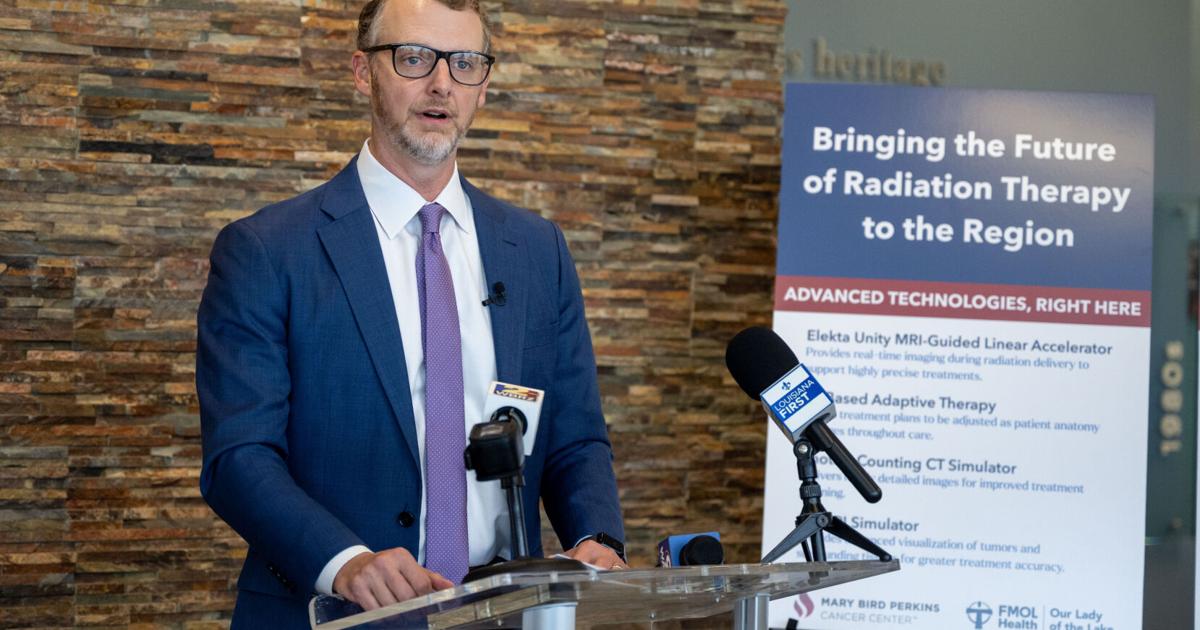
Five years after a bitter split, Our Lady of the Lake and Mary Bird Perkins Cancer Center are renewing their partnership to invest $10 million in radiation therapy technology, the healthcare providers announced Thursday.
The new tech includes an updated AI program for Mary Bird Perkins’ existing radiotherapy program that will allow doctors to see changes in tumors and surrounding anatomy, adapting treatment in real time and with greater precision.
In 2021, Our Lady of the Lake and Mary Bird Perkins had a bitter divorce after 30 years of working in tandem to treat cancer patients in the Baton Rouge region.
“It’s quite a departure from where we were five years ago, before my time,” said E.J. Kuiper, CEO and president of the Franciscan Missionaries of Our Lady Health System, which operates the Lake. “The biggest loser in that were the cancer patients.”
While the providers will not be connected physically, they will share patients who are in need of the highly specialized treatment.
New machines will be located on the first floor of Mary Bird Perkins. Patients could utilize the new technology as soon as next spring.
“It was an opportunity I was obviously excited about,” said Dr. Jonas Fontenot, CEO of Mary Bird Perkins Cancer Center. “Because it leverages the strengths of our individual organizations.”
The investment with Mary Bird Perkins will not get in the way of the Lake’s $70 million cancer institute set to open in the former Bone and Joint Clinic of Baton Rouge, which is down the street from the hospital.
“We’re offering a lot of services in the new cancer institute that we’re building right now,” Kuiper said. “Radiation oncology, which is really one of the specialties of Mary Bird Perkins, is not part of that scope.”
The Lake is in the final stages of selecting a contractor for the new institute and does not yet have a timeline for its completion.
Mary Bird Perkins is still with the national OneOncology network and remains separate from Our Lady of the Lake. But both Fontenot and Kuiper said they hope ongoing talks between the hospitals will bridge cancer care for patients in the Baton Rouge region and in Louisiana as a whole.
The investments
A key piece of the puzzle is an updated AI program for the Elekta Unity system, an MRI machine that guides radiation. The system enables doctors to see a tumor during the treatments while applying doses, reducing the number of sessions required for cancer treatment.
The treatment can be used on more than 40 types of cancerous tumors. The cancers that could be most impacted by treatment are certain gastrointestinal, lung, prostate, pancreatic and throat cancers.
The updated program will “grow the portfolio and the number of patients we can accommodate in this adaptive strategy that is specific and customized to (each patient’s) disease,” Fontenot said.
The organizations also invested in an advanced photon-counting CT simulator, which provides higher resolution images so doctors can see tumor borders clearly; CT-based adaptive technologies, which allows physicians to see when tumors move and alter radiation beams in real time; and a new 3T MRI simulator, which maps the potential path of radiation before treatment.
“It’s a great day for Baton Rouge, a bad day for cancer,” Kuiper said.