
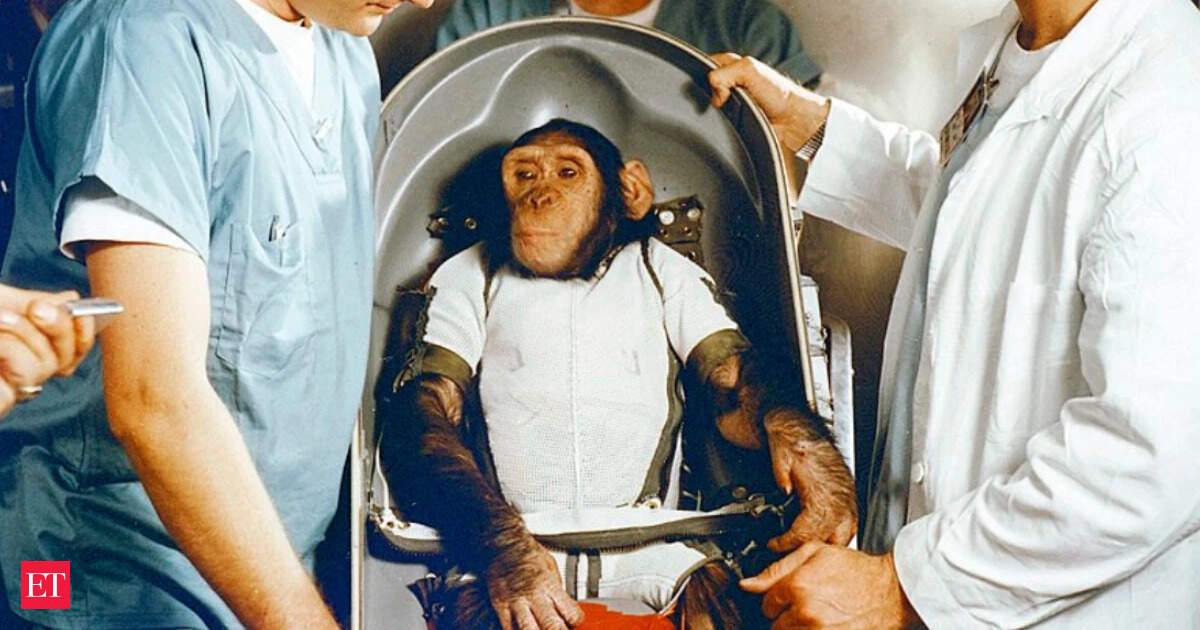
Before an American astronaut left Earth, a chimpanzee had already flown into space. On January 31, 1961, a three-year-old chimpanzee named Ham rode a Mercury-Redstone rocket 157 miles above the Earth and was safely returned after a flight of about sixteen and a half minutes, a mission that took place 65 years ago this year. According to NASA‘s official history of animals in space, the mission was designed to test whether a chimpanzee could still perform simple, trained tasks correctly during the stress of launch, weightlessness, and re-entry, before any human took that same risk.
Meet the chimp who trained like an astronaut
Ham was born in the wild in French Cameroon in July 1957. NASA’s history notes that his actual training began in 1959, when he was transferred to Holloman Air Force Base in New Mexico. His training was demanding. According to a study in the journal Military Medicine titled “HAM, A Space Pioneer,” Joseph V. Brady, a behavioral neuroscientist at the Walter Reed Army Institute of Research, worked with NASA to prepare Ham for the mission. That research describes a system of lights and levers, in which Ham was supposed to flip one lever every 20 seconds or so to prevent a mild electric shock to his foot. Smithsonian records add that Ham would receive a reward for a correct response, usually a banana pellet or a drink of water, while a wrong response would result in a light shock. This system let scientists test whether a primate, and later a human, could still perform simple tasks under the stress of spaceflight.

Ham in a spacesuit. Image Credits: NASA via Wikimedia Commons
The flight nearly went off course
Ham’s mission was supposed to reach an altitude of about 115 miles and land 290 miles downrange. However, the mission did not go exactly as planned. Ham’s capsule was far off target because of technical problems with the Redstone booster. The spacecraft reached an altitude of 157 miles and a speed of 5,857 miles per hour, landing 422 miles downrange instead of the planned 290, according to NASA’s mission history. The Smithsonian corroborates these figures and notes that Ham experienced stronger g-forces than anticipated, but survived the flight without serious harm.
 Live Events
The capsule had one more problem waiting. After splashdown, ocean waves battered the capsule’s landing bag system, and the resulting wear tore the heat shield loose once the craft was already in the water, a separate failure from the launch and re-entry itself. That forced NASA to redesign the system and conduct one more booster test flight before it would risk a human crew. Ham had already done his part by then: he worked the levers as trained and was reported to be in good health after his recovery, according to the Military Medicine study. NASA history notes that his total flight was about 16.5 minutes, including some 6.6 minutes in weightlessness, and a post-flight medical exam showed him only slightly fatigued and dehydrated.
Ham reaching out for an apple. Image Credits: Wikimedia Commons
One chimp’s flight that helped pave the wayFollowing Ham’s success, NASA launched its first human into space: Alan Shepard, on May 5, 1961, on a path not much different from the one Ham had already survived. The stakes went well beyond a single launch. The Military Medicine study notes that this work was happening in the middle of a race with the Soviet Union to put the first man safely into orbit, which meant NASA could not afford to send an untested system into space. That same research explains that Ham’s flight gave NASA the real proof that a living passenger could correctly perform assigned tasks through launch, weightlessness, and re-entry, precisely the evidence engineers needed before they could clear a human being for the same journey.
A legacy that still orbits our imagination
The mission was not the end of Ham’s story. Records show he was put on display at the Washington Zoo in 1963 and spent almost 20 years mostly alone. In 1980, he was transferred to the North Carolina Zoological Park in Asheboro, where he could finally interact with other chimpanzees. He died on January 17, 1983, at the age of 25. Today, Ham is remembered as one of the early figures in human spaceflight, even though he was never human. For readers watching rocket launches livestreamed on their phones today, Ham’s flight is a reminder that space travel depended on more than engineers and rockets, and it also depended on a well-trained chimpanzee that was sent into the test flight first.