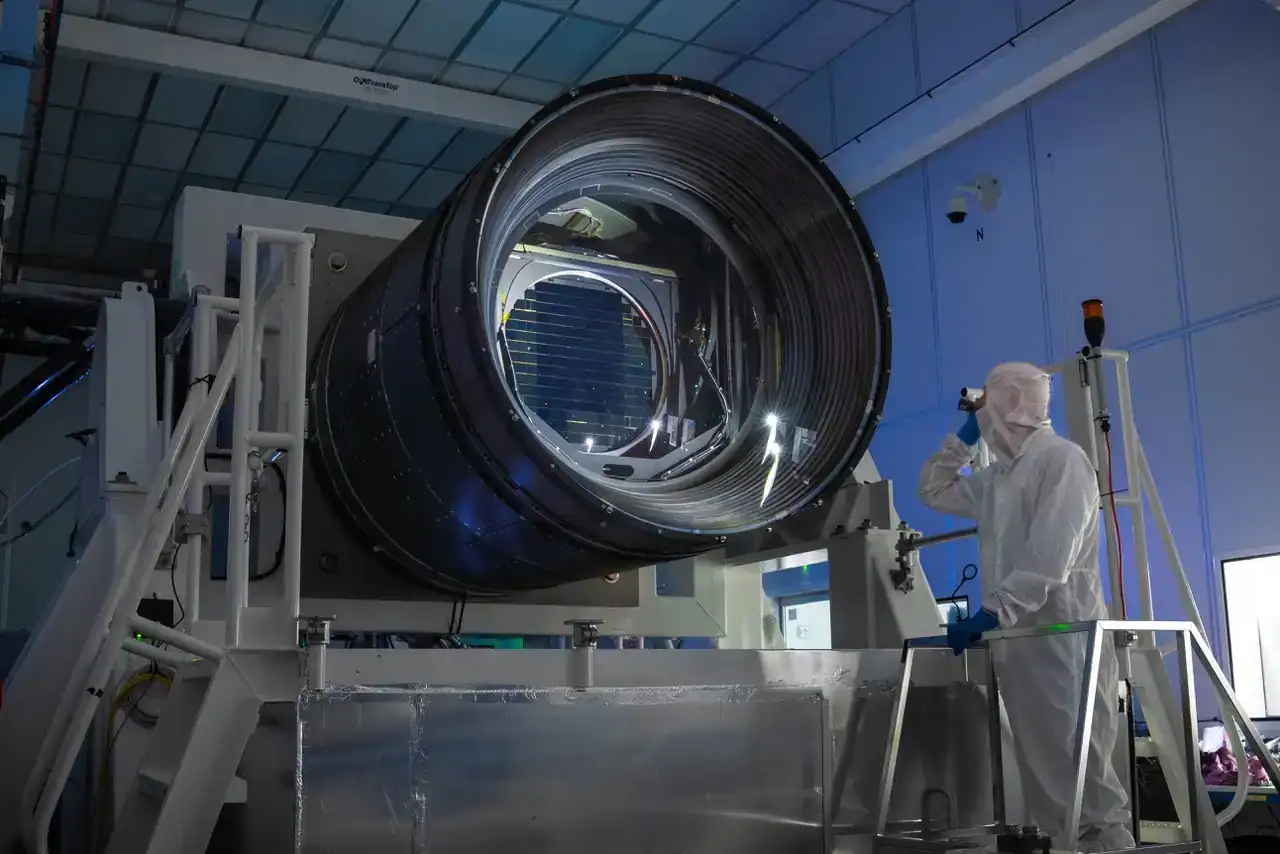
 The LSST camera, with one of the color filters positioned in place. Credit: Olivier Bonin/SLAC National Accelerator Laboratory
On a remote Chilean mountaintop, inside a domed observatory named after astronomer Vera Rubin, a camera unlike any the world has opened its eye to the universe. It’s not just ridiculously large — it’s historic. The first images from this 3,200-megapixel optical juggernaut were released to the public last year. This camera, capable of capturing a golf ball from 15 miles away, signals the dawn of a new era in astronomy.
The LSST Camera — short for Legacy Survey of Space and Time — is the centerpiece of the Vera C. Rubin Observatory. At 1.57 meters across, its lens is officially the largest ever made, earning a Guinness World Record. Behind it lies a mosaic of 189 ultra-sensitive CCD sensors, cooled to -100°C to reduce electronic noise. Together, this system produces crystal-clear images of the cosmos, night after night.
The camera photographs the southern sky, sweeping across 3.5 degrees of sky at a time — about seven times the width of a full moon. Each exposure lasts 15 seconds. Then, with a deep mechanical sweep of its shutter, the telescope moves on to the next patch.
This will repeat 1,000 times a night, every night, for the next decade.
“We will achieve a level of clarity and depth never seen before in images covering the entire southern hemisphere sky,” said Aaron Roodman, Deputy Director of Rubin Construction at SLAC National Accelerator Laboratory.
Rubin publicly unveiled its first major images in June 2025. But that was a preview rather than the formal beginning of its main survey. After another year of commissioning, the 10-year Legacy Survey of Space and Time officially began in ernest in late June 2026. The observatory is now collecting about 10 terabytes of data on a typical night and is expected eventually to catalog some 20 billion galaxies and 17 billion stars.
Here are 7 images that show what that looks like — from a fractal vegetable used to test the camera to fields containing millions of galaxies.
1. The Trifid and Lagoon Nebulae
 In this immense image NSF-DOE Vera C. Rubin Observatory offers a brand new view of two old friends: the Trifid and Lagoon Nebulae. The image provides a demonstration of what makes Rubin unique: its combination of an extremely wide field of view and the speed that allows it to take lots of big images in a very short time. Below the Trifid Nebula in this image is the Lagoon Nebula (or Messier 8), another vibrant stellar nursery glowing about 4,000 light-years away. You can actually spot the Lagoon with just a pair of binoculars or a small telescope. At its heart is a cluster of young, massive stars — their intense radiation lights up the surrounding gas and shapes the swirling clouds into intricate patterns. The Lagoon nebula provides scientists with a great place to study the earliest stages of star formation — how giant clouds collapse, how star clusters take shape, and how newborn stars start to reshape their environment. Credit: NSF–DOE Vera C. Rubin Observatory/NOIRLab/SLAC/AURA.
One of Rubin’s first showcase images looks like an impossibly dense painting of the Milky Way.
×
Thank you! One more thing…
Please check your inbox and confirm your subscription.
The observatory combined 678 exposures collected during just over seven hours to reveal the Trifid Nebula above the larger Lagoon Nebula, two enormous clouds of gas and dust several thousand light-years away in Sagittarius. The full composite contains almost five billion pixels.
Pink hydrogen-rich clouds, dark dust lanes and blue regions shaped by young stars fill the frame. But the most important feature may be its sheer scale. Rubin can show structures within individual star-forming clouds without sacrificing the enormous surrounding star field.
That combination of width and detail is fundamental to the telescope. It can study a particular stellar nursery while simultaneously recording millions of other objects that happen to share the same patch of sky.
2. A mega cluster of ancient stars
 Credit: RubinObs/NOIRLab/SLAC/NSF/DOE/AURA
This is NGC 6544, a globular cluster: a densely packed, roughly spherical swarm containing tens of thousands of stars. The Milky Way has roughly 150 known globular clusters, many populated by stars that formed during the galaxy’s early history.
That makes them valuable cosmic fossils. Because so many stars occupy a relatively small region and share a common origin, astronomers can use clusters to study how stars age and how the Milky Way assembled.
Rubin’s wide images therefore work at two scales at once. What looks like a small bright knot in the full panorama becomes, on closer inspection, a stellar metropolis.
3. Galaxies everywhere!
 Credit: NSF–DOE Vera C. Rubin Observatory/NOIRLab/SLAC/AURA
At first glance, this image of the southern Virgo Cluster looks like a particularly crowded star field.
It is much stranger than that.
Except for a scattering of foreground stars in the Milky Way, almost every visible speck is an entire galaxy. Rubin’s First Look panorama contains roughly 10 million galaxies, sitting in a region of sky centered about 55 million light-years away.
Even that enormous number represents only about 0.05 percent of the roughly 20 billion galaxies Rubin expects to catalog during its 10-year survey.
4. Now let’s zoom in
 Credit: RubinObs/NOIRLab/SLAC/NSF/DOE/AURA
Now zoom into one galaxy near the edge of that immense Virgo image.
Dust lanes that were barely visible in the wider panorama become dark streaks winding through its spiral arms. Individual patches of star formation emerge. Even more remarkably, many of the tiny points surrounding the galaxy resolve into still more distant galaxies.
That is the unusual advantage of a survey telescope with Rubin’s combination of collecting power and resolution. Astronomers do not have to choose quite as starkly between seeing a broad region and seeing faint detail within it.
Over 10 years, each region in the main survey is expected to be visited hundreds of times. Stacking those exposures will make progressively fainter structures visible while retaining a record of what changed from night to night.
5. Endless stars in Lupus
 Credit: RubinObs/NOIRLab/SLAC/NSF/DOE/AURA
This 1.7-gigapixel view of the constellation Lupus is simply stunning.
Millions of Milky Way stars fill the image, with distant galaxies scattered behind them. Across the foreground hangs a faint, smoky veil known as galactic cirrus — wisps of interstellar dust illuminated by the combined light of nearby stars.
Such structures can be easy to overlook, but Rubin is built to detect faint features spread across large regions of sky.
6. Messier 21 is a stellar family portrait
 Credit: RubinObs/NOIRLab/SLAC/NSF/DOE/AURA
Messier 21 is another open cluster, but a remarkably young one.
Its stars are estimated to be only about 6.6 million years old. In astronomical terms, they are infants. Because the stars probably formed from the same molecular cloud at roughly the same time, the cluster gives astronomers a snapshot of early stellar evolution.
Many of its members are relatively faint, yet Rubin pulls them from the crowded background.
The telescope will ultimately measure billions of Milky Way stars, allowing researchers to trace not only clusters but larger stellar streams and structures. Those patterns preserve clues to the galaxy’s past, including encounters with smaller galaxies that the Milky Way absorbed long ago.
7. A spiral wrapped in dust
 Credit: NSF–DOE Vera C. Rubin Observatory/NOIRLab/SLAC/AURA
Here Rubin isolates another spiral galaxy.
Dark filaments of dust coil around its bright central region, while patches of luminous blue stars trace portions of the outer disk. These blue concentrations often mark sites of relatively recent star formation, where massive, hot stars briefly dominate the light.
Images like this may look similar to classic galaxy portraits from Hubble and other telescopes, but Rubin has a different job.
It is not primarily designed to spend hours scrutinizing one chosen galaxy. It will collect galaxies by the billions while repeatedly sweeping huge regions of sky. Individual objects become entries in an enormous statistical experiment — and, when one suddenly changes, a target for closer inspection by other observatories.
The machine beneath the Milky Way
 NSF–DOE Vera C. Rubin Observatory sits beneath a sweeping arc of the Milky Way on Cerro Pachón in Chile, poised to survey the Southern Hemisphere sky and create an unprecedented time-lapse view of the Universe.
 The NSF–DOE Vera C. Rubin Observatory team installing the LSST Camera on the Simonyi Survey Telescope in March 2025. | Credit: RubinObs/NOIRLab/SLAC/NSF/DOE/AURA/B. Quint
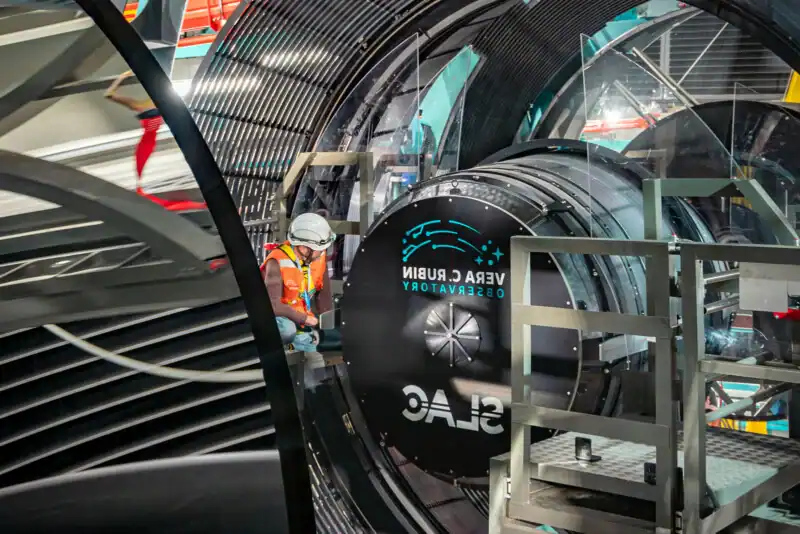 Credit: RubinObs/NOIRLab/SLAC/NSF/DOE/AURA/B. Quint
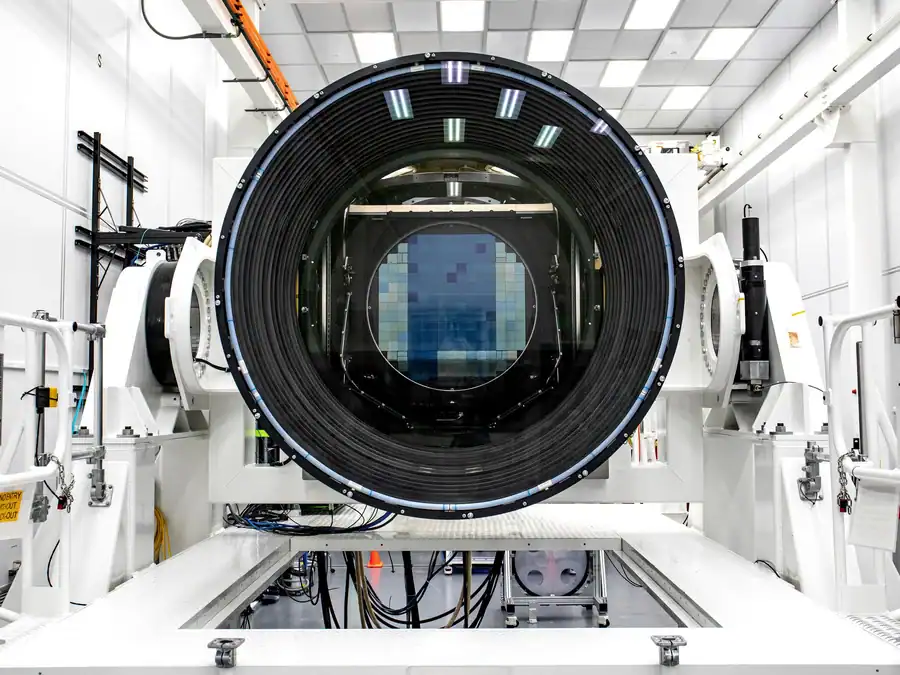 The camera’s detectors, the silver and blue squares, are seen through its uncapped 1.5-meter-wide lens. Credit: Jacqueline Ramseyer Orrell/SLAC National Accelerator Laboratory
The spectacular pictures released so far are only snapshots from a machine whose real scientific value is only beginning to show.
“What used to take years or decades to discover, Rubin will unearth in months,” astronomer Mario Jurić said in the observatory’s April 2026 announcement.
Above the observatory building, the Milky Way forms an enormous arc — precisely the sort of view Rubin was built not merely to photograph, but to measure repeatedly.
Over the coming decade, Rubin will revisit the sky again and again, accumulating trillions of measurements. Somewhere inside that torrent will be asteroids no one has catalogued, stars caught in their final moments, galaxies behaving unexpectedly and perhaps phenomena astronomers do not yet have names for.