
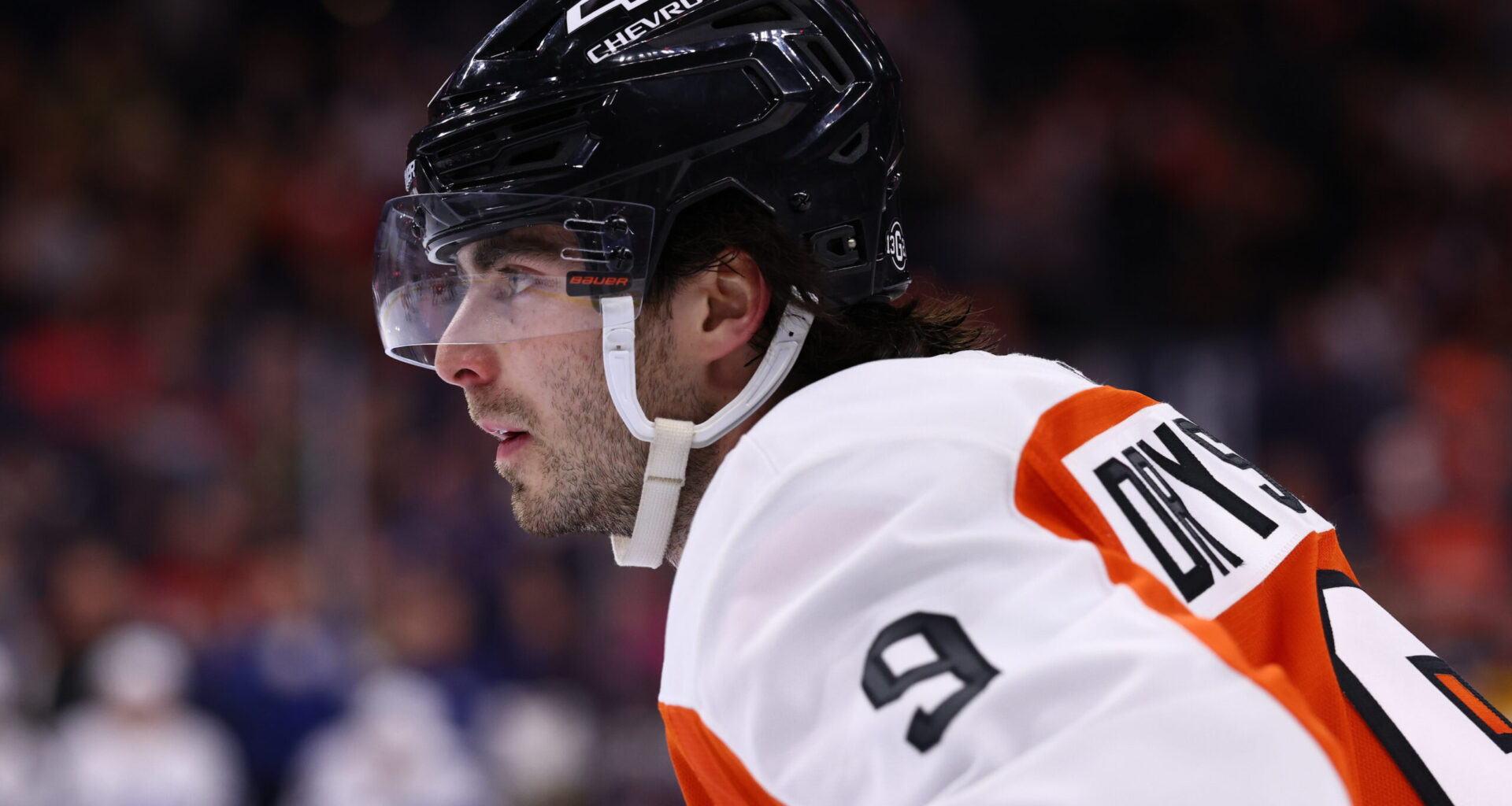
The Flyers will most likely bring a bevy of players with them to training camp. Some of them will be there for a few days, getting a taste of what a NHL training camp runs like, and enjoy the experience before heading back to junior, or Lehigh Valley. Others will survive the first few cuts and be on the bubble to surprise the organization. And then there are those who are guaranteed to be on the club barring a calamity or some season-ending injury.
There are a handful of players currently on the roster who could find themselves moving up the lineup and thereby getting more playing time. Obviously, if everybody is rolling, then certain players down in the pecking order are going to have to become red hot to hurdle over a winger or center in the top nine. Or a top-pairing blueliner. But a few players are looking to make a case not just for remaining with the club, but to make a bigger impact with the Flyers. Here are three such players we think could make the move into more important positions.
Noah Cates
Cates is coming off his best season in his career, with 18 goals, 47 points, and led the team in plus/minus (+26) by a country mile. The two-way player is coming into his own it seems. He probably won’t see himself breaking out like Sean Couturier did in 2017-18, where he surged to his first of consecutive 76-point seasons after registering just 34 points in 66 games during 2016-17. But considering he managed to do that much in just over 16 minutes per game, what could Cates do with two or three more minutes of ice time if bumped into the top six of Philadelphia forwards?
Another factor to consider is that Cates generated that production with a revolving door of linemates. He spent 180:07 playing with Bobby Brink and Matvei Michkov five-on-five. Brink and Tyson Foerster were with him for 145:01 in the same situation, while Michkov and Denver Barkey were with him for 83:39. In addition to those three combinations, Cates spent at least 50 minutes or more five-on-five with three other different combinations. He, Foerster, and Travis Konecny were together (78:55) for a spell. Cates played with Michkov and Carl Grundstrom (54:16), and finally he was between Brink and Nikita Grebenkin (50:55). Of course, with injuries and some lines not going, there’s bound to be changes on the fly. However, should Cates starting finding some chemistry with the two wingers on his line from the onset, it’s possible he begins seeing a bit more ice time to show his wares.
It wouldn’t be a huge stretch to see Cates in the 55-point to 60-point range. And considering the lack of production down the middle, every little bit helps. Although he turns 28 next year, and might be at his prime in terms of what he can be, there’s a chance Cates sees a bigger role with Philadelphia this season than at any point in his career.
Jamie Drysdale
Let’s begin this by stating the obvious. If Rasmus Ristolainen remains healthy and playing a lot of decent minutes, it’s almost a given he’s going to find himself alongside Travis Sanheim on the top Flyers defensive pairing. At least before he’s moved. It would be foolish to probably suggest something otherwise. However, if he gets injured, or if his play falls off, it would be the perfect opportunity for Jamie Drysdale to get a crack at the top pair alongside Sanheim. Drysdale has evolved quite nicely in his time here. The short stint he had after arriving from Anaheim was a stretch where one could see the assets and speed he had in his game. But it also revealed that he had a lot of work to do on the defensive end.
In 2025-26, Drysdale saw everything increase for the good. He played almost every game, missing only four during the season. He had one more goal over 2024-25, and ended up with a credible 32 points. Just over a quarter of those points came on the power play, but it wasn’t nearly enough to move the needle regarding the team improving with the man advantage. Perhaps most importantly, the coaching staff (and Todd Reirden) trusted Drysdale a bit more than in his last year under John Tortorella. He averaged 1:38 more ice time per game over 2024-25, which is a testament to the fact he looked like a better defenseman from start to finish. He picked his spots, and he rarely looked out of sorts.
That’s not suggesting Drysdale is going to evolve into the next Quinn Hughes or Cale Makar. He probably isn’t going to approach that tier at any point in his career. However, if Ristolainen plays well, and Drysdale is playing solidly alongside Cam York while providing more offense, it wouldn’t be a huge stretch to see Drysdale take that step into the team’s number two defenseman. And perhaps develop a strong partnership with Sanheim.
According to NHL Edge, Drysdale’s speed is in the ninety-eighth percentile (23.51 miles per hour), and his shot is in the ninety-second percentile (98.46 miles per hour). Although Drysdale would clearly be giving up size in comparison to Ristolainen, you can’t get hit often if you are blowing by opposing forecheckers. He’s young, and still has some things to learn. But he’s developed into far more than what most expected when he first arrived.
Matvei Michkov
This should be a given. Michkov has to put in the work, and has to hit the ground running the minute the puck is dropped against Pittsburgh. It’s unclear how many regulars are going to get playing time in the exhibition season. But considering there’s only four games for the club to see what combinations work, Michkov might even need to dazzle and dominate if he’s dressed against Washington on Sept. 21. But the talent is there, the training and conditioning was obviously put in this summer, and he has a lot to prove. Michkov is hoping he can build off 2024-25, not be floundering like he was for parts of 2025-26.
Ideally, Michkov and Rick Tocchet have mended whatever fenced needed mending. If they haven’t, it’s a good bet Flyers general manager Danny Briere locked them in a room until they did. But the Russian youngster is probably going to make it next to impossible for the team to not see him playing in the top two lines. Relegating him to third-line minutes (or even less than that) — especially if the defensive side has been pretty much cleaned up — would seem asinine at best. Criminal at worst. If Michkov finds himself with a player like Trevor Zegras, or possibly a younger, more creative center like Denver Barkey, then chances are Michkov’s production is going to substantially improve.
He has to put the work in, and ensure that he buries his chances whenever he gets a chance. If he’s able to do that early on, look for Michkov to start looking like the confident, high-end talent he was in 2024-25. As much as Philadelphia is seeking him to do that, he’s probably wanting it more himself. And that’s saying a lot! The sour taste of being scratched in an elimination game would piss off any player, and provide fuel to have any naysayers eat their words. Michkov looks to make his mark in 2026-27, and should be finding himself playing first-line or second-line minutes most of the year.