
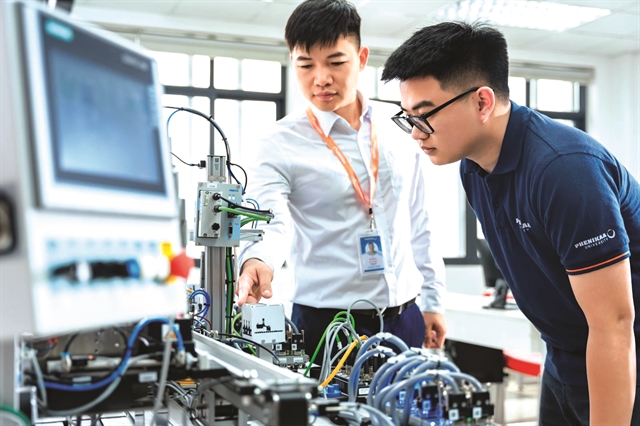
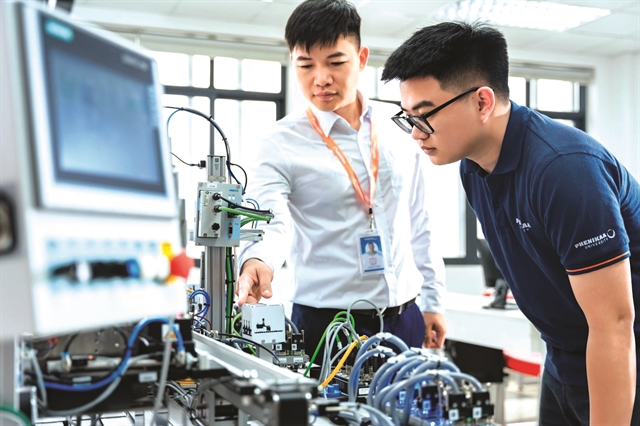
 Researchers at Phenikaa University work in a laboratory as Việt Nam expands its research and training capacity in quantum technology. — Photo baotintuc.vn
By Mai Hương
HÀ NỘI — For Việt Nam, the quantum race is no longer a question of whether to join, but how far it can go. The country has a strong foundation in mathematics, computer science and young talent – yet the hardest step lies ahead: building expertise in quantum physics, hardware and the experimental technologies at the heart of the field.
Quantum technology uses quantum physics for computing, communications and sensing. Once largely theoretical, it is now moving into real-world applications and attracting growing investment worldwide.
Việt Nam identifies quantum technology as one of the country’s strategic priorities under a resolution on breakthroughs in science, technology and innovation adopted by the Communist Party in December 2024, also called Resolution 57, providing a stronger policy basis for research, training and cooperation.
But industry experts said the country should focus less on simply joining the race and more on building the foundations needed to develop its own capabilities.
Building the core
Associate Professor Lại Ngọc Điệp, a lecturer and researcher at Université Paris-Saclay in France, said Việt Nam already had an important advantage.
The country has a strong young workforce in mathematics and computer science. These skills are useful for quantum algorithms, computing and information processing, according to Điệp.
“In the quantum world, I see Việt Nam’s potential as quite good, but it is in the later part,” Điệp said, adding that although Việt Nam was strong in the “back end” of quantum technology, particularly mathematics, computing science and IT, it lacked the specialised expertise needed in quantum physics – the core of the technology.
Physics is already difficult to attract young people to, while quantum physics is even more challenging, according to Điệp.
The gap is also visible in research infrastructure.
Research groups are beginning to work on quantum computing and related areas, but the country still lacks dedicated laboratories for many experimental quantum technologies.
Điệp said training and research must develop together, with investment in laboratories and equipment if Việt Nam wants to build core technologies rather than continue providing supporting services to foreign companies.
Điệp cited French quantum computing company Quandela as an example of Vietnamese expertise in the field, with Vietnamese partners contributing to its information technology work while the company develops the core technology.
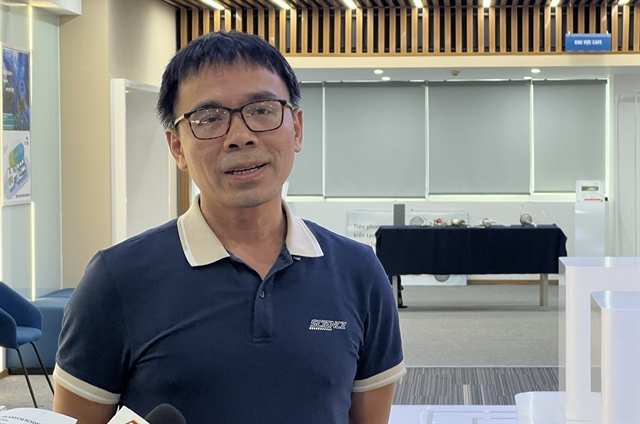 Associate Professor Lại Ngọc Điệp, a lecturer and researcher at Université Paris-Saclay in France, speaks to media. — VNS Photo Mai Hương
This suggests that Việt Nam has a possible entry point and the challenge now is to move further up the value chain.
Businesses and research institutions are also entering the field.
FPT, Viettel and Phenikaa are exploring quantum technology, while some universities and the Vietnam Academy of Science and Technology are developing training and research in the field.
Nguyễn Văn Duy, PhD, a researcher and head of the Quantum AI Labs group at Phenikaa University, said Việt Nam did not yet have a dedicated university programme in quantum technology, with existing programmes mainly focused on conventional physics. However, at least four universities are now preparing new courses, mainly in quantum computing.
His group is working on several areas, including superconducting circuits, quantum gates, quantum error correction, optimisation algorithms and quantum simulation.
Quantum and artificial intelligence are another emerging area. AI could help design quantum circuits, improve the control of quantum gates and support error correction. At the same time, researchers hope future quantum computers could provide new ways to accelerate some AI tasks, although the field remains at an early stage.
Growing the talent
According to researchers, the next challenge is to build a training and research system that can produce specialists for the whole quantum value chain.
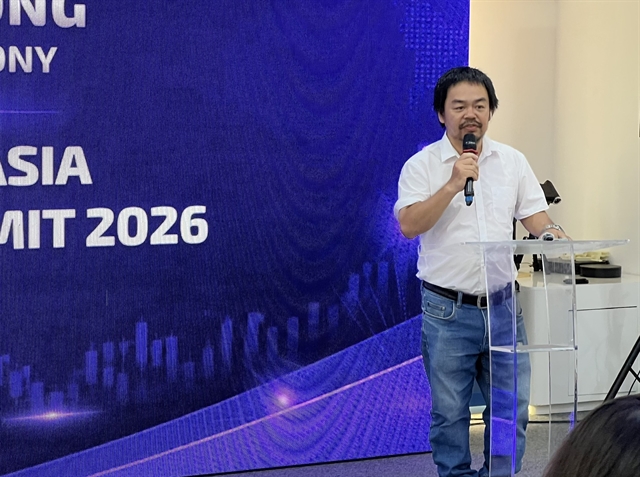 Nguyễn Văn Duy, PhD, head of the Quantum AI Labs group at Phenikaa University, speaks at a recent discussion on quantum technology. VNS Photo Mai Hương
Duy said one possible approach would be to create joint postgraduate programmes involving several universities.
Rather than each university trying to develop a complete programme with a small number of researchers and limited facilities, institutions in the same region could pool their expertise and infrastructure. He said similar models were already operating in France.
Training also needed to begin earlier.
His research group has organised a summer programme introducing quantum technology to high school students, with many participants coming from specialised physics schools. The programme is intended to encourage more young people to consider quantum technology before entering university.
International cooperation can help expand that talent pool.
Điệp has supervised more than eight Vietnamese PhD students in different fields, including four in quantum technology. Some have gone on to work for French companies developing quantum computers, quantum sensors and quantum communications.
He believes more Vietnamese scientists working overseas could contribute to the development of the sector at home.
But bringing them back would require more than offering a salary.
Scientists would also need laboratories, equipment, research teams and an environment where they can do meaningful work. Điệp said Vietnamese researchers overseas were willing to contribute, but suitable mechanisms and policies were needed to give them confidence to participate.
One model is already being tested through cooperation between Vietnamese and international scientists.
A quantum summer programme organised with support from VinIF has brought five professors from five countries to Việt Nam to teach young researchers. The professors are also expected to support the students in research over the following year.
Điệp said such models could be expanded.
The cooperation should not be limited to bringing foreign experts to Việt Nam. Vietnamese students and researchers could also spend time at overseas laboratories, creating a two-way exchange of knowledge and experience.
The regional network could also be expanded. Duy said the number of quantum researchers in ASEAN countries remained small, making regional cooperation important for organising conferences, workshops and research exchanges.
Building the ecosystem
International experts see the same need for a broad ecosystem.
Denis Avetisian, senior adviser at Rosatom Quantum in Russia, said a quantum industry could not be built simply by buying a quantum computer or creating a single research institute.
A quantum industry needs three basic elements: strategy, education and infrastructure, supported by skilled scientists, engineers and leaders who understand the technology, according to the expert.
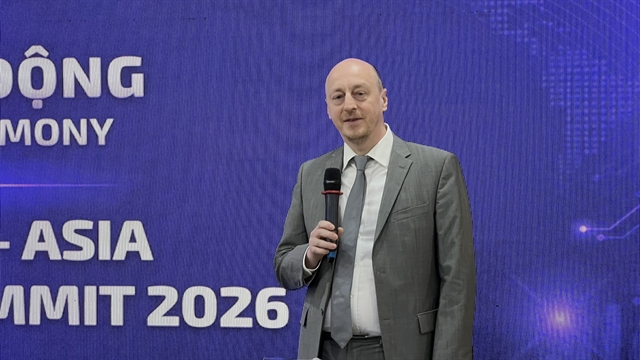 Denis Avetisian, senior adviser at Rosatom Quantum in Russia. VNS Photo Mai Hương
Roberto Mauro, chief product officer and general manager for Asia-Pacific at French quantum computing company Pasqal, also sees an opportunity for Việt Nam.
He said the country had mathematical and physical talent, a semiconductor and electronics base to build on, and the institutional will to move forward.
“The window to enter this field is open now, not in ten years,” he said, adding that Pasqal aims to be a long-term partner in Việt Nam’s quantum ecosystem, supporting research, training and practical applications.
That window, however, will not remain open indefinitely. For Việt Nam, the opportunity is clear, but turning potential into a genuine quantum capability will require patience, sustained investment and a willingness to build from the ground up.
Quantum technology is not a field that can be developed in a few months. Training researchers, building laboratories and mastering core technologies will take years. The challenge now is to ensure that Việt Nam is ready to make the most of the opportunity while the window remains open. — VNS