
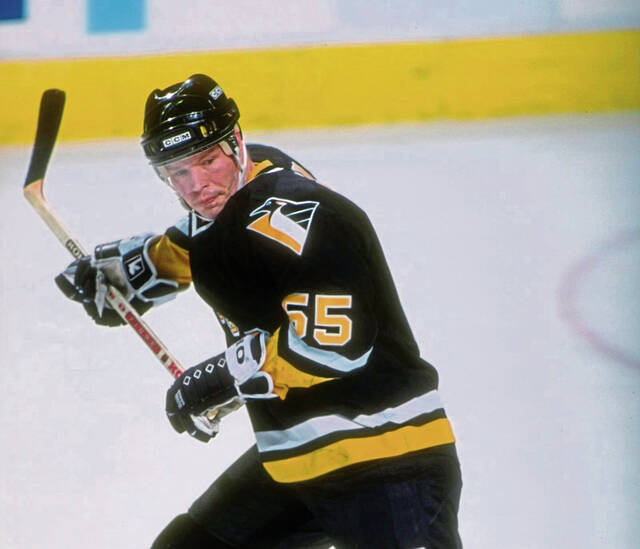
Larry Murphy is in the Hockey Hall of Fame because he won four Stanley Cups — two with the Pittsburgh Penguins (1991, ‘92) and two with the Detroit Red Wings (‘97, ‘98).
He also played 1,615 NHL games, the most by any NHL defenseman at the time of his retirement after the 2001 season. His 1,217 points are fifth all-time among blueliners. He’s also a three-time NHL All-Star and a two-time Canada Cup winner.
Those reasons are also why Murphy was recognized as a Pittsburgh Penguins Hall of Famer on Aug. 20 along with goalie Marc-Andre Fleury, general manager Jim Rutherford and former team president and franchise pioneer Jack McGregor. The group will be inducted prior to a game against the Ottawa Senators on Nov. 14.
But Murphy also had two specific skills that, 31 years after he last wore a Penguins jersey, still resonate with Pittsburgh fans who watched him skate at the Civic Arena.
Few who played the game were more consistent at keeping the puck in the attacking zone — especially on the man-advantage. It’s part of the reason why Murphy can boast 547 power play points, sixth-most among defensemen in the history of the league.
The other was the fabled “Murphy Dump.”
“Keeping the puck in, a lot of that is hand-eye coordination and evaluating the situation,” Murphy told me on a recent “Breakfast With Benz” podcast. “I wasn’t a guy that played with a lot of speed or had the hardest shot, but I really prided myself on being in the right position at the right time and making the right decisions. When the puck was on my stick, the chances were that I was going to get it to somebody and put him in a good position.”
The “Murphy Dump” was a basic aspect of the game that Murphy did with such regularity that the act eventually became branded with his name. Murphy claims that the moniker came from his former teammate Bob Errey, and was eventually mainstreamed by legendary Penguins broadcaster Mike Lange.
Murphy perfected the art of lofting the puck out of his zone and over the heads of the opposition, while still having enough control to land it without enough momentum to travel for an icing violation.
“It’s a very effective play,” Murphy said. “It puts the defense in a tough spot, especially landing it behind them. They have to find the puck, and at the same time, your forwards are barreling down on them.”
Murphy was so precise that he often got the puck to flatten out so that his own forwards could track it down and control it.
“The forwards would find it. The guys would love it,” Murphy said. “Phil Bourque would go crazy every time. I mean, he’s just a guy that could skate. I don’t know how many times he was able to blow by a defenseman and recover the puck. He couldn’t get enough of that.”
Murphy credits his junior coach in Peterborough, Gary Green, for refining his skills to make the play a go-to move on the ice.
“At the end of practice, he would have everybody line up on the goal line and just literally flip the puck out of the zone,” Murphy recalled. “That simple drill kind of stuck with me.”
Murphy’s first coach with the Penguins, Bob Johnson, embraced Murphy’s technique and encouraged him to use it often after the Penguins acquired him before the 1991 Stanley Cup playoff run.
“Bob Johnson loved it,” Murphy said with a laugh. “Sometimes he came running down the bench after I made a play. ‘That was great! That was fantastic!’ So I just stuck with it.”
Murphy said the most important aspect of the “Murphy Dump” was knowing when to try it.
“You had to evaluate if you had the time,” Murphy explained. “You had to get the puck in the right position, pull it back to your blade, and then flip it. The goal was, ‘The higher the better.’ The higher you got the puck, for the most part, the more it came down straight, the less chance it would continue for icing.”
Perhaps better phrased, according to Murphy, the most important aspect of the play was knowing when you shouldn’t try it.
“The most important element was don’t flub it,” Murphy emphasized. “Because you’re basically coughing up the puck, and it’s a pretty juicy giveaway at that point.”
Also, during our podcast, Murphy flashes back to the trade that brought him to Pittsburgh, his two championships with the Penguins, his titles in Detroit, playing with Rutherford and teaming up with Paul Coffey.