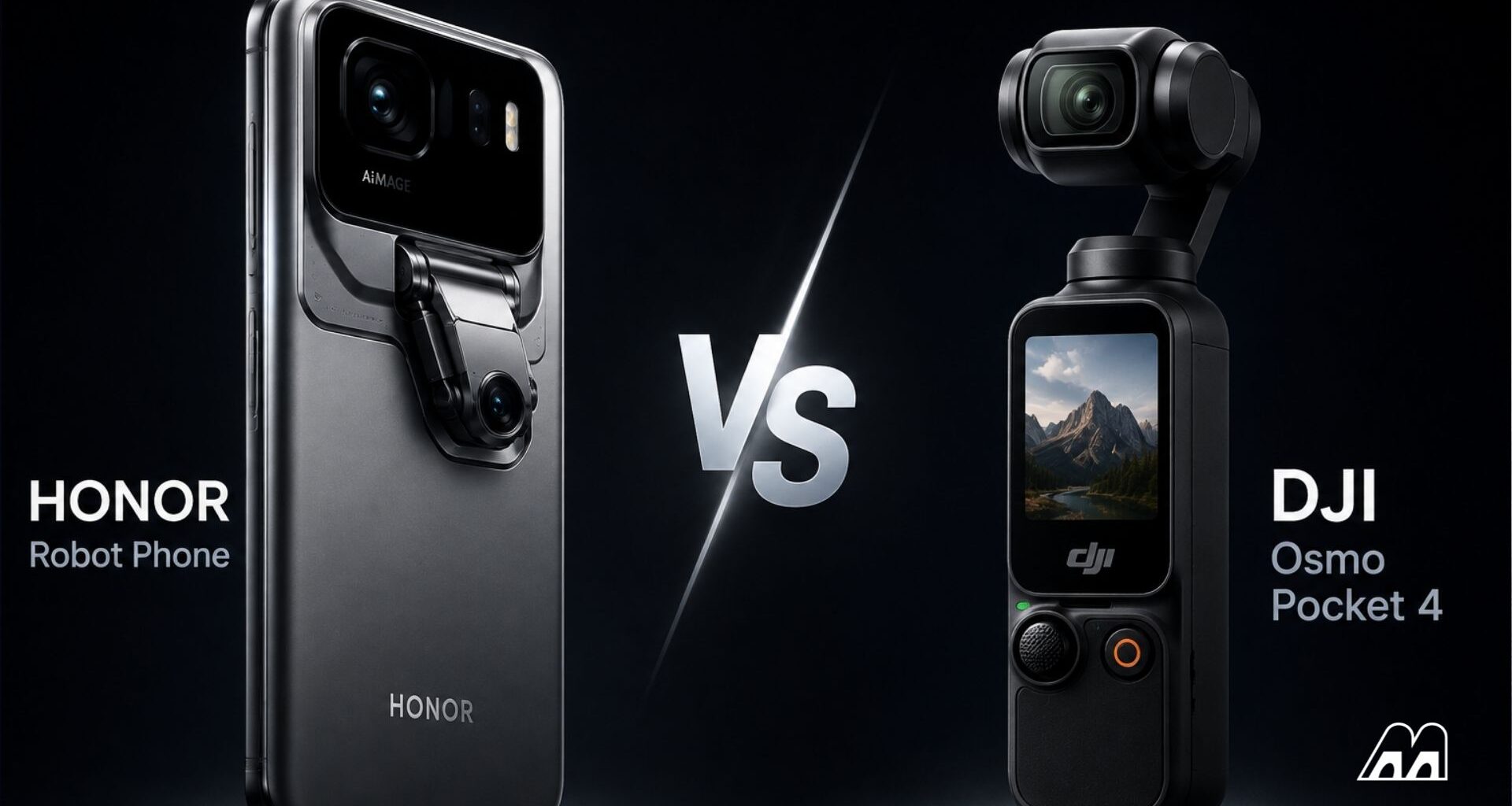
The HONOR Robot Phone is not a concept any more. It launched on 12 August 2026 with a fully motorised three-axis gimbal built into a titanium arm that deploys from the rear of the phone in about 0.8 seconds, and for the first time the question is not whether a phone can stabilise video at all but whether a separate pocket gimbal camera still earns its place in your bag.
The DJI Osmo Pocket 4 is the natural benchmark. It is the device most solo creators would otherwise buy for walk-and-talk vlogging, built from the ground up as a dedicated video tool with a 1-inch sensor, mechanical three-axis stabilisation, 4K at 240fps, 14 stops of dynamic range and 107GB of onboard storage. Here is how the two compare, and more importantly, who each one is actually for.
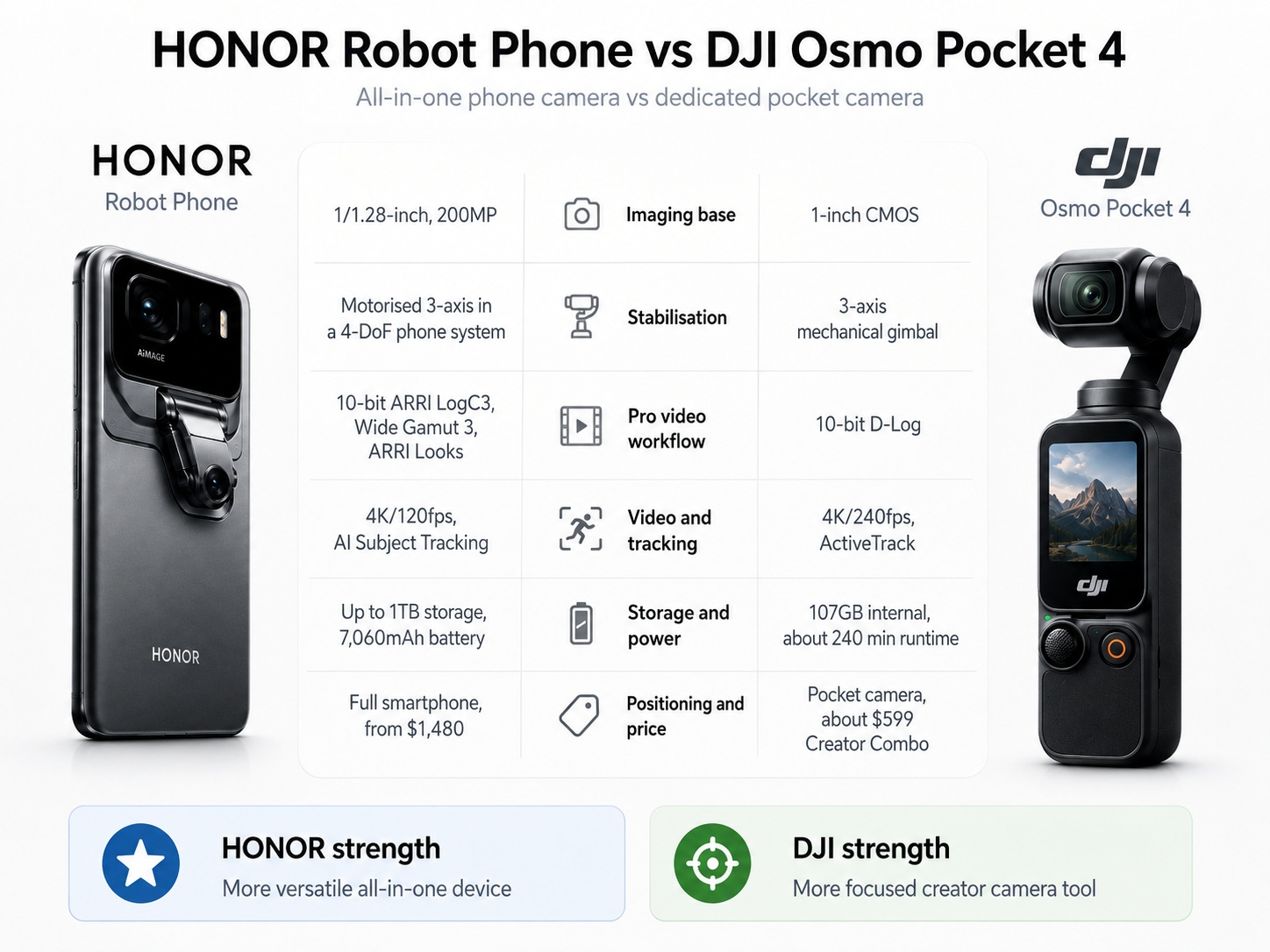
Specs at a glanceCategoryHONOR Robot PhoneDJI Osmo Pocket 4Main sensor1/1.28-inch, 200MP f/1.61-inch CMOSStabilisationIntegrated motorised 3-axis within 4-DoF system3-axis mechanical gimbalLog workflow10-bit ARRI LogC3, ARRI Wide Gamut 3, ARRI Looks10-bit D-LogDynamic rangeUp to 14 stops (AI-optimised)14 stopsTrackingAI Subject Tracking + voice-source localisationDJI ActiveTrackVideo4K/120fps4K/240fpsStorageSmartphone storage (up to 1TB)107GB internalBattery7,060mAh (also a phone)~240 min operating timePriceFrom $1,480 (12GB/512GB, China)~$599 (Creator Combo)Device typeFull smartphoneDedicated pocket camera
HONOR specs are from HONOR’s own launch announcement and ARRI’s confirmation. DJI specs are from DJI’s product page. The 14-stop dynamic range on the Robot Phone is an AI-assisted claim from HONOR; ARRI has confirmed the LogC3 integration but not the dynamic-range figure independently.
Stabilisation is where HONOR gets surprisingly close
This is the section that matters most, because it is the whole reason the comparison exists. HONOR’s 4-DoF gimbal system contains over 100 precision components, uses a 2.6-gram titanium motor capable of 360-degree-per-second movement, and supports AI subject tracking, gesture recognition and voice-source localisation that can rotate the camera toward whoever is speaking.
Marketing aside, the independent testing is what counts. Tom’s Guide tested the Robot Phone against both the iPhone 17 Pro Max and the Insta360 Luna Ultra, a dedicated pocket gimbal camera in the same class as the Pocket 4. Their finding: the gimbal delivered “remarkably smooth footage with zero micro-jitters,” and subject tracking stayed locked during normal walking with other people moving through the scene. The Luna Ultra was still slightly better at keeping a fast-moving subject near the frame edge, but the reviewer noted the margin was smaller than expected. PetaPixel’s hands-on was blunter, calling the device “not a gimmick” and noting it tracked subjects with solid consistency and good stabilisation. For a phone with moving parts, that is a genuinely strong showing.
DJI still has the bigger imaging foundation
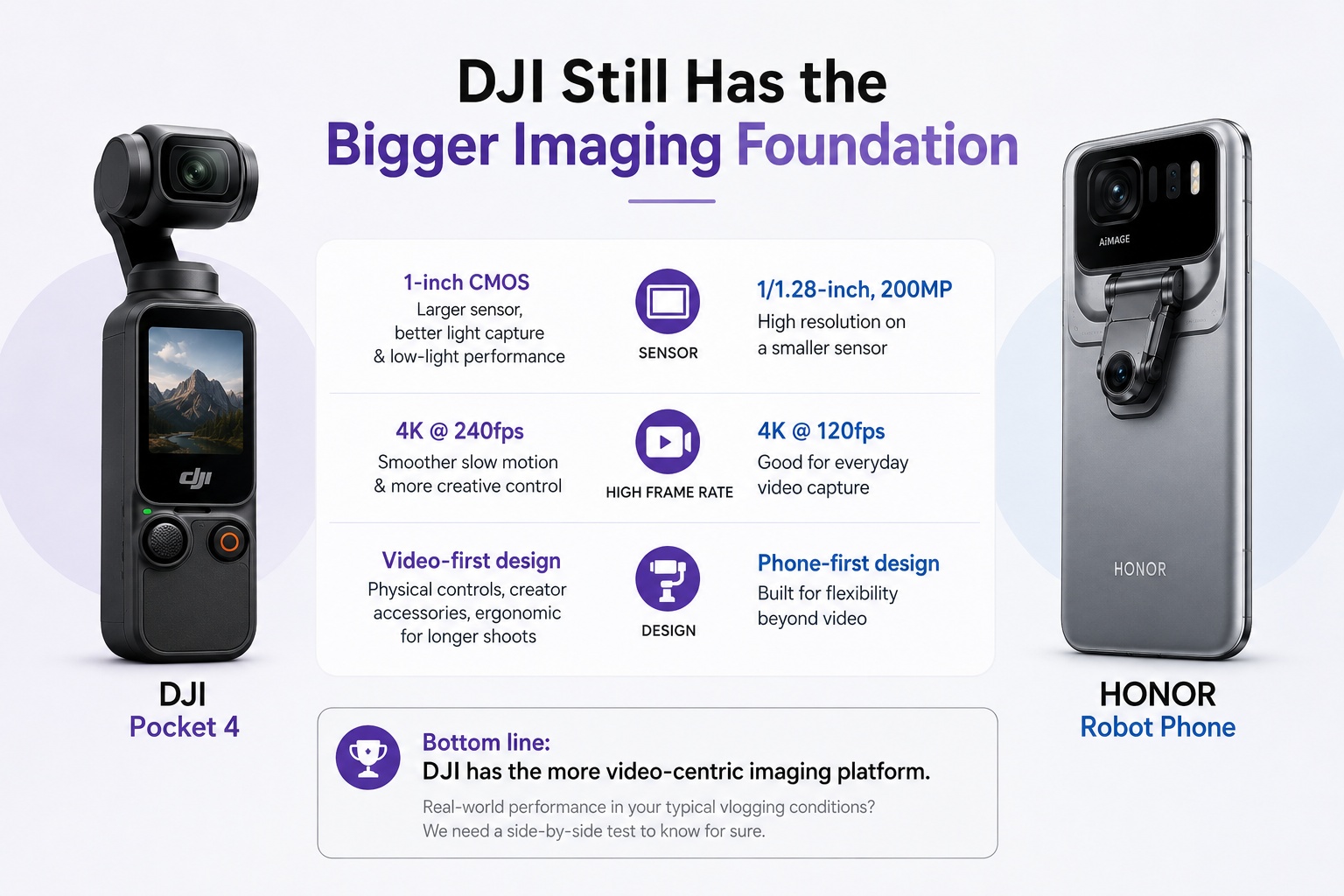
It is tempting to read “200MP versus 1-inch CMOS” and declare a winner, but that comparison is misleading in both directions. The DJI Pocket 4 uses a physically larger 1-inch sensor, which generally captures more light and handles noise better than the Robot Phone’s smaller 1/1.28-inch chip, even though HONOR packs far more pixels onto it. DJI also supports 4K at 240fps versus HONOR’s 4K at 120fps, which gives the Pocket 4 a clear edge in high-frame-rate capture and slow-motion work. And the Pocket 4 was designed from the start as a video-first device, with dedicated physical controls, creator accessories, and an ergonomic form factor built for extended handheld shoots.
On hardware alone, DJI retains the more video-centric imaging platform. Whether that translates into visibly better footage in the conditions most vloggers actually shoot in requires a controlled side-by-side test that, as of late August, nobody has published for this specific pairing.
HONOR may have the more interesting colour workflow
This is where the Robot Phone does something no other phone currently does. Through its partnership with ARRI, the camera manufacturer behind much of Hollywood’s production pipeline, the Robot Phone supports native 10-bit ARRI LogC3 recording, ARRI Wide Gamut 3 and real-time-previewable ARRI Looks, all processed through HONOR’s H1 imaging chip. ARRI’s CPO David Bermbach confirmed that this is the first time ARRI’s image science has been deployed on a consumer device.
The Pocket 4 has its own legitimate log workflow in 10-bit D-Log with 14 stops, and it is well-proven across the creator community. But HONOR’s ARRI integration gives a smartphone unusually direct access to an established cinema colour pipeline, which is a genuinely novel capability rather than just a spec-sheet talking point. Whether you can tell the difference in a finished YouTube video is a different question, but for anyone who grades their footage in DaVinci Resolve, the ARRI path is a meaningful offering.
For solo creators, convenience may matter more than image quality
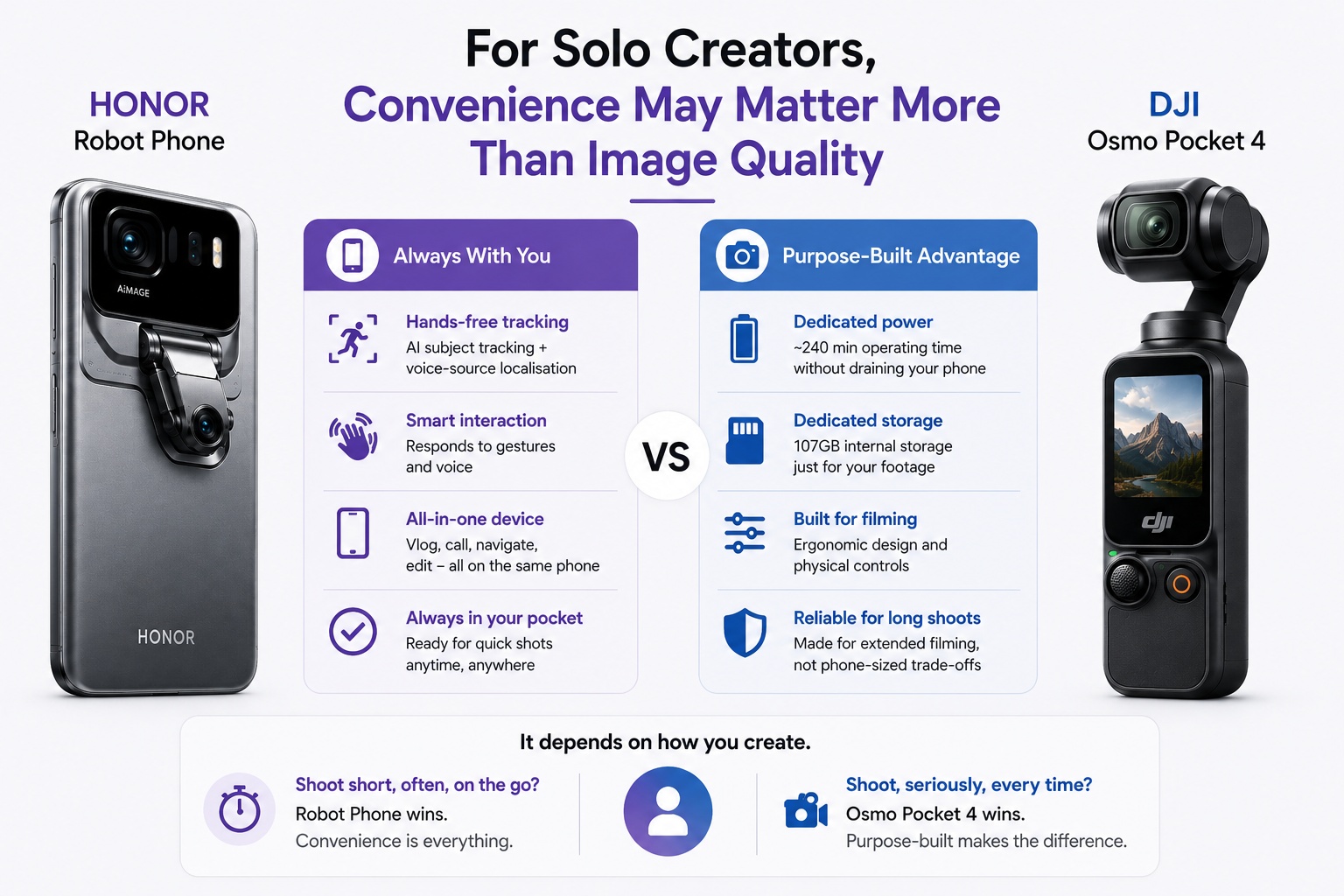
This is the heart of the decision, and it is where the Robot Phone’s pitch is strongest. The phone is always with you. It can track a subject hands-free. It responds to gestures and voice. It can vlog, take calls, run maps and edit footage on the same device without any additional hardware.
The Pocket 4 is an additional device you have to remember, charge, carry and manage separately. But being a dedicated device is also its advantage: it has purpose-built controls, a dedicated battery that does not compete with your phone, 107GB of storage that does not fill up alongside your apps and photos, and ergonomics designed for extended filming rather than for fitting in a phone chassis. If you shoot for two hours straight, the Pocket 4’s form factor and battery independence win. If you shoot for two minutes twenty times a day, the Robot Phone’s always-in-your-pocket presence wins.
The biggest unanswered question is durability
HONOR says the gimbal’s structural strength is 200% greater than its internal design reference, and the titanium motor is built to 360-degree-per-second precision. Those are manufacturer claims on a product that has been on sale for roughly two weeks. Independent long-term durability data does not exist yet, and the concern is reasonable: a mechanical gimbal inside a device you carry in your pocket, drop on tables and occasionally fumble onto pavement is a very different engineering proposition from a gimbal inside a device that lives in a protective case when not filming. The scepticism is understandable, but currently anecdotal. HONOR’s durability claims need months of real-world use before they can be treated as proven.
Who should consider which
The HONOR Robot Phone makes more sense if you vlog casually, shoot lots of walk-and-talk content, prioritise always-with-you convenience, want a phone and camera in one device, are drawn to the ARRI log workflow, and dislike carrying a separate gadget. Keep the DJI Pocket 4 if you shoot long sessions, depend on predictable ergonomics and a dedicated battery, want the 1-inch sensor’s low-light advantage and 4K/240fps, use DJI’s accessory ecosystem, or cannot afford to have your phone tied up as your primary camera while you need it for calls and navigation.
Verdict
HONOR has not made the dedicated gimbal camera obsolete. What it has done is make carrying one optional for a much larger group of creators than anyone expected a phone could reach. The Pocket 4 remains the better pure filming tool. The Robot Phone is the better all-in-one compromise, and the gap between “compromise” and “dedicated” is smaller than it has any right to be.
Marko is a tech journalist covering AI, consumer technology, crypto, and digital innovation. His work focuses on clear, accessible reporting that helps readers understand how new technologies are shaping business, finance, and everyday life.