
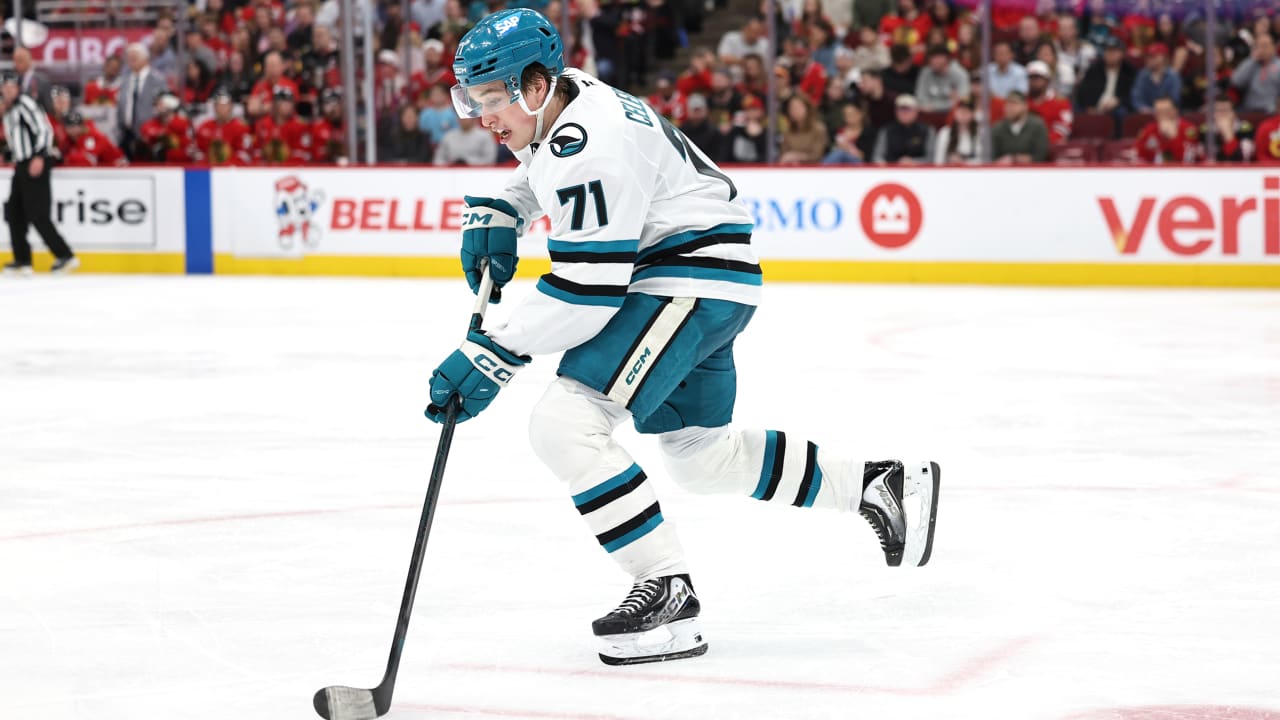
When San Jose won the 2024 NHL Draft Lottery and selected Celebrini with the No. 1 pick, some believed that the Sharks had obtained a “Jonathan Toews-type” — good scorer and two-way player — but even that positive assessment missed the mark. Coaches have labeled him a unique talent equivalent to New York Islanders defenseman Matthew Schaefer, the 2026 Calder Trophy winner voted as NHL rookie of the year.
“Both Celebrini and Schaefer are generational players,” Islanders coach Peter DeBoer said, “not just in their talent but in their commitment and maturity at such a young age. I haven’t seen players that young have such an impact on their respective franchises — both on and off the ice — since Pittsburgh’s Sidney Crosby.”
Celebrini’s associates, such as Sharks director of goaltending Evgeni Nabokov, underline the point.
“I’ve been around the NHL a long time,” Nabokov said, “and all things considered — especially his age — Macklin is remarkable. His compete level all over the ice is unreal and his shiftiness is something rare to watch.
“Plus, he’s able to pull it off by using his speed, while his shot has a great release. ‘Mack’ is very elusive and never gets tired because he’s got a mighty engine. I love watching him in practice. He tries something different all the time.”
Celebrini had 10 points and led the 2026 Winter Olympics with five goals — tying Jarome Iginla from 2010 in Vancouver for the most by a Canadian in a single Games with NHL participation — to help Canada win the silver medal and was voted the IIHF Male Player of the Year. He signed a five-year, $94 million contract with the Sharks on July 29, with an average annual value of $18.8 million that was passed when Makar signed an eight-year, $163.2 million contract ($20.4M AAV) with the Avalanche on Aug. 28, the first deal in League history to go more than $20 million a year.
“That was at the front of my mind throughout the whole negotiation,” Celebrini said Aug. 27. “I want to make sure that with where the (NHL salary) cap was going, that the number made sense for the team first and foremost. Making sure that everyone can get paid and that we’re in a good spot to build the way we want to build, I felt like we kind of landed on that number.”
The prodigy was starring as a 14-year-old at Shattuck-St. Mary’s School in Faribault, Minnesota, Mike Johnston, general manager of Portland in the Western Hockey League, realized that a generational performer was on the horizon.
“I’ve been in junior hockey for the last 15 years and Celebrini was the best young player I’ve ever seen,” Johnston said. “What stood out about him was his energy, his drive, his compete and his high-end skill and vision. He drove the play every shift, nonstop. You don’t often see elite players with that high motor work ethic and compete.”
Looking back seven decades, one can find a center whose game grew just as fast as Celebrini’s, Hockey Hall of Fame forward Henri Richard, the “Pocket Rocket,” of the Montreal Canadiens.
“Henri wasn’t supposed to make the team at our training camp in 1955,” said coach Toe Blake in my book “The Flying Frenchmen.”
“The Pocket was only 18, too young for prime time, but he was our best player in every scrimmage. We couldn’t cut him.”
Henri, the kid brother of Maurice “Rocket” Richard, was a catalyst for the Canadiens dynasty that won the Stanley Cup for an unprecedented five consecutive years from 1955-60.
At the moment, Celebrini will be pleased if he can jump-start the Sharks to a playoff berth this season.
“If anyone can do it,” Nabokov said, “Macklin is the man.”
NHL.com independent correspondent Max Miller contributed to this report