
85,500 wild horses, burros roam in the US. Here’s how their population has grown

Data Visualization Journalist
There are about 85,500 wild horses and burros, or wild donkeys, across the U.S. — a population that has more than doubled since 2012.
Related video above: Bureau of Land Management holds wild mustang adoption event in Cullman County, Alabama, in 2024
The horses — which roam throughout 10 western states — have recently drawn attention after The New York Times reported that some are ending up in slaughterhouses through third-party buyers after being sold by the federal government.
The Bureau of Land Management maintains that it does not send wild horses to slaughterhouses.
A growing population
The wild horse and burro population began to grow dramatically in 2012, but has leveled off since 2020, according to a Get the Facts Data Team analysis of BLM data.
The animals have no natural predators, and BLM estimates that unmanaged wild horse herds can grow 15-20% per year.
When the herd size grows beyond what the land can support, the horses’ body condition can deteriorate, and starvation is a risk, according to a BLM spokesperson.
Where are the horses?
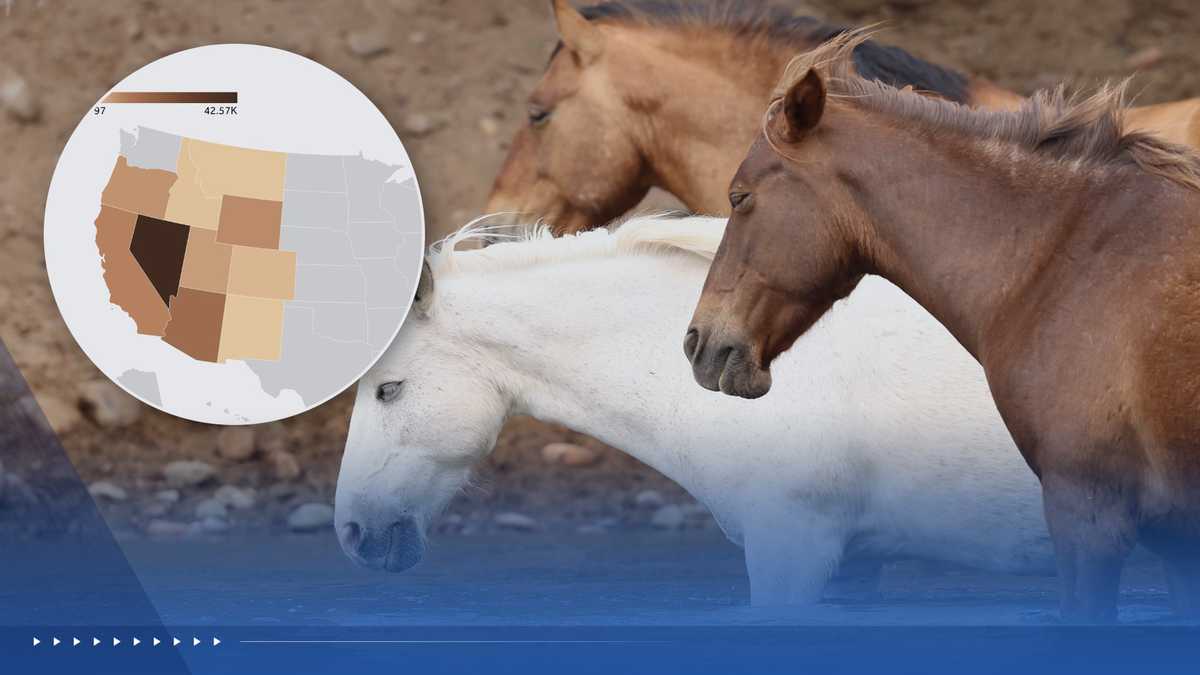
The majority of wild horses and burros are located in Nevada, which has more than 42,500 of the animals.
Arizona has the greatest burro population, at about 13,500, in addition to about 270 wild horses.
Behind Nevada, Wyoming has the second-highest horse population at 7,165.
Some wild horse populations are outside of BLM’s mandated responsibility.
Maryland’s Assateague Island, for example, is home to 83 wild horses, per a March 2026 census by the National Park Service. Two of those horses were struck and killed by motorists on the island this summer.
How many wild horses are sold?
In the past year, federal sales of wild horses have tripled.
In fiscal year 2025, the federal government sold 2,387 horses. The year prior, it sold 793.
Some of those horses were sold for as little as $25 per animal.
As for burros, about 1,330 were sold last fiscal year, 85% more than the year prior.
Wild horses and burros are sold as a form of population control, according to BLM. Last fiscal year, 7,853 horses were removed by BLM from the range and either adopted, sold or placed in off-range pastures.