
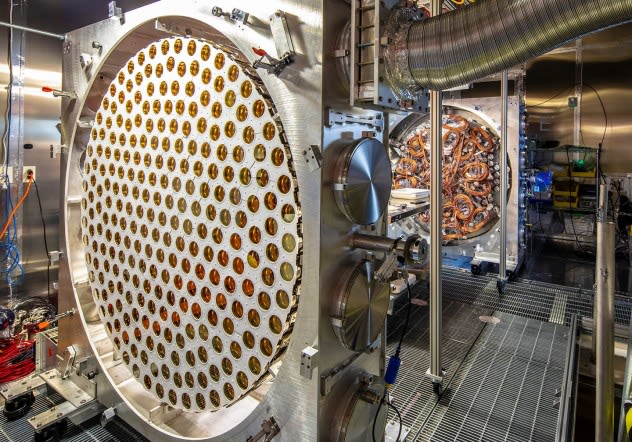
Nearly a mile beneath South Dakota, scientists conducting an experiment detected a particle interaction unlike anything else they have seen.
One possibility has researchers particularly intrigued: It could be dark matter.
Dark matter is thought to make up roughly 85% of the mass in the universe, according to NASA, yet scientists still do not know exactly what it is. Researchers around the world have spent decades designing experiments to detect dark matter and learn more about it, but a direct detection has remained elusive.
The unusual signal was recorded by the LUX-ZEPLIN experiment, also known as LZ, which operates nearly 1 mile underground at the Sanford Underground Research Facility in South Dakota. The experiment is supported by the U.S. Department of Energy and includes about 250 scientists and engineers from around the world.

An image of the LZ, which uses tubes to capture light from particle interactions. (Sanford Underground Research Laboratory)
Researchers said the single event appeared in the part of the experiment where they would expect dark matter to show up, while interference from known background signals is extremely low, according to a Department of Energy (DOE) press release.
That does not mean scientists have found conclusive evidence of dark matter, but after months of studying other possible explanations, researchers have not been able to easily account for what happened.
“This is the first example in any experiment I’ve worked on of an outlier that appears valid in every way. Of course, we’re still twisting our brains trying to think if there’s a rare background mechanism we could’ve missed, but it’s thrilling to wonder if this could be the first hint of a dark-matter observation,” Berkeley Lab physicist Aaron Manalaysay said in a press release.

This NASA image shows two massive galaxy clusters previously captured by NASA’s James Webb Space Telescope and Chandra X-ray Observatory, with areas of possible dark matter in blue. (NASA via AP)
Why search for dark matter a mile underground?
The unusual location is an important part of how the experiment works.
LZ uses 10 tonnes of extremely pure liquid xenon to search for tiny flashes of light created when particles interact with the detector. Scientists are specifically looking for WIMPs, or weakly interacting massive particles, one theoretical type of dark matter particle, according to the DOE.
Placing the detector nearly a mile underground helps block cosmic rays and other particles from space that could create false signals. Additional shielding, including a large water tank, helps researchers filter out even more interference.
The new finding came from an analysis of 220 days of data collected between March 2023 and April 2024. Researchers expanded their search beyond the simplest types of dark matter interactions and found one event that stood out.
According to the DOE, researchers estimate there is about a 0.5% chance that the event could be explained by the known background signals they studied. Physicists require much stronger evidence before declaring a discovery, especially when dealing with something as elusive as dark matter.
Scientists will now keep collecting data and watching for more unusual interactions. If similar events begin appearing, the case for dark matter could grow stronger; if not, researchers may eventually find another explanation for the mysterious signal.