
The Steamboat Springs City Council heard a sobering assessment of behavioral health in the Yampa Valley on Tuesday: Despite strong awareness of local resources and a reputation for community support, many residents still face loneliness, high levels of substance use and persistent barriers to getting care when they need it.
Brittney Wilburn, executive director of Northwest Colorado-based nonprofit The Health Partnership, summarized to council at their Tuesday meeting the results of two surveys sent out in the winter: one to community members, and another to healthcare providers.
Around a year ago, the Yampa Valley Community Foundation joined the Katz Amsterdam Foundation Network, a group of 12 mountain resort communities in the west fueled by the ski industry and tourism with a focus on improving mental health in those communities.
The first project the foundation undertook, explained YVCF Vice President of Philanthropy Traci Hiatt, was a community and provider behavioral and mental health survey created in collaboration with The Health Partnership.
The surveys aim to identify the “highest-priority gaps” in behavioral and mental healthcare and potential pathways to improve mental health outcomes in both the short and long term.
“We asked our community two questions: how are you doing, and can you get the help you need when you need it?” said Wilburn.
Around 975 residents between Routt County and the city of Craig were surveyed. The vast majority of respondents live in the valley year-round, and nearly half were between ages 18 and 44. Ninety percent of respondents were white, 7% were Hispanic or Latino, 11% were below the federal poverty level and 79% are employed, including those who identify as self-employed.
For the provider survey, 72 providers responded, with 54% identifying as licensed clinicians, 59% saying they work alone and 5% offering services in Spanish. Over 90% were not Hispanic or Latino.
The survey results revealed that, while loneliness averages in the Yampa Valley are in parallel with national data, local substance use disorder rates are comparatively “through the roof,” said Wilburn.
Four central themes emerged from the data: hidden struggles, party culture, the need for locally available intensive outpatient services, and the importance of trusted community resources.
According to the survey, one in three Yampa Valley residents are lonely.
“What we know about our community is that those aged 18-39 experienced more poor mental health days, as well as the LGBTQ+ community and our Hispanic communities,” explained Wilburn, “and our very low-income and Hispanic and LGBTQ+ communities are more lonely.”
Both community members and providers reported housing as being a primary stressor.
Wilburn said that prevention is also under-resourced. This includes activities or events that support people’s overall sense of connection and belonging — yoga, hiking, a sober group — that don’t necessarily involve a healthcare provider.
Alcohol, said Wilburn, is “very prevalent” in the social lives of respondents, with a majority of individuals in the valley engaging in alcohol use. Those drinking excessively, she added, are mostly men, individuals aged 18-39 and the Hispanic community.
Nearly 79% reported that drinking was very important to their social lives, while just over half reported that it has impacted their lives.
The statistics on trusted community resources were relatively positive, noted Wilburn, with 90% of respondents saying they would ask for help if they needed it. Over 83% of respondents said they are aware local behavioral health resources exist, and only 15% said they would not know what to do in a real crisis.
One tension that surfaced from the survey data was that, while responses reflected the Yampa Valley as being a caring and trustworthy community, people often find it difficult to discuss mental health challenges.
Across Craig and Routt County, 60% of respondents said their community was sympathetic toward mental health, but only 48% said it was easy to talk about. In Craig specifically, both of those numbers drop significantly.
The biggest barrier to local residents receiving the mental and behavioral healthcare they need, said Wilburn, is cost and insurance. But the real issues often go deeper than that, she added.
“It’s like, ‘I want to see somebody that’s not in my network,’ or ‘I want to see somebody who speaks Spanish because I’m a Spanish-speaking individual, and only five people in my community speak Spanish, and I can’t see them when they’re available because I’m working two jobs,’” said Wilburn. “There are just a lot of challenges.”
The Health Partnership shared the survey results with a coalition of mental and behavioral health stakeholders prior to the council presentation, asking them to “brainstorm some solutions.”
“The key areas that we felt like we could move the needle on were around affordability, resource awareness and navigation, broadening the spectrum of care, community wellness and prevention, and party culture,” said Wilburn.
In the affordability realm, stakeholders suggested organized coordination for providers around insurance, as well as improved employee assistance programs.
For both resource awareness and navigation and broadening the spectrum of care, stakeholders posted the creation of a centralized building where all nonprofits in the behavioral and mental health space live such that it reduces barriers for community members to access care.
Wilburn acknowledged the unhoused individuals in the community, along with those “in transition,” and emphasized the need to create “transitional opportunities” to get such individuals stabilized and back into the community.
In the community wellness and prevention space, the importance of free mental health services for both students and staff in schools, as well as parent and caregiver training, rose to the top.
Finally, on party culture, Wilburn said stakeholders suggested creating overnight parking near drinking hubs and a multi-use sober venue space. She added that a “boozeless campaign” is in the works.
Following the presentation, Councilor Dave Barnes asked whether the survey included questions on social media use. Wilburn responded that while the organization’s youth survey does ask those questions, the survey for adults did not.
“I do know that when we look at the data from 2022 to 2024 for the youth survey, there has been a decline in the number of poor mental health days and youth having trusted adults,” she said, “so there’s been a positive shift for youth over the past few years.”
Councilor Michael Buccino asked about particular data on impacts from marijuana use, which he described as a “huge aspect” in the local community.
Hiatt said that while “there’s a lot to be learned there,” the focus has remained more on alcohol-based anecdotal responses from UCHealth staff, emergency department personnel, law enforcement and first responders.
Council President Steve Muntean asked how the impacts of the results can be quantified, and tangentially, how success can be measured.
“For me, there’s so many goals,” said Wilburn. “One is that we reduce the crises that are happening, and so we would see fewer mental health holds in the hospital … and by the crisis response team.”
“I think we would see people getting connected to resources further upstream so that they’re not resulting in crises,” she continued, “and we would see loneliness levels decrease.”
Wilburn explained that The Health Partnership puts forward a community health needs assessment every three years, and that over the last three cycles, behavioral health has risen as a critical priority.
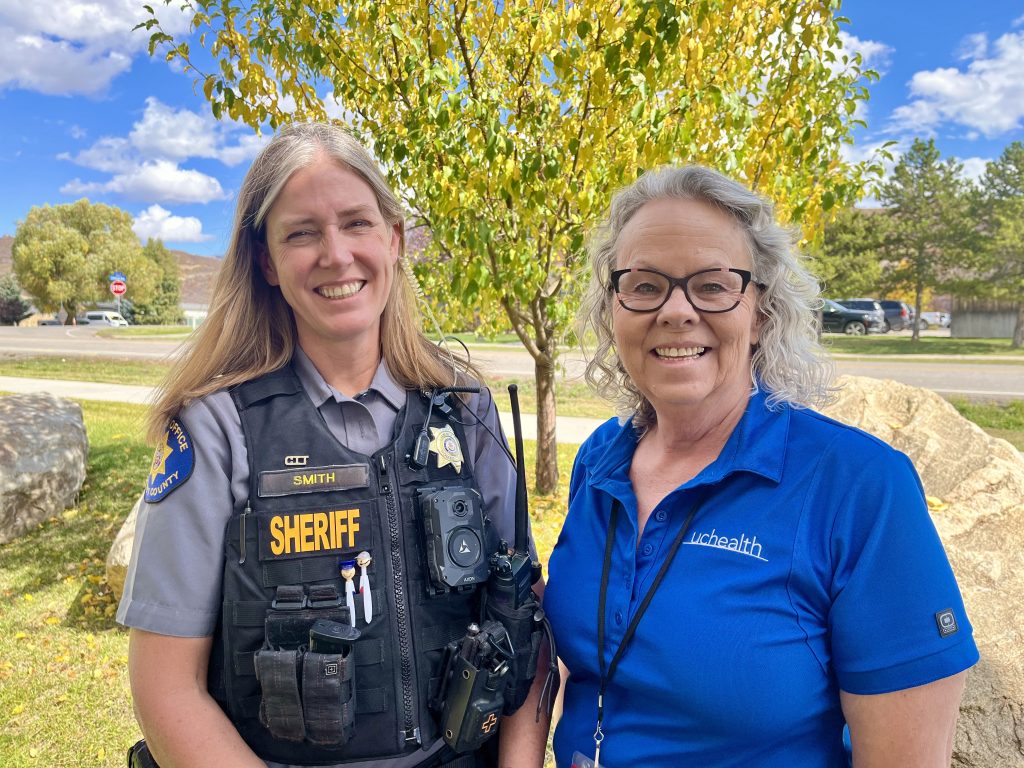
Recent progress in the behavioral and mental health space include the Routt County Sheriff’s Office launching a mental health response team, something Wilburn said has been “really successful”; a “Piensalo Bien” campaign to increase awareness around substance use disorders, alcohol use and drinking and driving in the Latino community; and the creation of the Hope Initiative, a soon-to-be-launched project that works with individuals who are struggling but not yet in crisis.