
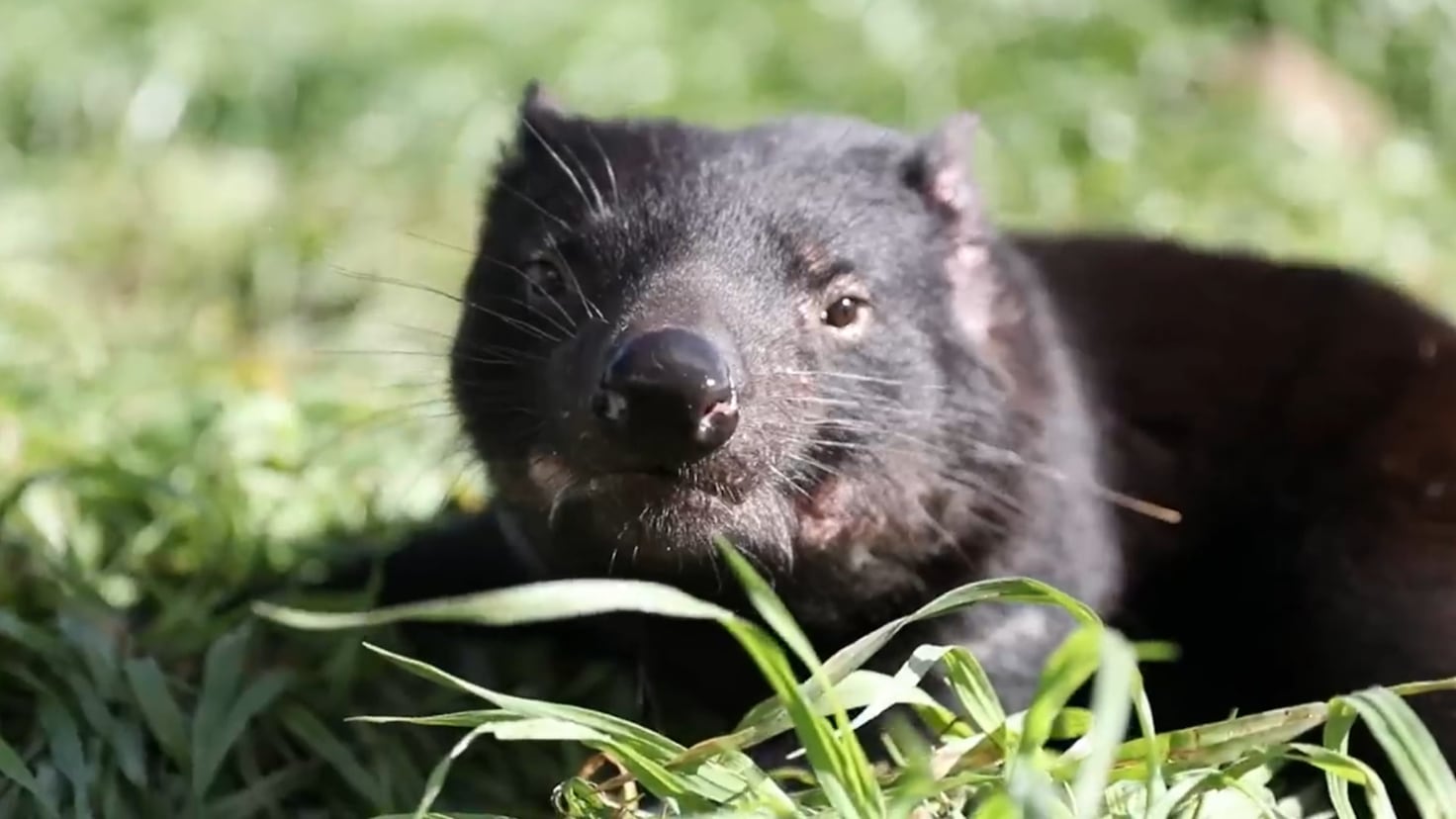
Just about everyone is familiar with the cartoon character Taz from the Looney Toons, the rambunctious Tasmanian devil who drills holes through everything he encounters as he spins like a tornado and devouring everything in sight. While the stocky, dog-sized carnivorous marsupials can seem fierce when a group of them are in a feeding frenzy, or when threatened, they are generally shy and cautious, preferring to avoid conflict with humans.
The apex predator once roamed all of Australia but by around 3,500 years ago, competition from dingos had erased their presence there and they could only be found on the island of Tasmania. That population though has been afflicted by a contagious form of cancer known as Devil Facial Tumor Disease (DFTD), shrinking their numbers by 90% since it was discovered in 1996. There are believed to be only around 25,000 Tasmanian devils left in the wild.
Since 2020, there has been a dedicated ongoing effort called Devil Back to reintroduce the Tasmanian devil back to the mainland carried out by Aussie Ark where they will hopefully remain safe from contracting DFTD. That year they released 26 individuals onto the nearly 1,000-acre Barrington Wildlife Sanctuary, a predator-proof haven about 190 miles north of Sydney.
Taz is back in Australia
The Tasmanian devils brought over by Aussie Ark have been busy at work growing their numbers. The program says that over 500 joeys, Tasmanian devil pups, have been born and they are now the largest mainland population.
However, many more were born but never made it. A female Tasmanian devil gives birth to around 20 to 40 joeys the size of a rice grain at the same time according to Tourism Australia. However, it is a life-or-death race to reach her four teats in her pouch, where just like kangaroo joeys those that succeed will stay until they can venture out on their own.
It is hoped that their reintroduction one day into the wilds of the Australian mainland will eventually help with rebuilding the ecosystem they once inhabited by controlling the populations of feral cats and foxes which hunt other endangered species.
Additionally, they will help keep the environment free of diseases. Besides devoring birds, snakes and other mammals up to the size of small kangaroos, they also scavenge for carrion, using their incredibly strong jaws to crush bones, allowing them to ingest them along with everything else.
Related stories
Get closer to the game! Whether you like your soccer of the European variety or that on this side of the pond, our AS USA app has it all. Dive into live coverage, expert insights, breaking news, exclusive videos, and more. Plus, stay updated on NFL, NBA and all other big sports stories as well as the latest in current affairs and entertainment. Download now for all-access coverage, right at your fingertips – anytime, anywhere.
And there’s more: check out our TikTok and Instagram reels for bite-sized visual takes on all the biggest soccer news and insights.