

A sharp sell-off in global government bonds is exposing investor anxiety that the macroeconomic backdrop may be shifting toward persistently higher inflation, as governments struggle to rein in spending and sovereign debt.
Pressure on yields is not just a factor of this year’s rise in government borrowing and higher energy prices. Investors highlight a pivot away from globalization toward protectionism, and geopolitical tensions, which have materialized in trade tariffs, industrial reshoring and increased defense spending, as signs of a broader shift that could keep inflation structurally higher.
That would mark a decisive break from the generally low and comparatively stable inflation environment that followed the global financial crisis — heralding wide-ranging implications for investors’ portfolios.
Stock Chart IconStock chart icon
U.S. 10-Year Treasury.
“Structural features of the global economy have shifted and now create inflationary, rather than disinflationary impulses,” said Emma Moriarty, portfolio manager at CG Asset Management.
“Tariffs, and then more recently, the outbreak of war in the Middle East have been the sharp end of this changing order. It is wrong to think of the energy shock as temporary, as the underlying structural change that has caused it might be quite long-lived.”
‘Spiraling’ public debt ‘coming home to roost’
The U.S. 10-year Treasury yield climbed to its highest level since November 2023 this week, while Japan’s 10-year government bond yield moved above 3% for the first time since 1996. In the U.K., yields on 10-year Gilts — the benchmark for Britain’s government debt — hit a post-2008 high, as German 10-year bund yields, a barometer for euro zone borrowing, rose to levels not seen since 2011.
Longer-dated yields in those countries also touched multi-year or multi-decade highs.
Jon Cunliffe, head of investment office at JM Finn, said that while cyclical inflation pressures may continue to moderate, investors should not assume a return to the persistently low and stable inflation regime that prevailed between 2010 and 2020.
“The key unknown is the extent to which AI will exert a disinflationary pull via a significant boost to productivity — this is certainly what new Fed Chair [Kevin] Warsh is hoping for as U.S. policymakers wrestle with growing fiscal dominance,” Cunliffe told CNBC via email.
Stock Chart IconStock chart icon
Japan 10-Year Bond.
Investors say this week’s yield spike, particularly at the longer end of the curve, underlines investor demands for a higher term premium in the face of greater fiscal borrowing requirements, persistent inflation uncertainty and reduced central bank support for government debt in some major economies.
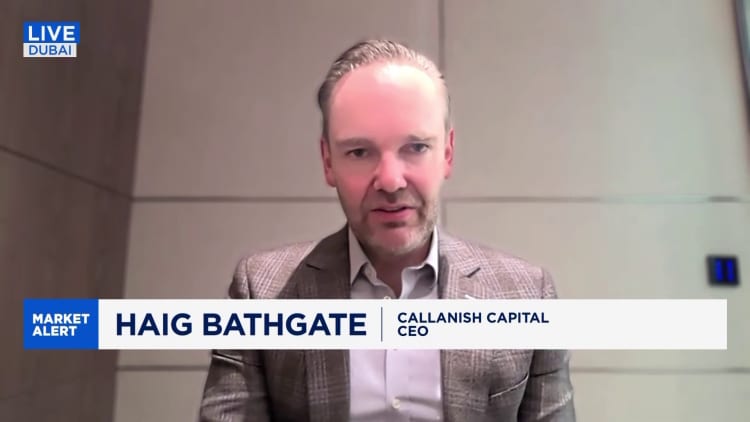
Speaking with CNBC on Wednesday, Haig Bathgate, CEO at Callanish Capital said that while this week’s sell-off reflects a degree of short-term noise, sustained inflation across the term structure is “going to be a feature going forward in markets”.
“At some point, this is going to come home to roost,” Bathgate said of the “spiraling” public spending.
“We know from the ’70s looking back at history, once the inflation genie is out the bottle, it’s very hard to put it back in,” he added. “It is more sustained than anybody thought.”
Central banks now face an increasingly complex challenge over interest rate trajectories, with inflation still vulnerable to ongoing supply-side shocks and geopolitical disruption, but policymakers wary of aggressive tightening amid sluggish growth.
“In this context, the Bank of England and Federal Reserve may therefore tolerate temporary inflation overshoots while monitoring whether second-round wage and pricing effects emerge,” said Cunliffe. “Elsewhere, however, the ECB and the BoJ are on a more definite tightening path, with the former targeting inflation versus growth, and the latter on a path to normalize monetary policy now that both growth and inflation are on a sustainable footing.”
Odds for a rate hike at the next Federal Open Market Committee later this month rose to more than 66% following Federal Reserve Chairman Kevin Warsh‘s keynote speech at Jackson Hole, Wyoming on Friday Aug. 28, up from about 35% prior to his remarks.
Stock Chart IconStock chart icon
German 10-year Bunds.
Padhraic Garvey, regional head of research, Americas and head of global rates and debt strategy at ING, said the Iran war and elevated energy costs provide an additional upward pressure point on longer-dated yields. “This is especially a live problem for Europe to deal with, and for Asia, and indeed beyond,” Garvey said in a note Thursday.
Brent crude — the international oil price benchmark — moved 0.2% higher on Friday morning to $95.71 a barrel, after reaching a one-month high on Thursday, while U.S. West Texas Intermediate prices rose 0.4% to trade at $91.61 a barrel.
“If the music stopped now, the absolute level of long-end yields for many issuers looks reasonably fair. The problem is the music is still blaring. A lot is going on, and most of the pressure continues to point upwards for long rates. That does not have to be a drama, but then again, it could become one should it get pushed too far,” Garvey added.
“It’s tough to see the pressure for higher long-end yields magically dissipate.”
Garvey said that market pricing for a 25-basis-point hike at the September Federal Open Market Committee meeting had shifted from roughly 50-50 to 3-to-1 in favor.
Stock Chart IconStock chart icon
U.K. 10-Year Gilts.
The yield surge is also reshaping portfolio trade-offs for investors.
“More inflation volatility has also tended to increase the correlation between equity and bond markets, reducing the diversification benefits of holding the latter in balanced portfolios,” said John Stopford, head of multi-asset income at Ninety One. “Increased real interest rates, however, raise the cost of capital and potentially make bonds a more competitive asset class, especially with equity valuations looking elevated.”
Brian Mangwiro, managing director in the global fixed income team at Barings, said government bond funds should be positioned defensively in shorter duration instruments.
“Multi-strategy fixed income funds can also focus on higher income, but, again, with a bias for shorter duration. For the U.S., the sell-off in Treasurys and ongoing curve steepening is also consistent with a weaker US dollar. This is generally bullish for emerging markets.”