
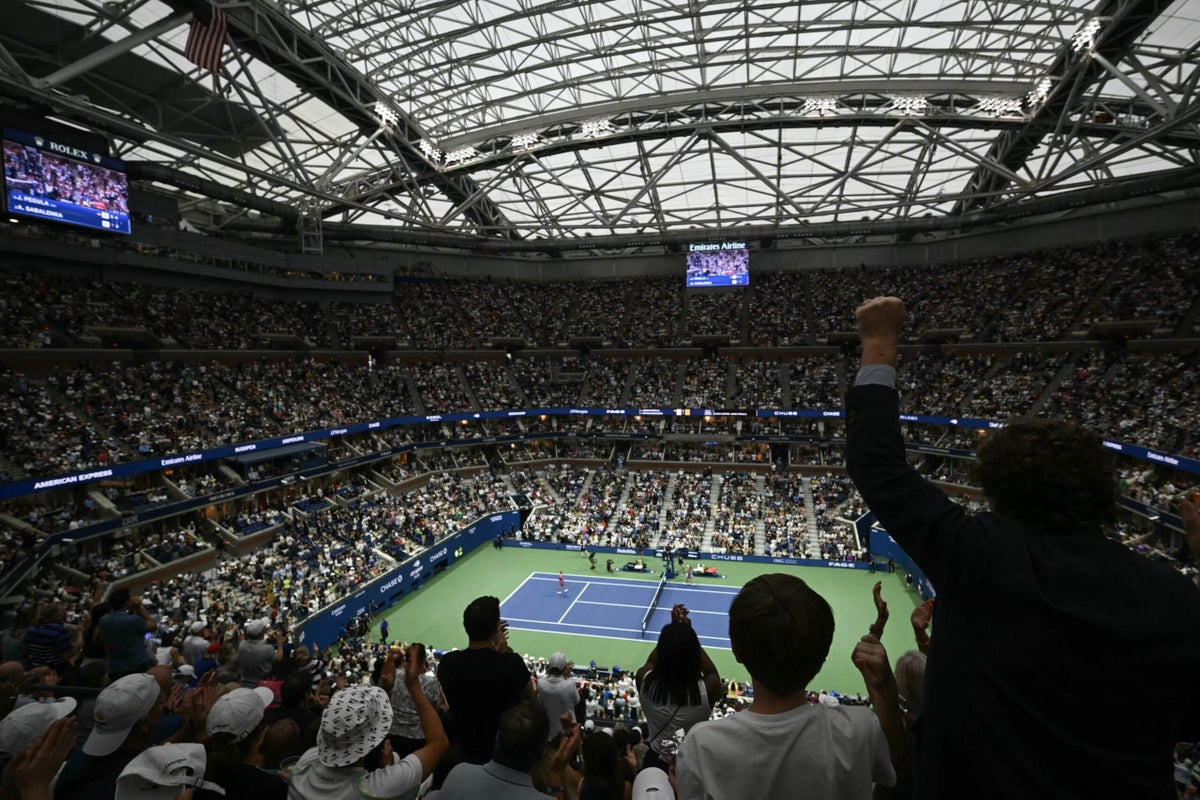
FLUSHING, N.Y. — In late summer, professional tennis lands in opposite world in New York City.
Don’t go looking for hushed tones, decorous silence or the other traditions of a sport whose roots exist on the hallowed lawns of polite society. At the U.S. Open, music blares from speakers. A near-constant buzz rises from every crowd, interrupted only by bursts of exuberance. Trains rumble behind the main stadiums, Arthur Ashe and Louis Armstrong, while planes approaching and departing from La Guardia Airport bring their stomach-churning roars.
The Billie Jean King Tennis Center opens for business and a lot of basic tennis etiquette takes a break. This is an amped-up, raucous version of the sport.
On day one of the 2025 tournament, 2021 champion Daniil Medvedev provided a signal example by inciting the crowd to delay his match against France’s Benjamin Bonzi for six minutes — while he was down match point. A photographer walked onto the court between Bonzi’s first and second serves. Umpire Greg Allensworth ruled that Bonzi should get a first serve. Irate, Medvedev approached Allensworth’s chair, whipping up the crowd to boo and chant. After berating Allensworth, Medvedev returned to the baseline. Bonzi got ready to serve. The crowd didn’t stop.
This was extreme. But all the players know that they are in for a ride.
What does the high cost of this year’s U.S. Open mean for tennis?
Matthew Futterman
“You know if you’re playing on Ashe it’s going to be loud, especially a night match,” said Madison Keys, the Australian Open champion. It’s so loud that she often can’t hear her coaches, or the sound of the ball off the opponent’s strings, which is a key cue for players at the elite level. “You have to learn sign language pretty quickly, and sometimes you fail.”
In 2026, this has only heightened — but it’s not really happening on the court. The tournament’s corporate sponsors have further recognized the value of inviting influencers to show off the tournament, catering to the idea that someone can be a fan not so much of tennis, but of the U.S. Open.
When night gives way to day, the sun continues to rise and the sport goes on. The world gets a glimpse of what some players wish tennis would be all the time: a noisy rumble that looks a lot more like basically every other sport, in which self-expression, celebration and trash talk are welcomed as entertainment enhancements rather than affronts to common decency. Most of the majors have made small adjustments, like music at changeovers, light shows at night, and letting crowds move more freely, especially higher up in larger stadiums. But needle and drama remain unembraced, even when they are taken as normal in the hyper-competitive world of other elite sports.
That is especially true for Americans, who get celebrated in New York more than anyone else. They’ve grown up watching the NBA and the NFL and even baseball, where jawing and showboating are pro forma. They are not really sure why they have to behave like they are at a funeral.
“I understand respect and respecting your opponents and the traditions of tennis,” said Ben Shelton, who has become a crowd favorite across the globe for his big-time game and exuberance to match, after opening the tournament for 2025 on the biggest stage in tennis. He reiterated that message in 2026.
“At the same time, I think that people get called out for little things or the wrong things. It’s like: ‘Really? We’re going to give someone a hard time about that?’
“Having a simple conversation with somebody, is, like, looked down upon.”
Shelton has no shortage of company. After Naomi Osaka saw her match against Anastasia Zakharova interrupted by a photoshoot — flash and all — in the crowd, she said in a news conference that “overall I think there are huge positives.
“I’m not the one to, like — what do you say? You want people to continue to grow the sport. I just think it has to be in a way that everyone knows the rules and the etiquette.”
Coco Gauff, who loves the support of the Arthur Ashe Stadium crowd, took a similar view.
“I definitely think it’s cool to have a new demographic and I definitely think it helps grow the sport. But like with anything, any venue you go to, like if you’re being invited to a red carpet, you wouldn’t show up in jeans. I think it’s just follow the etiquette of the sport. That’s all,” she said after defeating Paula Badosa.
In tennis, as in other sports, the tension between old standards and new approaches can emerge as one generation takes the spotlight from another and a sport becomes more diverse. Baseball worked through its behavioral debate during the past decade, as a new generation of players brought an exuberance and some pretty fun post-home run bat flipping to the game that so-called traditionalists found disrespectful. The NFL, long known as a the “No Fun League,” finally loosened its rules about touchdown celebrations eight years ago, though taunts and violent gestures can garner unsportsmanlike conduct penalties.
If there is one place that most tennis players will draw a line, it’s noise during points. At the top level, the noise of racket on ball is a crucial indicator of the speed, spin and depth with which it will approach. Taking away that cue makes playing much more difficult.
Still, something of an evolution is taking place, with the pressure to adopt courtliness on the wane. Medvedev, the demonstrative and colorful Russian, has been waiting for this moment for nearly a decade, though what he delivered Sunday night into Monday morning — including questioning Allensworth over whether he was “a man,” crossed the line. Bonzi said that the Russian “put oil on the fire.”
“I’m getting a big fine,” Medvedev said in a news conference after a five-set defeat that would likely have been a three-set one without his intervention. In the end he was fined $42,500.
Still, the distinction between basic etiquette and what might be considered showboating or taunting can shift from week to week and tournament to tournament, depending on the locale. The Australian Open has the air of a festival. The French Open crowd is famously touchy, especially when one of their own is involved. Then there’s Wimbledon, where the most frequent noise is likely to be a “ssshhhhh” rippling across Centre Court when someone yells out of turn.
That principle of change according to context goes for fans, too. Alex Eala got on her way to making more history for the Philippines by reaching the third round in 2026, with two court assignments on Louis Armstrong Stadium, the second-biggest court. The huge Filipino diaspora, concentrated just a few minutes away by train in Woodside, Queens, backed its woman to the hilt.
But it was in 2025 that they truly carried her over the finish line. In an upset win over No. 14 seed Clara Tauson, the Filipino fans cheered Eala’s every move. They cheered Tauson’s every error. The Dane, frazzled and exasperated, let Eala back in from 5-1 down in the third set, before the archipelago’s new sporting hero won the deciding tiebreak 13-11.
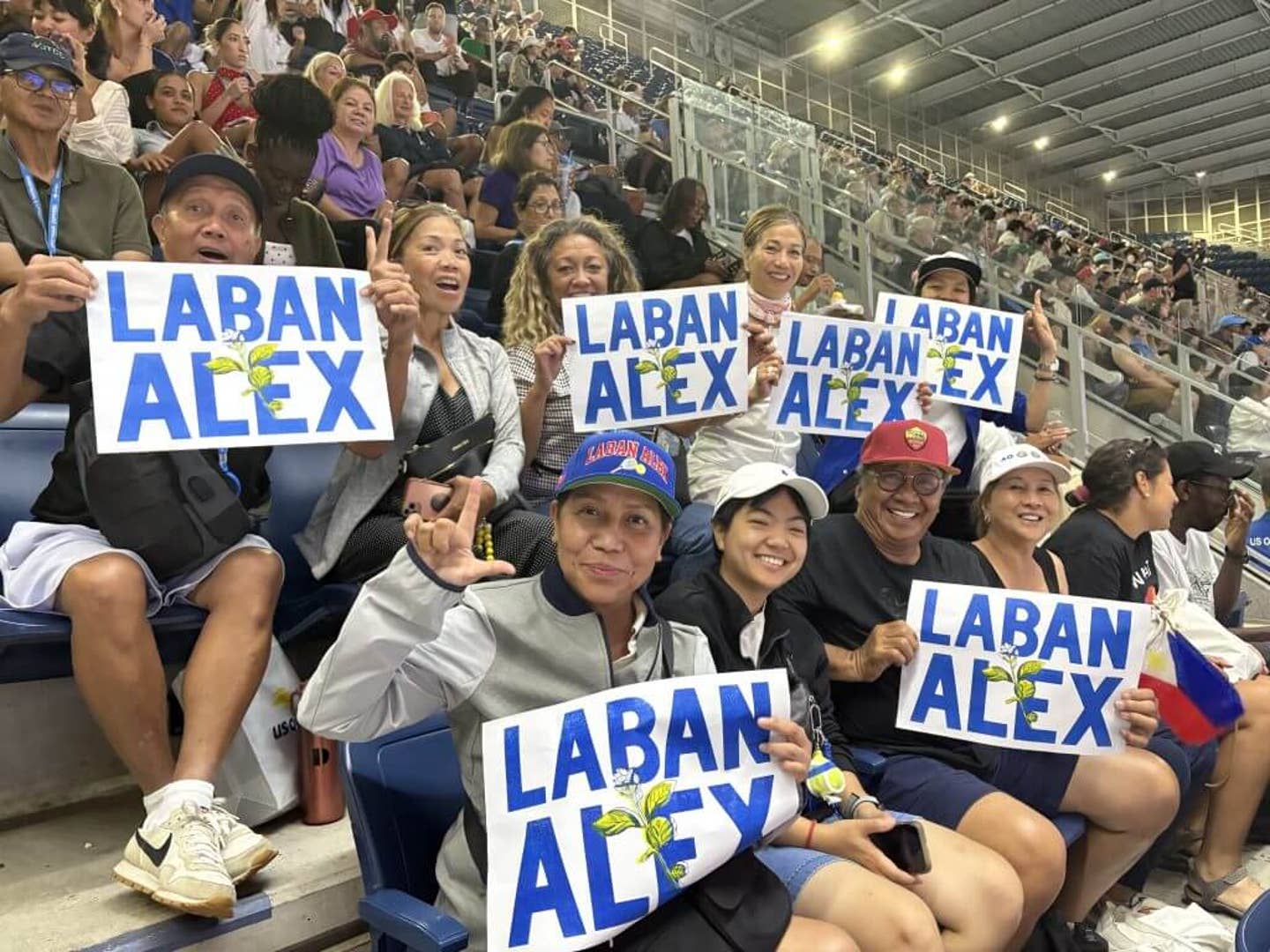
Alex Eala’s fans have inspired artists to create posters in New York. (Rebecca Tauber / The Athletic)
In New York, just about anything goes. Sometimes, players learn they’re taking things too far. Shelton is plenty familiar with that.
He is a product of college tennis, an atmosphere that is as rowdy as it gets in the sport, in which no amount of fist-pumps or celebratory screams are considered over the top. Even now, three years removed from that college career, he only holds back so much.
There are moments in just about every match Shelton plays that he does something ridiculous, whipping the crowd into a frenzy. At the end of his second-round match against Hubert Hurkacz, an eye-bulging celebration followed a relentless performance against a very tricky opponent. The 20,000-or-so fans in the biggest stadium in tennis more than matched his energy.
“If I was commentating I would talk about how loud this crowd was from start to finish,” Shelton said on the court.
He’s still learning where the sweet spot is. Just three years ago, during his first run to a Grand Slam semifinal, Shelton’s post-match celebration included hanging up the phone on his beaten opponent.
When Novak Djokovic beat him in straight sets to end what was an upstart run, he hung up the phone right back, sending the message that Shelton had crossed a line between celebrating and showing up an opponent. Shelton gave him a death stare at the net during the handshake and said afterward that he believed players should be free to celebrate however they want.
He has not hung up the phone since, though sometimes he can’t resist letting out a high-decibel “YEAH” when an opponent sends a ball out or into the net during a key rally. Most players largely celebrate their own successes, rather than their opponents’ errors, and antics like those supposedly violate the sport’s unwritten behavioral codes.
Andrea Vavassori, one half of the U.S. Open mixed doubles champions with Sara Errani, scolded Shelton for hitting him with a close-range shot early in a men’s doubles match last spring, though the shot was completely legitimate.
“So soft,” Shelton was heard saying to his partner Rohan Bopanna as they gathered their gear after beating Vavassori and his partner Simone Bolelli.
Shelton had a disagreement with Flavio Cobolli over a gesture the Italian made toward the end of their three-set semifinal in Toronto a year ago. Shelton, who is 6 feet 4 inches, with the chiseled physique of a prize fighter, was shirtless as they talked things out. He stood up, moved in close with his arms crossed, putting Cobolli’s eyes about even with his chin.
It was the sort of face-off that happens multiple times in every NFL game. But because it was tennis, it became a social media moment that zipped around the internet, with some debate about whether Shelton crossed some nebulous celebratory line with his emotions.
“Having a younger crowd in tennis is really important in attracting younger fans, the future fans of our sport,” he said. “The kids love the flair and the excitement and the competition.”
But both Shelton and Cobolli quickly attempted to stifle any potential fallout from the incident, defaulting to decorum as fast as they could. They insisted they had settled the matter in the locker room and didn’t want to talk about it any more. That’s the way things are supposed to happen in this sport.
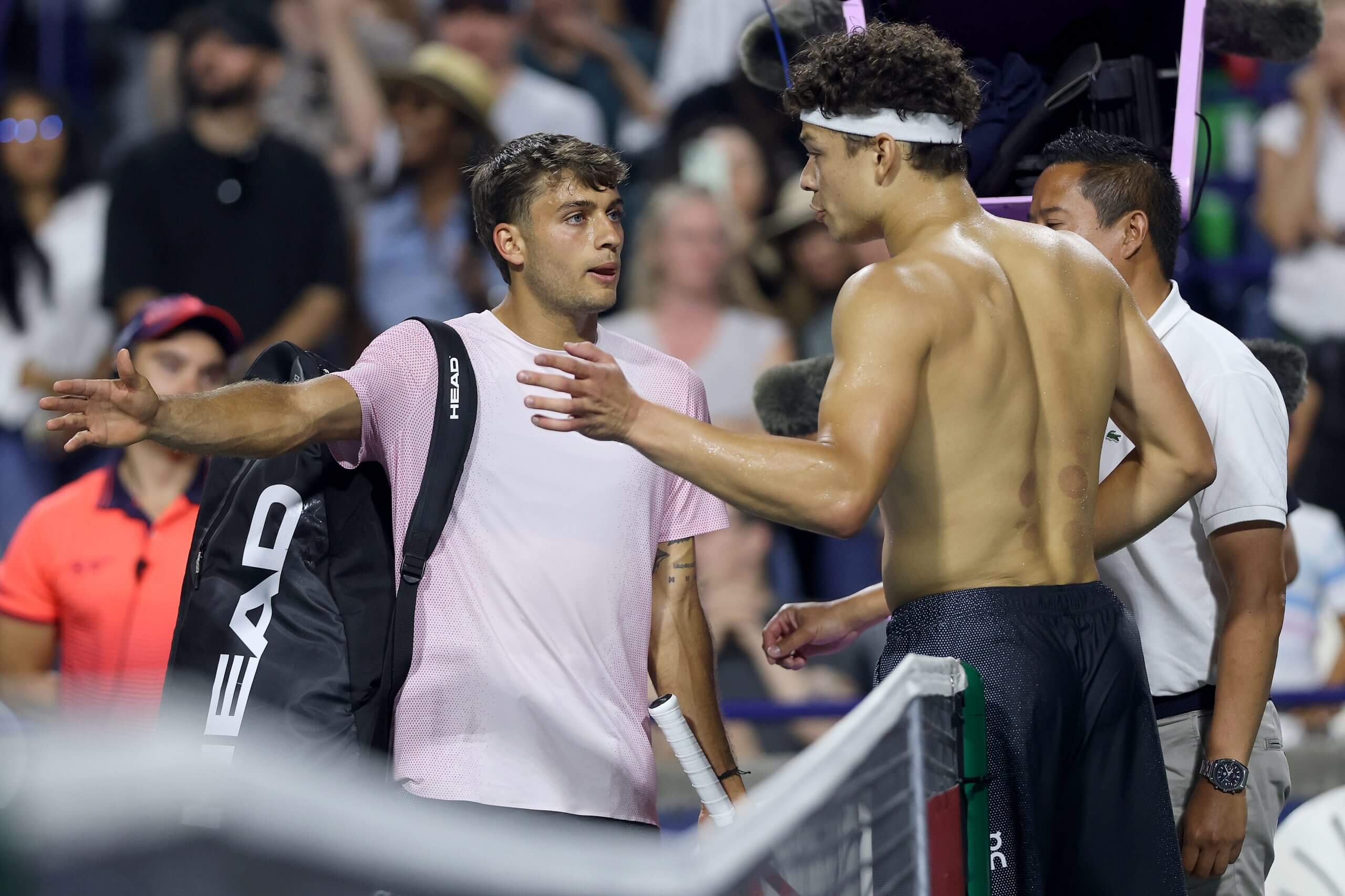
Flavio Cobolli and Ben Shelton’s confrontation in Canada wouldn’t have caused much fuss in most other sports. (Matthew Stockman / Getty Images)
It was not so dissimilar from the events following the 2025 French Open women’s final, when Aryna Sabalenka dissed Coco Gauff in defeat after Gauff came back to beat her in three sets. Sabalenka blamed the conditions and herself, saying that Gauff hadn’t won — she lost. Gauff took some issue with this, but with the title in hand, she didn’t need to be too bothered.
Sabalenka posted an apology within days, after bearing the brunt of a major, understandable backlash. By the time they showed up at Wimbledon, a peacemaking effort was underway. They filmed a TikTok dance video on Centre Court, to prove they buried the hatchet. But then Wimbledon itself promoted the video, because in tennis peace must prevail, even if sporting rivalries so often benefit from some genuine needle.
Now contrast those events with the eye-catching confrontation between Noah Lyles and Kenny Bednarek at last year’s U.S. Track and Field Championships. Lyles stared down Bednarek as he crossed the finish line of the 200 meters, ahead of his rival. Bednarek didn’t like it and gave Lyles a shove as they slowed down. There were words, and for a couple of days fans and non-fans alike were talking about nothing else.
“Bonkers,” Frances Tiafoe, America’s top tennis showman, said of the incident.
But athletics didn’t tie itself in knots trying to produce a detente.
“Something is on the line and everyone is tuning in,” Shelton said.
It’s exactly the sort of stuff that Tiafoe said he’d like to see more of in tennis, rather than the automatic reversion to the unwritten codes of this supposed genteel game. He’d like to act that way himself at the end of some matches.
“I’d love to be like, ‘I don’t like you,’” he said ahead of the tournament, where he has become a master of leading the crowd on Arthur Ashe like a conductor guiding an orchestra. “I wish there was a lot more of that, because, I mean, like you lose a tough match. ‘Oh, man, I’m so happy for you.’
“No, you’re not. Like, you’re not. You’re just not.”
Tiafoe, an obsessive NBA and NFL fan, watches his comrades trash talk their way through game after game and wishes tennis could be that way. It might even be good for business. The NBA and the NFL are pretty successful entities. Still, he doesn’t have high hopes for the scrapping of more than a century of decorum. A fortnight of sound and fury in New York will have to do.