
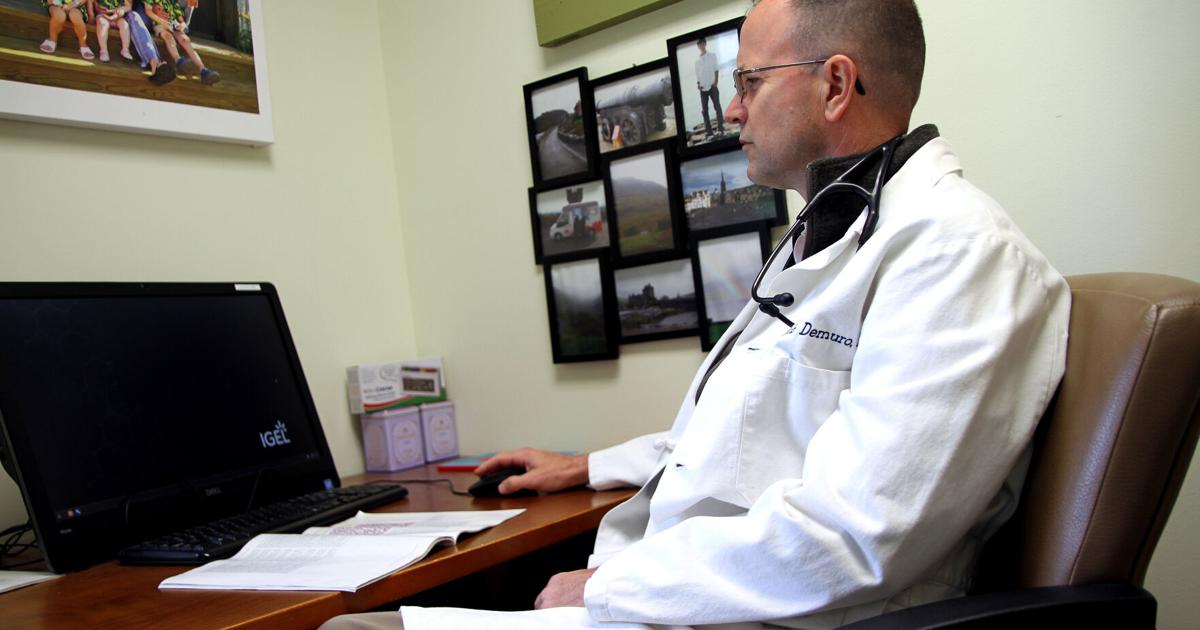
When Dr. Rob Demuro moved from the small town of Earlville in upstate New York to attend medical school in Buffalo, he always planned on returning to his rural roots.
Shortly after completing residency training in the late 1990s, Demuro grabbed a map of the Adirondacks and began searching for a community with a hospital in need of his services. The doctor of internal medicine eventually landed on Elizabethtown in Essex County and made a phone call to inquire about a job.
“There certainly was a need,” he said. “So, I came here in ‘99 and I’ve enjoyed it ever since.”

Dr. Rob Demuro has been serving patients in Elizabethtown since 1999. Born and raised in a small community upstate, Demuro found his way to Essex County after attending medical school in Buffalo.
John Gereau
But these days, Demuro, who serves as the president of the Essex County Medical Society, is more the exception than the rule. Hospitals and health systems are struggling to find qualified candidates amid a nationwide physician shortage that has created a fiercely competitive environment. More than 5 million New Yorkers live in an area that is underserved by physicians.
The problem is more pronounced in rural communities, where a lack of housing and services like childcare drive potential candidates away. Living in a small community is a lifestyle that many coming out of medical school are not accustomed to, and the quieter pace is simply undesirable for some, regardless of the job opportunity.
“You can’t sort of convince somebody they want to practice in the rural Adirondacks,” Demuro said. “They have to want to because you want them to stay.”
The issue extends to metropolitan areas, including Schenectady, where Ellis Medicine has spent significant time and resources in recent years to attract new physicians, and is currently in talks about joining the Albany Med Health System in hopes to leverage more resources to obtain staff.
The lagging workforce is projected to worsen over the next decade as a generation of physicians prepares to retire, and the need for specialty services grows due to the country’s aging population, according to Amy Nickson, senior vice president for state policy for the Healthcare Association of New York State.
“We have to be mindful that we are also seeing and experiencing changing patient demand in New York state, we have a population that is getting older and thankfully living longer,” she said. “At the same time, we are making medical advances every single day, and so the need for particular services is also evolving.”
New York trains more physicians than any other state, but nearly half of the newly trained physicians leave for opportunities elsewhere. And studies have found that those who do stay in the Empire State often have no plans to work in rural areas in need of physicians.
Roughly a quarter of the state’s population live in an area that is designated a Healthcare Professional Shortage Area by HRSA. The designation is handed down when the patient-to-physician ratio for an area reaches 3,500-1, around double for what the agency considers sufficient.
There are more than 60 such designations throughout the state based on geographic location and special populations like Medicaid enrollees. The federal agency estimates that New York needs more than 1,989 combined primary care, mental health and dental professionals to remove the designations.
The ballooning shortage is multifaceted, according to health care advocates and policy experts, who say the problem will require rebuilding a pipeline that has long been squeezed, and looking towards an international and out-of-state workforce that can alleviate pressures on a more interim basis.
The state has tried to entice physicians and other health care professionals to work in rural areas through service-based incentive programs that offer loan forgiveness for working in a designated shortage area for a period.
But opportunities are limited and the program is costly, according to data from the state’s Department of Health. John Emery, a department spokesperson, said the agency is committed to “addressing the distribution of physicians and improving access to care in underserved communities.”
Pipeline constraints
Dr. Alan Boulos, dean of the Albany Medical College, described the physician shortage as a “very significant” issue that stems from a lagging number of residency training slots that has created a bottleneck.
The residency pipeline for years has failed to keep pace with the growing demand for doctors, with the number of available training slots failing to keep pace with medical school graduates in recent years.
In 2026 alone, a total of 48,050 prospective residents submitted an application through the National Resident Matching Program, a non-profit that matches medical students with training programs. But only 44,344 slots were available, leaving nearly 8% of students, or 3,706, without a residency program.
Boulos traced the issue back to 1997, when the federal government put a cap on the number of residency slots funded through Medicare and Medicaid dollars as part of a broader effort to limit federal health care spending.
The cap created new financial pressures for teaching hospitals like Albany Medical Center that have had to find new ways to fund residency positions while grappling with other growing health care costs.
Funding residency positions is not only costly, but a “slow, iterative process” that is heavily regulated and requires careful examination to ensure appropriate clinical volume.
A balancing act
As residency opportunities continue to lag, interest in medicine is climbing. U.S. medical schools received a record combined 54,669 applicants in 2025, a 5.3% increase compared to a year earlier, according to the Association of American Medical Colleges.
The surging interest coupled with dearth of residency opportunities threatens to constrict an already congested pipeline, Boulos said.
“We don’t want to add students if they don’t have a good post-residency, post postgraduate training program available to them,” he said.
Congress approved funding to create 1,200 new Medicare-support residency slots in 2021, a move that has been praised by major medical groups and advocates.
But the effort has ultimately fallen flat due to regulatory restrictions and a maldistribution of opportunities, said Robert Martiniano, senior program director for the Center for Health Workforce Studies, a University at Albany research center that examines the health care workforce.
“They continue to struggle with putting physicians in the places that need them the most,” he said.
Martiniano said shoring up the physician pipeline not only requires significant build out, but an infusion of students with diverse backgrounds, including those from rural areas.
A recent survey of newly-trained physicians completed by the Center for Health Workforce Studies found that only 4% of new physicians plan to practice in a rural area, and just 16% plan to work in a Health Professional Shortage Area.
The survey found that 76% of physicians who graduate high school and medical school in New York plan to stay in the state to practice medicine.
Martiniano said that creates an opportunity: Get students from rural communities interested in medicine early so they can go on to medical school and eventually return to practice in the communities they grew up in.
But doing so is no easy task. Rural areas tend to have fewer students and poorer academic outcomes compared to suburban districts that have greater resources.
“It’s hard to talk about training registered nurses, nurse practitioners and physicians when they’re not continuing their education,” Martiniano said. “So, we have to introduce them to health care careers earlier in high school and prepare them to go on to school.”
‘Spend money to make money’
In Schenectady, Hometown Health Centers has been focused on improving its workplace culture and increasing wages to remain competitive, said Christine Smoot Lowers, the organization’s executive director.
“You can’t run a health care organization without qualified health care providers,” she said.
The effort has so far paid off: Hometown Health, which operates a health center in Amsterdam, has not only retained its staff, but recently recruited two new providers — a process took six months to complete.
Smoot Lowers said the organization is also focused on expanding services, including accepting same day appointments next month. The goal, she said, is to create new revenue streams that can ultimately be reinvested into providing quality patient care.
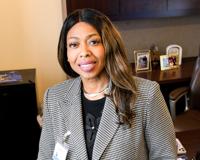
Hometown Health Centers CEO Christine Smoot Lowers is pictured on Feb. 18.
PETER R. BARBER
“I think you have to spend money to make money sometimes, so my goal is to be strategic about how we spend money,” Smoot Lowers said.
A similar strategy is playing out across town at Ellis Medicine.
Christopher Jordan, the hospital systems chief operating officer, said the Ellis administrators continue to examine services to determine what needs to be expanded and what can be moved to other partners in the community.
Improving the work environment has also been a focal point. Still, the hospital begins courting possible physicians during the first year of residency.
“Which means if it’s a three-year residency programing, we’re having conversation expecting that conversion will yield higher results three years from now,” Jordan said.
Ellis is also looking towards another strategy: Consolidation.
For years the Schenectady health system has been looking to merge with another organization in order to bolster its appeal to potential candidates and leverage shared resources. Ellis is seeking to join the Albany Med Health System after merger talks with St. Peter’s Health Partners fell through in June after six years.
“I think that the more pressure we see on hospitals and health systems, the more consolidation is going to become increasingly important,” Jordan said.
An outside workforce
Kevin Kerwin, the president and CEO of Iroquois Healthcare Association, which represents 50 hospitals throughout the Capital Region and North Country, said part of the solution must come from outside New York.
Kerwin pointed to temporary worker authorizations and interstate licensure compacts that allow physicians to practice after moving to the state, and will allow doctors to practice medicine across state borders without having to wait for a license, a process that could take months.
New York is just a handful of states not participating in the compacts, which Kerwin said has faced political opposition. The compacts, he said, are not “a means to an end” and just one piece of the puzzle.
“Any one of these things is a great thing, but we need to look at it systemically and build the pipeline from the beginning until the end,” he said.
John Rugge believes another solution lies with service obligation programs that help pay down physician’s medical school debt in return for working in an underserved rural community. The programs bring new providers into the area with the goal of them staying after their commitment ends.
Rugge is the founder of Hudson Headwaters Health Network, a sprawling community care network that today includes more than two dozen clinics and health centers throughout the North Country.
Rugge said he was able to retain 80% of physicians who came to Hudson Headwaters through the programs.
“They found out this was a great choice after all,” he said.
In New York, the state launched the Doctors Across New York initiative that offers loan repayment and practice support to help recruitment efforts. The program has brought hundreds to underserved areas, but at great costs. In the past three years, 301 contracts have been awarded, totaling more than $37.7 million.
The state’s Department of Health is anticipating awarding 139 new contracts this year, at a cost of $15.8 million.
There are similar programs on the national level for physicians and nurses. Rugge said the programs allow physicians to gain a better understanding of life in a small community, which can often be overlooked for many who grew up in urban and suburban communities.
“A major reason for coming to or staying in the rural area is the expression of appreciation and satisfaction that the community gives and the patients give,” Rugge said. “You know you’re doing something very, very important to people.”