
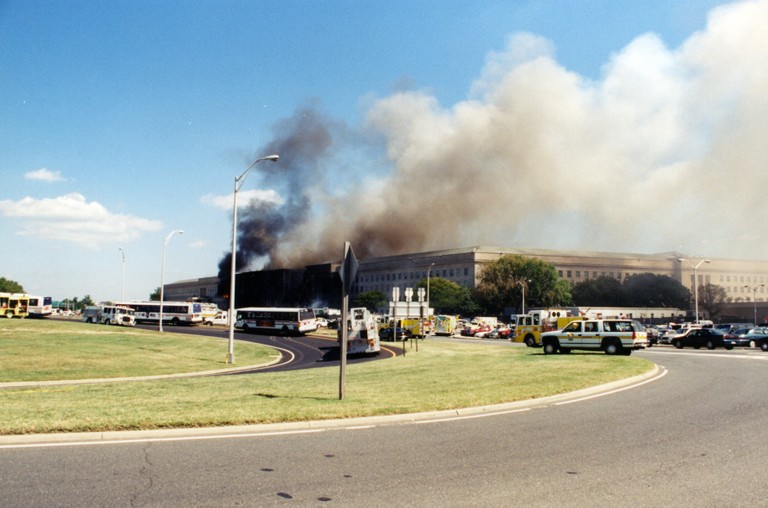
On the morning of Sept. 11, 2001, I stood on the roof of the Voice of America headquarters in D.C., watching thick black plumes of smoke rise from the Pentagon, almost two miles away, into a crystal blue sky that only moments earlier had been perfectly clear. Flames, supercharged by jet fuel, clawed at the nerve center of American defense.
What we did not know at the time was that another hijacked aircraft, United Airlines Flight 93, was still in the air and heading toward D.C.
Later, we would learn the U.S. Capitol was its target.
Its gleaming white dome stood just across the street from the Voice of America building, barely more than 500 yards from where I was standing. The passengers and crew of Flight 93, after learning through phone calls that two other hijacked aircraft had struck the World Trade Center and the Pentagon, fought back.
The plane crashed near Shanksville, Pennsylvania. All 44 people aboard died, including the four hijackers, but the actions of the passengers and crew prevented the aircraft from reaching D.C., saving many other lives and possibly those of us standing on that roof.
As the U.S. marks the 25th anniversary of the 9/11 attacks, the proximity of that danger remains a deeply personal memory. But the anniversary also presents an opportunity to reconsider one of the most consequential strategic lessons of that day: even the world’s most powerful nation can be vulnerable, and its alliances can be among its most important defenses. Nearly 3,000 people were killed in New York, at the Pentagon and in Pennsylvania.
NATO steps up
The attacks transformed U.S. national security, led to wars in Afghanistan and Iraq, expanded the American intelligence and counterterrorism apparatus and reshaped airport security, surveillance and law enforcement.
Their impact reached far beyond the United States. Sept. 11 also produced an extraordinary demonstration of international solidarity that is particularly relevant at a time when the value and durability of America’s alliances are again being debated.
For the first and only time in its history, the North Atlantic Treaty Organization turned to Article 5, the collective-defense provision at the heart of the alliance.
NATO allies agreed on Sept. 12, 2001, that if the attacks were determined to have been directed from abroad, they would be regarded as an attack against all NATO members. Once that determination was made, the alliance formally invoked Article 5.
The significance is sometimes obscured by the passage of time. NATO was created in 1949 largely to protect Western Europe against the Soviet threat, with the military power of the United States providing the backbone of the alliance.
Yet when Article 5 was finally needed more than half a century later, it was not Europeans asking America to come to their defense. It was America’s allies coming to the defense of the United States.
That support went beyond declarations of sympathy. NATO’s Airborne Warning and Control System surveillance aircraft were deployed to help protect American airspace, allowing U.S. aircraft and personnel to be redirected to operations elsewhere. NATO countries subsequently contributed troops and resources to the war in Afghanistan, where forces from the United States and allied countries fought and died during a conflict that lasted two decades.
The record of what followed 9/11 is far more complicated than the unity of those first days. The war in Afghanistan ended in 2021 with the Taliban once again controlling the country. The 2003 invasion of Iraq, which was not an Article 5 operation, divided NATO allies and damaged American credibility abroad. Counterterrorism policies generated lasting disputes over torture, detention, surveillance, executive power and the balance between national security and civil liberties.
The 25th anniversary cannot be understood simply as a story of American resolve or allied unity; it also requires an accounting of the strategic mistakes made in the name of preventing another attack.
But those failures do not erase the importance of what happened immediately after 9/11. If anything, the current international environment makes the lesson more relevant.
Threats to come
The threats confronting the United States and its allies in 2026 are substantially different from those that dominated national-security thinking after the attacks. Terrorism remains a concern, but Russia’s war against Ukraine has returned large-scale warfare to Europe. NATO countries are also confronting cyberattacks, sabotage, espionage, attacks on critical infrastructure and increasingly sophisticated disinformation campaigns. Artificial intelligence has accelerated the ability to manufacture false images, video and narratives, while inexpensive drones have altered the economics of warfare.
These threats frequently occupy the space between traditional definitions of war and peace. A cyberattack can disrupt a nation’s infrastructure without a missile being launched. Sabotage of an undersea cable can inflict economic damage while leaving responsibility deliberately unclear. A coordinated disinformation operation can weaken public confidence in an alliance before a military confrontation begins. The central problem for NATO is increasingly not only how to respond to an unmistakable armed attack, but how to deter adversaries that deliberately operate below that threshold.
That makes the principle behind Article 5 more consequential, not less. Collective defense is ultimately a form of deterrence. Its greatest success occurs when it is never needed because a potential aggressor believes an attack on one member would produce an unacceptable response from many.
There is also a parallel between that principle and what happened aboard Flight 93. The passengers and crew were confronted with a threat none could overcome individually. Once they understood that their aircraft was part of a larger attack, they acted collectively. They could not save themselves, but their actions prevented the hijackers from reaching their intended target and saved people they would never meet.
For those of us standing in D.C. that morning, that distinction was not theoretical. We simply did not know it yet.
Twenty-five years later, the United States is again confronting the rise of terror groups, difficult questions about the cost of alliances, the obligations they impose and the extent to which American security depends on events beyond its borders.
Those are legitimate debates. The experience of 9/11, however, provides an important piece of historical evidence that should be part of them.
When America itself came under attack, it discovered that the alliances it had spent decades building were not simply commitments America had made to defend others. They were commitments others had made to defend America.
The lives, legacies and families of those who died on 9/11 and people who continue to die of illnesses they contracted while trying to help others that day is the most important part of the story to be remembered on this anniversary.
The second is the selflessness of NATO that we saw then and need now.
Get breaking news and daily headlines delivered to your email inbox by signing up here.
© 2026 WTOP. All Rights Reserved. This website is not intended for users located within the European Economic Area.